

Nigeria Sends Troops to Benin Republic: A Bold Move to Safeguard West Africa’s Unstable Flank
By: Juba Global News Network December 10, 2025 In a move that’s both swift and revealing of Nigeria’s increasingly central role in West African secur
By: Juba Global News Network
December 10, 2025
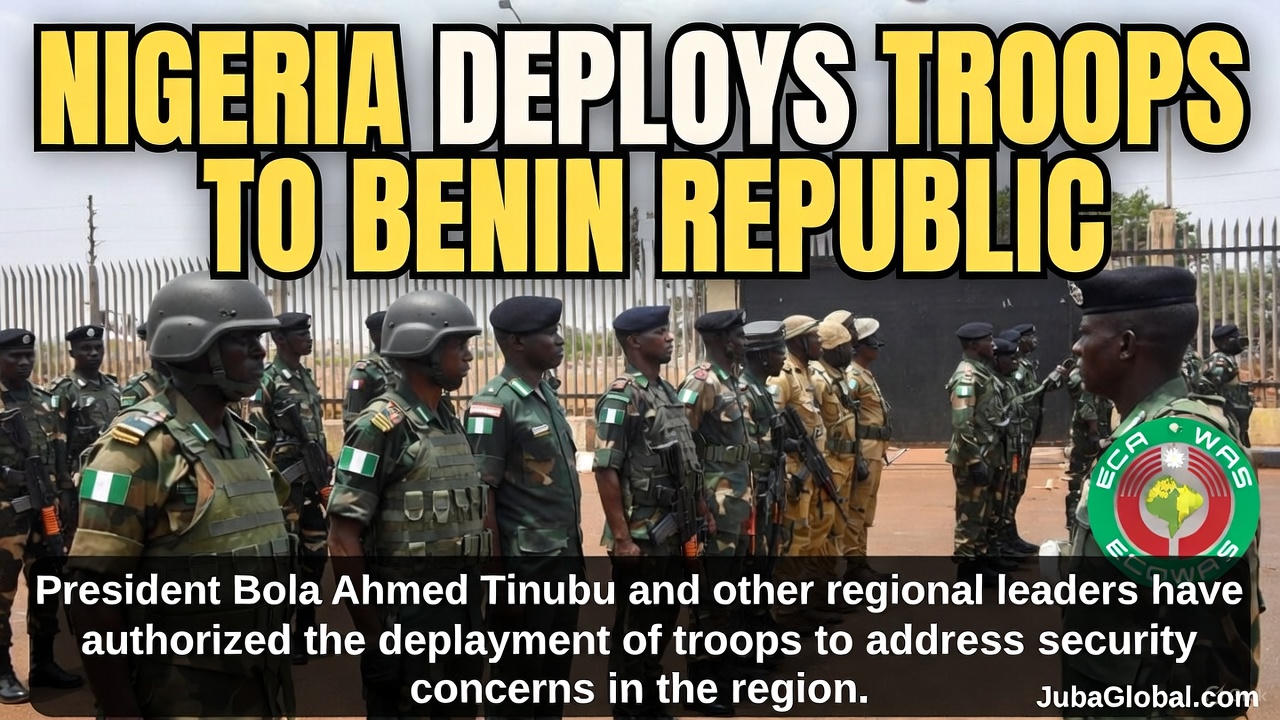
In a move that’s both swift and revealing of Nigeria’s increasingly central role in West African security, the Nigerian Senate has given the nod to President Bola Ahmed Tinubu’s request: troops are headed to the Republic of Benin. This decision landed on December 9, 2025—barely three days after a botched coup in Cotonou and with jihadist threats ramping up along the easy-to-slip Benin–Nigeria border. Not since the Gambia mission back in 2017 have Nigerian troops deployed abroad under an ECOWAS mandate. Clearly, Abuja’s signaling it won’t just sit back and watch chaos creep down from the Sahel.
The plan? An initial force, somewhere between 1,500 and 2,000 personnel from the Nigerian Army’s 82 Division and special units, will get to work on joint border patrols, intelligence hubs, and new rapid-response bases in northern Benin’s Alibori and Atakora regions. It’s all part of a bigger regional emergency, declared by ECOWAS on the same day, with leaders realizing that the collapse of just one coastal state could send shockwaves through the Gulf of Guinea.
From Coup Attempt to Regional Alarm
It all got triggered by a night of chaos: on December 6, 2025, a pack of mid-level officers, bolstered by restless palace guards, tried to storm Benin’s presidential palace as well as military sites in Cotonou and Porto-Novo. President Patrice Talon, tipped off by French intelligence and loyal commanders, managed to slip away unharmed. By morning, the coup plotters were dead or in custody. Still, the very attempt—the biggest challenge to Talon’s grip since 2016—laid bare deep cracks: youth unemployment over 40%, charges of election rigging ahead of 2026, and growing Sahelian jihadist infiltration.
Just hours after, ECOWAS chief Omar Alieu Touray convened an urgent online summit. Intelligence shared by Nigeria and Togo made for a worrying read: JNIM (Jama’at Nasr al-Islam wal Muslimin) and IS-West Africa cells had set up rear bases in Benin’s Pendjari and W National Parks. They were using old smuggling trails—once meant for drugs and guns—to shuttle fighters and weapons toward northwestern Nigeria and Benin’s own coast. According to a secret Nigerian DSS report, “if Cotonou falls, jihadists get their hands on a real state apparatus right next to Lagos.”
Nigeria’s Calculated Gamble
For Abuja, stepping in now is as much about defense as it is about flexing muscle.
- Geographic Weakness: The Nigeria–Benin border stretches over 800 kilometers, and it’s barely controlled. In towns like Kamba, Chikanda, and Malanville, more than 100,000 people cross every day. Should order collapse in northern Benin, Nigeria’s Kebbi, Sokoto, and Kwara would be immediately flooded by both refugees and fighters.
- Economic Imperatives: The Lagos–Cotonou corridor is one of Africa’s main trade arteries, with $2.8 billion changing hands each year. If Benin fell to jihadists or a rogue junta, that pipeline chokes, endangering even the $15 billion Lagos–Abidjan highway project.
- Regional Prestige and Leadership: After seeing Mali, Burkina Faso, and Niger drift out of ECOWAS’s orbit and into the Russian-aligned AES bloc, Nigeria’s drawing a clear line. As Senate President Godswill Akpabio put it behind closed doors: “We can’t just let the Sahel blaze destroy everything.”
- Local Politics: Tinubu’s catching flak over insecurity at home, but taking action abroad lets him look strong. He’s pitching the deployment as “safeguarding Nigerian lives and investments,” a narrative bound to click with voters eyeing the 2027 elections.
Mandate and Rules: The Fine Print
The Nigerian force operates under a mixed mandate:
- ECOWAS Authorization: Under Article 25 of the 1999 ECOWAS Protocol on Conflict Prevention, Nigerian troops count as part of the Standby Force.
- Bilateral Deal: A fresh Nigeria–Benin Defence Pact, inked on December 8, lets Nigerian forces set up forward bases and pursue suspects up to 50 km inside Benin.
- Strict Limitations: Unlike some older missions, this deployment’s capped at 12 months, renewable, with firm rules—no meddling in Benin’s politics. Command is joint: a Nigerian brigadier-general sharing the helm with a Beninese co-commander. France, meanwhile, promises intelligence and airlift support, but no actual troops on the ground.
How the Region’s Reacting: Relief, Doubts, and Distrust
- Benin: Talon’s officially grateful, calling Nigeria “a big brother in tough times,” but behind closed doors, he’s a bit uneasy about how it all looks for Benin’s sovereignty.
- Togo and Ghana: Both chipped in—300 and 500 troops, respectively—relieved Nigeria’s taking the main risk.
- AES Bloc (Mali, Burkina Faso, Niger): Their state media in Bamako and Niamey are calling the intervention “neo-colonial aggression,” warning that Nigerian soldiers could become “targets for the whole Sahel resistance.”
- France and the U.S.: They’re quietly okay with it. Paris wants stability for its ex-colony without getting its own hands dirty; Washington sees it as a way to block Wagner/Africa Corps from spreading further.
What Could Go Wrong?
Military experts aren’t sugarcoating it: this intervention is risky, even if it’s necessary.
- Insurgent Blowback: JNIM’s already vowing to “launch a new front against the Nigerian crusaders.”
- Pushback Inside Benin: Opposition politicians there are calling the move “an occupation in disguise,” especially with the old border disputes in mind.
- Strain at Home: Nigeria’s army is stretched thin as it is—fighting Boko Haram and ISWAP in the northeast, bandits in the northwest, separatists in the southeast. Pulling out elite units now could leave gaps.
- Economic Strain: The mission’s set to cost at least $180 million in year one, just as fuel subsidy cuts and the naira’s slide have stirred up public anger.
A Defining Test for West African Security
As Nigeria’s first boots cross into Benin in the coming days, the whole region is holding its breath. Pulling this off could give ECOWAS some much-needed credibility, steady the coast, and prove that African-led fixes still have a shot. But if things spiral—if the mission drags on, if civilians get caught in the crossfire, or if another junta seizes power—it could speed up the bloc’s unraveling and embolden both jihadists and ambitious officers everywhere.
For now, Nigeria’s decided it’d rather act than just wait and hope. As Defence Minister Mohammed Badaru Abubakar put it, “We’re not sending our soldiers to conquer anyone. We’re building a wall—not of concrete, but of will—so the fire in the Sahel doesn’t swallow us up.” That wall’s going up. Whether it stays standing could shape West Africa’s fate for decades.
© JubaGlobal.com – Reporting Africa without fear or favour.
