

Netanyahu Threatens Iran’s Supreme Leader: “Wouldn’t Issue Life Insurance”
By Juba Global News Network Staff JubaGlobal.com March 13, 2026 In one of the most provocative public statements of the ongoing US-Israeli war against Iran
By Juba Global News Network Staff
JubaGlobal.com
March 13, 2026
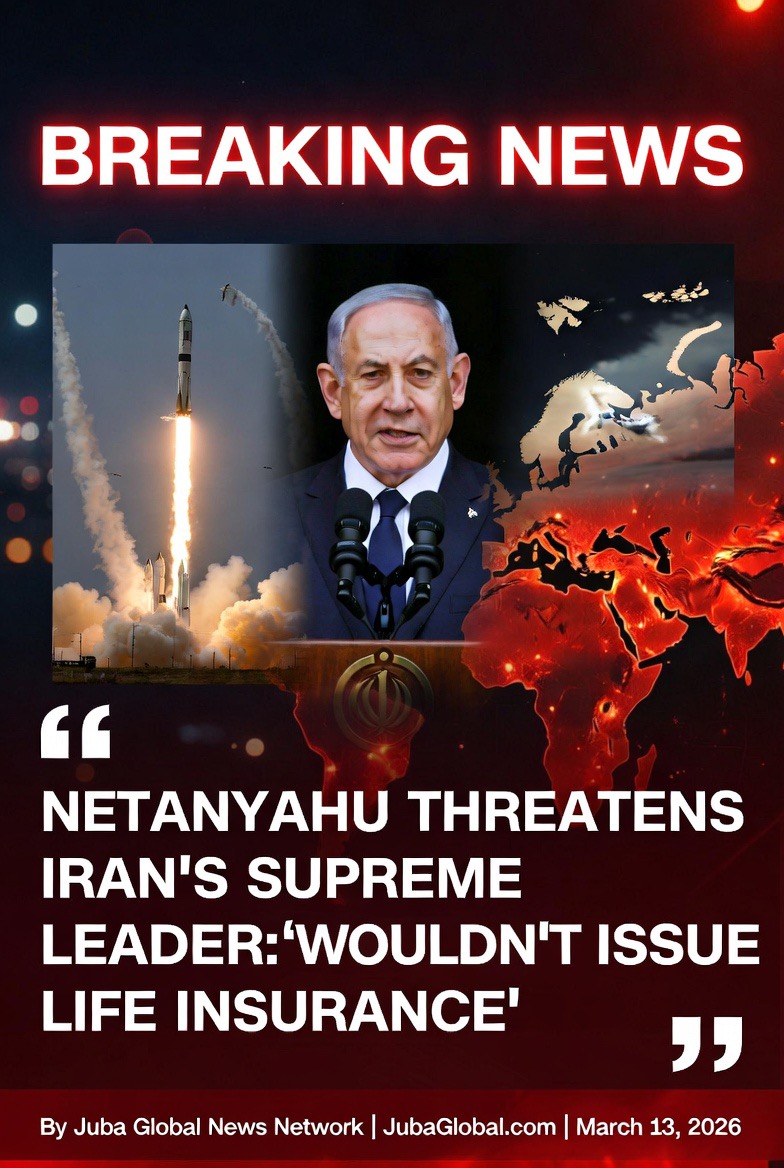
In one of the most provocative public statements of the ongoing US-Israeli war against Iran, Israeli Prime Minister Benjamin Netanyahu delivered a thinly veiled death threat against Iran’s newly installed Supreme Leader Mojtaba Khamenei during a late-night televised address from an undisclosed secure location. Speaking in both Hebrew and English, Netanyahu declared that any Iranian leader responsible for continued attacks on Israel “wouldn’t be wise to purchase life insurance right now,” before adding with unmistakable clarity: “I wouldn’t issue one.”
The remark, delivered with the prime minister’s characteristic gravitas and edged with dark humor, came hours after Iranian missile and drone barrages struck northern Israel and Gulf Arab states, and amid fresh reports of massive Israeli airstrikes hitting over 200 targets inside Iran in the preceding 24 hours. It marks the most explicit Israeli reference yet to the possibility of targeted elimination of Iran’s top leadership since the conflict erupted on February 28 with strikes that killed Mojtaba’s father, Ayatollah Ali Khamenei, several senior IRGC commanders, and other key figures.
The Full Context of the Statement
Netanyahu’s address was framed as an update on Operation Roar of the Lion — the codename for the sustained Israeli air campaign aimed at systematically dismantling Iran’s ballistic missile production, air defenses, nuclear-linked facilities, and command infrastructure. After detailing the latest wave of strikes (including confirmed hits on the rebuilt Taleghan compound at Parchin and multiple underground missile storage sites), the prime minister shifted tone when addressing Iran’s new leadership:
“We have already removed the previous architect of terror. The new one should understand very clearly: anyone who continues to send missiles at Israeli cities, anyone who keeps the Strait of Hormuz closed, anyone who orders attacks on our Gulf partners — that person should not count on a long future. I wouldn’t issue life insurance on any of the current leaders of the terrorist organizations or their patron in Tehran. Not today. Not tomorrow.”
He continued: “Regime change in Iran is not our declared goal — yet the regime’s choices may make it inevitable. The Iranian people deserve better than a leadership that hides in bunkers while sacrificing their youth and their future on the altar of vengeance.”
The “life insurance” line — a phrase Netanyahu has used before in reference to Hamas and Hezbollah leaders — was immediately interpreted by Iranian state media as an open call for assassination. Tehran responded within the hour, with Foreign Ministry spokesman Nasser Kanaani calling it “the unhinged rant of a war criminal facing inevitable defeat.”
Strategic Messaging or Genuine Intent?
Israeli security analysts are divided on whether the statement should be read primarily as psychological warfare or as signaling genuine operational planning:
- Psychological pressure — By publicly questioning the physical safety of Mojtaba Khamenei (who has not appeared in video since his selection as supreme leader and is rumored to have been injured in the initial February strikes), Israel aims to sow doubt within Iran’s power structure, exacerbate succession tensions, and encourage internal dissent or defections.
- Deterrence through ambiguity — The remark keeps Iran guessing whether Israel (possibly with U.S. tacit approval) is actively preparing decapitation strikes against the new supreme leader or other surviving top figures.
- Domestic audience — With millions of Israelis spending nights in shelters due to Hezbollah barrages and occasional Iranian missile penetrations, Netanyahu needs to project unbreakable resolve and eventual victory.
Critics inside Israel, including opposition leader Yair Lapid, accused the prime minister of reckless escalation: “Threatening to assassinate a head of state while we are already fighting a multi-front war is not strategy — it is gambling with Israeli lives.”
Mojtaba Khamenei’s Precarious Position
The new supreme leader remains largely unseen since his March 9 appointment by the Assembly of Experts. State media has relied on still photographs and voice-over readings of his statements. Unconfirmed reports from Iranian exile sources and Western intelligence suggest he sustained leg injuries during the initial attack that killed his father and has been recovering in a secure medical facility near Tehran or Qom.
Whether or not Israel possesses actionable intelligence on his location, the public threat alone increases his personal risk profile exponentially — forcing even tighter security, further isolation from public view, and potential command-and-control challenges at the worst possible moment for Iran.
International Reactions
- United States — The White House declined to comment directly on Netanyahu’s wording but reiterated that “all necessary measures” to protect Israel and U.S. forces remain authorized. President Trump, asked about the remark during a Mar-a-Lago event, grinned and said: “Bibi doesn’t bluff. When he says something like that, people should listen.”
- Gulf states — Saudi Arabia and the UAE issued no official reaction, though privately Gulf officials expressed concern that public threats against Iran’s supreme leader could provoke even more desperate Iranian retaliation against Gulf energy infrastructure.
- Russia & China — Both condemned the statement as “irresponsible incitement to assassination of a sovereign leader” and called for an immediate UN Security Council session.
- UN Secretary-General — António Guterres urged “maximum restraint from all parties” and warned that “rhetoric that personalizes this conflict only heightens the risk of catastrophic miscalculation.”
Where the War Stands
As the conflict enters Day 15, the scorecard is grim on all sides:
- Israel continues deep strikes inside Iran, claiming significant degradation of missile and nuclear capabilities.
- Iran maintains the Strait of Hormuz closure, launches retaliatory barrages, and activates proxies (Hezbollah, Houthis).
- Civilian suffering mounts: hospitals damaged in Iran, universities hit in Beirut, black smoke over Dubai, constant sirens in northern Israel.
- Global economy reels: oil above $100/barrel, airfares exploding, shipping lanes disrupted.
Netanyahu’s “life insurance” quip may ultimately prove to be little more than wartime rhetoric — or it may foreshadow a future operation that dramatically alters the trajectory of this already devastating war.
For now, it hangs in the air like the smoke over Tehran and Tel Aviv: a warning, a taunt, and — depending on who you ask — either the language of deterrence or the prelude to even greater escalation.
Juba Global News Network will continue providing live coverage as events unfold.
Stay informed. Visit JubaGlobal.com for continuing updates.
#Netanyahu #IranLeader #IsraelIranWar #RegimeChange #MiddleEastCrisis #IranWar #JubaGlobal
