

Netanyahu Orders Deeper Israeli Invasion into Southern Lebanon
By Juba Global News Network | JubaGlobal.com March 30, 2026 Israeli Prime Minister Benjamin Netanyahu has directed the Israel Defense Forces (IDF) to expan
By Juba Global News Network | JubaGlobal.com
March 30, 2026
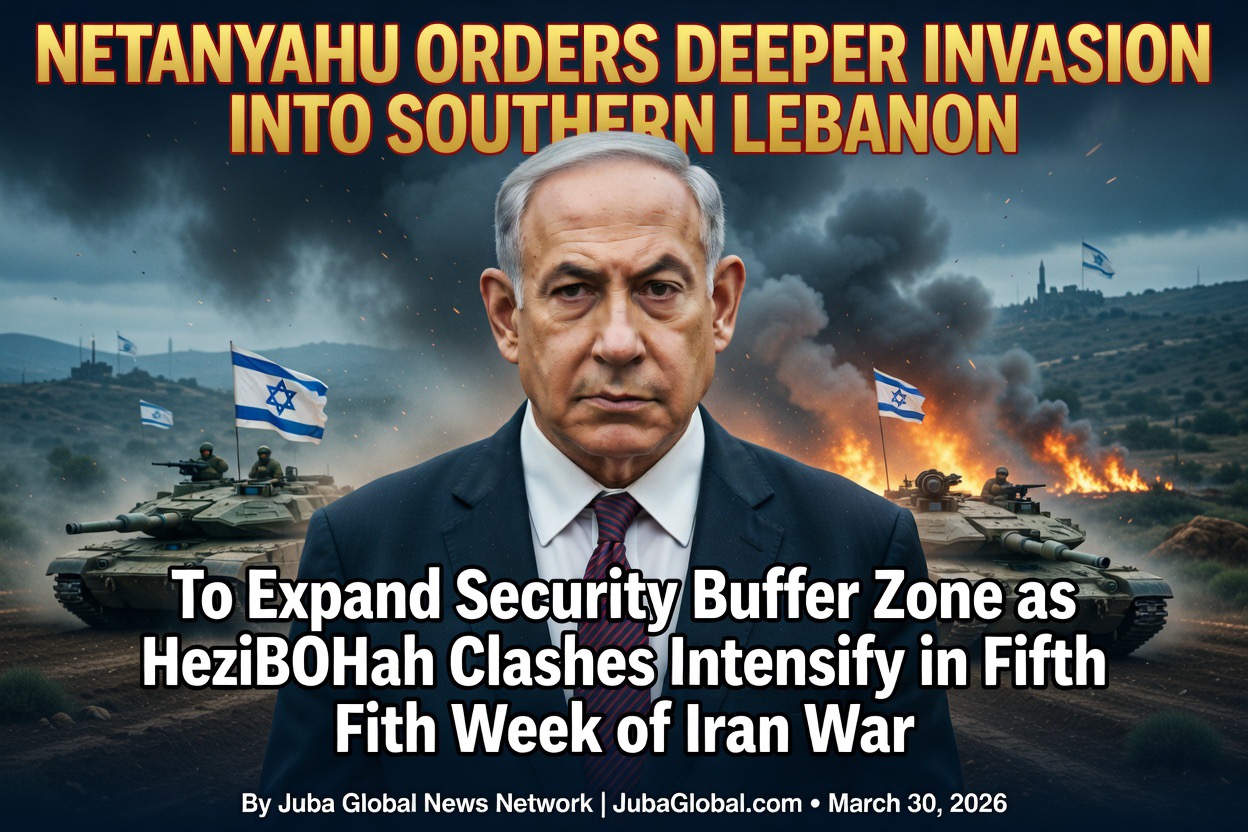
Israeli Prime Minister Benjamin Netanyahu has directed the Israel Defense Forces (IDF) to expand ground operations deeper into southern Lebanon, aiming to enlarge the security buffer zone along the border as clashes with Hezbollah intensify on this secondary front of the wider Iran war.
The decision, announced following a security cabinet meeting, comes as the multi-front regional conflict enters its fifth week. Israeli forces have already established positions several kilometers inside Lebanese territory, and the new orders call for further advances to neutralize remaining Hezbollah infrastructure and rocket-launching sites close to the border.
Netanyahu stated that the operation is necessary “to ensure the safety of Israeli citizens and to prevent Hezbollah from reconstituting its threat after years of Iranian-backed buildup.” He emphasized that Israel has no intention of occupying Lebanese territory permanently but will take whatever measures are required to create a lasting buffer against cross-border attacks.
Background of the Lebanon Front
The current escalation in southern Lebanon is closely linked to the broader Iran war. Hezbollah, Iran’s most powerful proxy, began intensified rocket and drone attacks on northern Israel shortly after the initial US and Israeli strikes on Iranian targets in late February 2026. In response, Israel launched a major air campaign against Hezbollah strongholds, followed by limited ground incursions.
As of March 30, the IDF reports having destroyed hundreds of Hezbollah rocket launchers, command centers, and weapons storage facilities. However, the group continues to fire barrages into Israel, albeit at a reduced rate due to sustained Israeli pressure.
The decision to push deeper into Lebanon reflects frustration with Hezbollah’s resilience and the group’s continued coordination with Iranian directives. Israeli intelligence assesses that Hezbollah still possesses significant remaining capabilities, including precision-guided missiles and underground tunnel networks.
Military Developments on the Ground
Israeli forces are employing a combination of armored units, infantry, and special forces in the expanded operation. Key objectives include:
• Clearing villages and terrain used as launch pads for attacks on Israel.
• Destroying cross-border tunnels and weapons smuggling routes.
• Establishing a wider demilitarized buffer zone, potentially extending 10–15 kilometers into Lebanon in some sectors.
Hezbollah has responded with fierce resistance, using anti-tank missiles, drones, and ambushes against advancing Israeli troops. Casualties have been reported on both sides, though exact figures remain closely guarded by military censors.
The United Nations Interim Force in Lebanon (UNIFIL) has expressed grave concern over the deepening incursion. One UNIFIL peacekeeper was killed in recent fighting, highlighting the risks to international observers caught in the crossfire.
Regional and International Reactions
The expansion of Israeli operations in Lebanon has drawn mixed responses:
• United States: The Trump administration has expressed support for Israel’s right to defend itself while urging restraint to avoid opening a full new theater that could complicate efforts against Iran proper.
• Iran: Tehran has condemned the moves as “aggression” and vowed continued support for Hezbollah, though its own military resources are stretched by direct confrontation with the US and Israel.
• Lebanese Government: Beirut has called the incursion a violation of sovereignty and appealed to the international community for intervention, though its influence over Hezbollah remains limited.
• Arab States: Countries such as Saudi Arabia and Egypt have quietly welcomed measures that weaken Hezbollah but publicly call for de-escalation to prevent wider war.
Diplomatic efforts, including the recent meeting of foreign ministers in Pakistan, are now grappling with how to address both the Iran conflict and the Lebanon front simultaneously.
Humanitarian Impact
The fighting has displaced tens of thousands of Lebanese civilians from southern villages, adding to an already strained humanitarian situation in Lebanon. Infrastructure damage, including roads, power lines, and homes, is mounting. International aid organizations warn of potential shortages of food, medicine, and fuel if the conflict prolongs.
On the Israeli side, continued rocket fire has forced residents in northern communities to remain in shelters or evacuate, disrupting daily life and the economy in the Galilee region.
Strategic Implications for the Wider Conflict
The deeper push into southern Lebanon serves multiple strategic purposes for Israel:
1. Degrading Hezbollah’s Capabilities: Reducing the group’s ability to threaten Israel while Iran is under direct pressure.
2. Dividing Iranian Resources: Forcing Tehran to support multiple fronts simultaneously.
3. Creating Leverage: Strengthening Israel’s negotiating position in any future regional de-escalation talks.
However, risks remain high. A prolonged ground campaign could lead to higher Israeli casualties, international criticism, and potential escalation involving other Iranian proxies or even direct Iranian intervention.
Analysts note that the Lebanon front, while secondary to the US-Iran confrontation, could become a decisive factor in determining the overall duration and outcome of the current crisis.
What Lies Ahead?
As operations expand, critical questions include:
• How far will Israeli forces advance before declaring the buffer zone sufficiently secure?
• Will Hezbollah attempt a major counteroffensive or shift to a war of attrition?
• Can diplomatic channels, currently focused primarily on the Iran nuclear and Hormuz issues, also address the Lebanon theater?
Prime Minister Netanyahu has indicated that the operation will continue “until the objectives are fully achieved,” while maintaining that Israel remains open to diplomatic solutions if Hezbollah agrees to withdraw its forces from the border area.
Juba Global News Network will continue to monitor developments on the Israel-Lebanon front, including military movements, diplomatic responses, and the humanitarian situation.
Related Coverage:
• US Deploys 3,500 Marines to Middle East as Troop Total Surpasses 50,000
• Houthis Launch Attacks on Israel as Yemen Rebels Fully Enter the Iran War
• Trump Claims Iran Has ‘Given In’ to Most US Demands as War Enters Fifth Week
This article is based on statements from Israeli officials, military sources, UN reports, and regional analysts as of March 30, 2026. The situation on the ground remains highly fluid.

10 thoughts on “Netanyahu Orders Deeper Israeli Invasion into Southern Lebanon”
Comments are closed.