

Mojtaba Khamenei’s First Major Address as Supreme Leader: “Crushing Revenge” Vowed as Iran Doubles Down on Strait Closure and Regional Escalation
By Juba Global News Network | JubaGlobal.comMarch 15, 2026 In his most extensive public appearance since assuming the role of Supreme Leader following the
By Juba Global News Network | JubaGlobal.comMarch 15, 2026
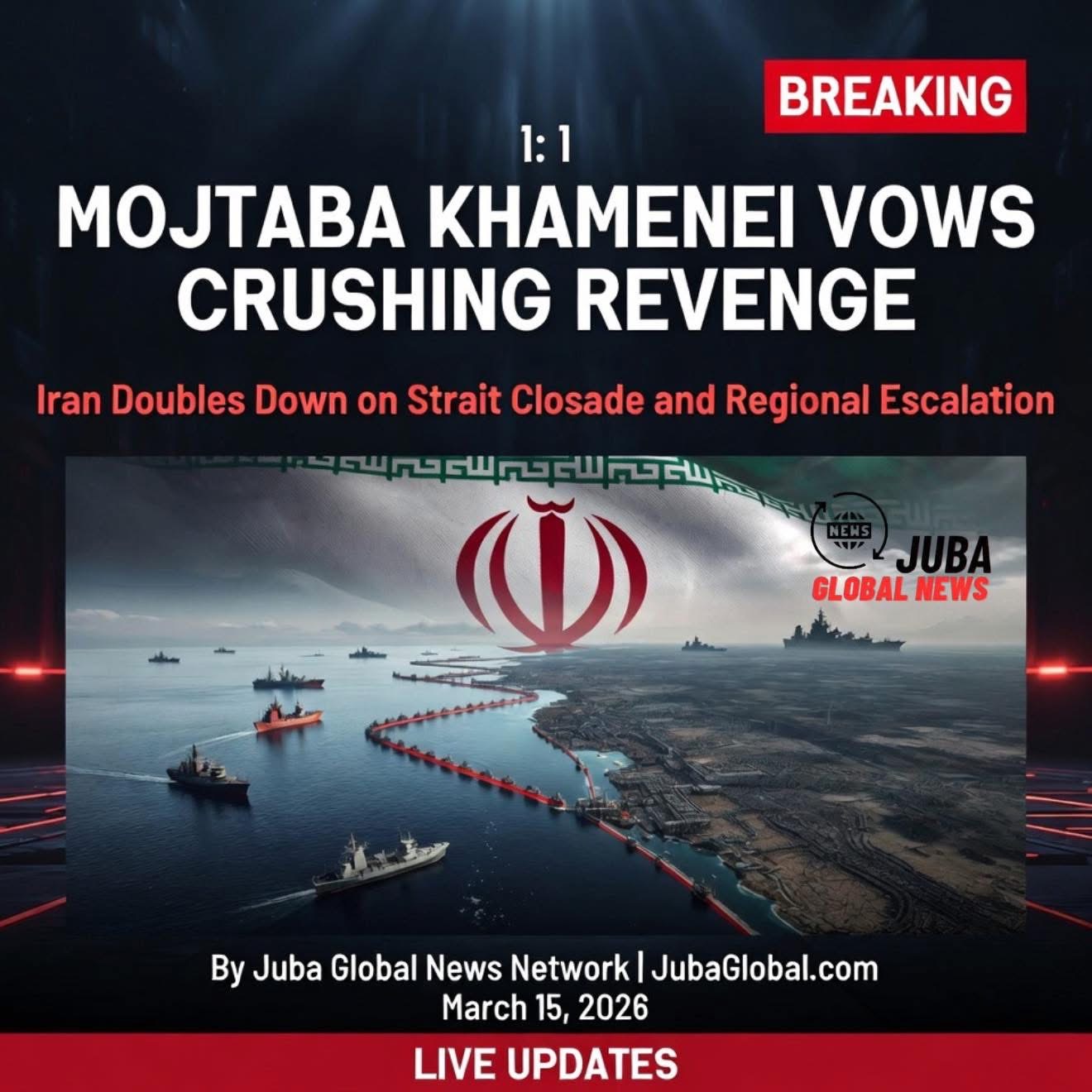
In his most extensive public appearance since assuming the role of Supreme Leader following the reported death of his father Ayatollah Ali Khamenei in late February, Mojtaba Khamenei delivered a fiery, hour-long televised address from Tehran late on March 14, 2026. The speech—broadcast live on state television and across IRGC-affiliated channels—was laden with religious rhetoric, defiance toward the United States and Israel, and explicit threats of expanded retaliation across the Middle East.
Standing before a large portrait of his father and flanked by senior commanders of the Islamic Revolutionary Guard Corps (IRGC), Mojtaba Khamenei declared that Iran would not yield to what he called “Zionist-American economic terrorism and military aggression.” He directly addressed the recent U.S.-Israeli strikes on Kharg Island and the Isfahan Nuclear Technology Center, labeling them “barbaric crimes against our nation’s sovereignty and scientific elite.”
“The enemies think they can decapitate our nuclear program by assassinating our best minds and demolishing our defenses,” he said. “They are mistaken. They have only ignited the fire of resistance. We will respond with crushing revenge—measured, precise, and devastating—until the aggressors are forced to retreat in humiliation.”
Khamenei explicitly tied Iran’s continued closure of the Strait of Hormuz to the broader conflict, framing it as both a legitimate act of self-defense and a tool of leverage against global powers dependent on Gulf oil. “The Strait remains closed until the last American warship leaves our waters and the Zionist entity ceases its attacks on Lebanon and our soil,” he stated. “This is not negotiation from weakness; this is enforcement of our red lines. The world that benefits from our oil must now feel the cost of its silence.”
The address came amid mounting evidence of Iran’s strategic recalibration. Satellite imagery analyzed by defense firms shows IRGC naval units dispersing from Kharg Island to smaller facilities along the Makran coast and in the Gulf of Oman, suggesting preparations for a prolonged asymmetric campaign rather than direct confrontation with superior U.S. naval forces. Iranian state media also released grainy footage purporting to show newly laid naval mines and anti-ship missile batteries repositioned along key chokepoints.
Khamenei singled out several targets for potential retaliation:
- U.S. military bases in Bahrain, Qatar, and the UAE, which he accused of serving as launch platforms for the Kharg and Isfahan strikes.
- Commercial shipping of “complicit nations” transiting the Gulf.
- Israeli population centers and energy infrastructure, vowing that Hezbollah’s rocket barrages were only “the opening act.”
- “Traitorous” Gulf Arab states that he claimed provided logistical support to the coalition.
He also issued a rare public call to Iran’s proxies across the region. “The axis of resistance—from Yemen to Iraq to Lebanon to Syria—stands united,” Khamenei said. “Every front will now burn hotter until the enemy pays the full price.”
The speech triggered immediate reactions. Within hours, Hezbollah intensified rocket fire into northern Israel, launching more than 60 projectiles in a single barrage—the largest in 48 hours—wounding at least four civilians in Kiryat Shmona and forcing thousands into shelters. Houthi forces in Yemen claimed responsibility for a failed drone attack on a Saudi oil facility near Abqaiq, while Iraqi militias aligned with Iran fired several rockets toward U.S. bases near Erbil, though none caused casualties.
Internationally, the address deepened divisions. Russia’s Foreign Ministry praised Khamenei’s “principled stand against imperialism,” while China’s state media called for de-escalation but stopped short of condemning Iran. Gulf Arab capitals—particularly Riyadh and Abu Dhabi—placed their armed forces on high alert and quietly accelerated talks with Washington about joint defense measures.
Inside Iran, the speech was met with a mix of fervent support from hardline factions and growing private anxiety among ordinary citizens. Long lines persisted at gas stations after fuel subsidies were further reduced, and unconfirmed reports emerged of small protests in several provincial cities over rising living costs and fear of wider war. Independent analysts estimate that Iran’s daily oil exports have fallen below 300,000 barrels—less than 15 percent of pre-conflict levels—straining an economy already battered by sanctions and airstrikes.
President Donald Trump responded swiftly on Truth Social: “Mojtaba just made a big mistake. Threatening the world’s oil lifeline and calling for ‘crushing revenge’ while his country bleeds? Bad move. We are ready, willing, and more than able. The clock is ticking.”
Defense experts interpret Khamenei’s rhetoric as both a domestic rallying cry and a calculated gamble. “He needs to project unbreakable resolve to maintain regime cohesion after losing his father and suffering major military setbacks,” said Dr. Suzanne Maloney of the Brookings Institution. “But the longer the Strait stays closed, the more Iran isolates itself economically and risks direct hits on its remaining export capacity.”
As casualties in Iran surpass 1,400 dead and 18,000 injured from coalition airstrikes, and global oil prices hover above $105 per barrel, Mojtaba Khamenei’s first major address signals that Tehran intends to fight on multiple fronts rather than seek an early off-ramp. Whether this posture leads to negotiation through intermediaries in Oman and Qatar or to further escalation remains the central question facing the region—and the world.
Juba Global News Network maintains correspondents in Tehran (via secure channels), the Gulf capitals, Washington, and Jerusalem. For full video of the Supreme Leader’s address, translated excerpts, real-time proxy attack tracking, and expert reaction, visit JubaGlobal.com.
Related Coverage:
- Global oil prices surge past $105 amid Hormuz blockade fears
- Trump calls for multinational naval coalition to reopen Strait
- Fresh Hezbollah barrages wound civilians in northern Israel
- Kharg Island military sites “totally demolished” — CENTCOM footage
- Isfahan nuclear strike kills 15 scientists, delays Iran’s breakout
Stay informed. Stay ahead. Juba Global News Network — reporting the truth from the front lines.
