Macron Announces France Nuclear Warhead Increase: “To Be Free, We Must Be Feared”
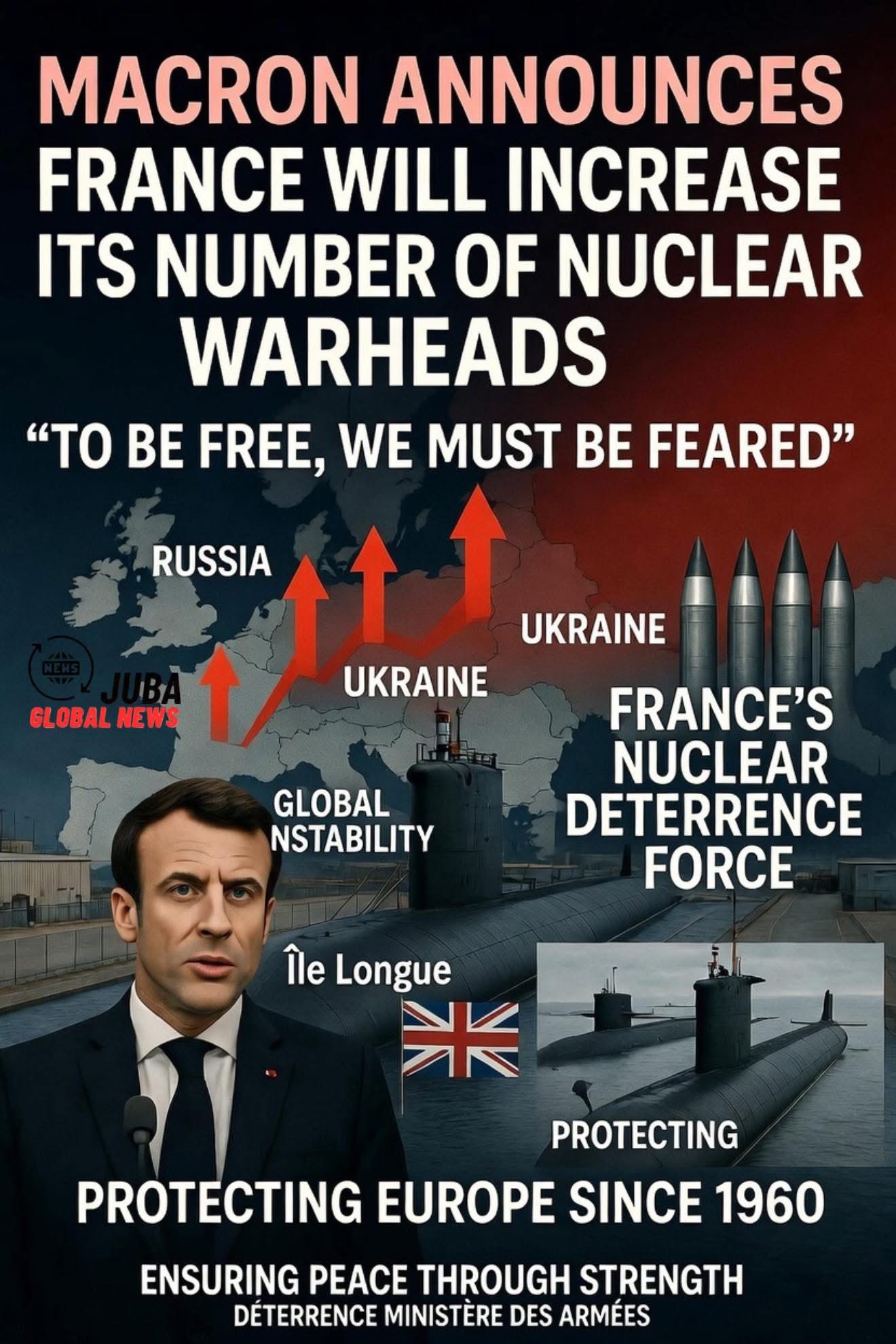
In a landmark address delivered on March 2, 2026, from the secure Île Longue nuclear submarine base in Brittany, French President Emmanuel Macron unveiled a major overhaul of France’s nuclear doctrine—the most significant since the end of the Cold War. Declaring that “to be free, we have to be feared,” Macron announced that France will increase its nuclear warhead stockpile for the first time in decades, while deepening nuclear cooperation with European allies through a new concept he termed “forward deterrence” or “advanced deterrence.” The move comes amid heightened global instability, including Russia’s ongoing aggression in Ukraine, uncertainties in U.S. alliance commitments, and rising threats from China, all set against the backdrop of the escalating US-Israel-Iran conflict shaking the Middle East.
A Historic Shift in Nuclear Policy
France currently maintains an estimated 290 nuclear warheads—the world’s fourth-largest arsenal after Russia, the United States, and China—unchanged in size since 1992 under a policy of “strict sufficiency.” Macron emphasized that this cap is no longer adequate in today’s volatile strategic environment.
“An upgrade of our arsenal is essential,” he stated firmly. “That’s why I have decided to increase the number of nuclear warheads in our arsenal.” He declined to specify the scale of the expansion or future totals, explaining that France would no longer publicly disclose precise figures to preserve operational credibility and deterrence value.
The president framed the decision as a necessary response to “geopolitical upheaval fraught with risk” and “ambient animosity.” He highlighted the need to ensure France’s force de frappe (strike force) retains its “assured destructive power” for decades to come. Macron also confirmed plans for a new nuclear-powered ballistic missile submarine (SNLE), named The Invincible, to enter service by 2036, bolstering the oceanic leg of France’s triad.
“Forward Deterrence”: Extending Europe’s Nuclear Shield
The most groundbreaking element of the speech was Macron’s proposal for “forward deterrence”—a structured, deeper nuclear-security partnership with select European nations, distinct from but complementary to NATO’s existing nuclear arrangements.
France will intensify cooperation with eight key partners: the United Kingdom (Europe’s other nuclear power), Germany, Poland, the Netherlands, Belgium, Greece, Sweden, and Denmark. Initiatives include:
- Joint nuclear exercises involving France’s air-launched nuclear capability (Rafale fighters equipped with ASMP-A missiles).
- Potential temporary deployment of French nuclear-armed aircraft to allied territories.
- Enhanced strategic dialogue, including a new France-Germany “nuclear steering group” to discuss doctrine, conventional-nuclear integration, and missile defense.
Macron stressed that ultimate decision-making authority over nuclear use would remain solely with the French president—no sharing of launch codes or veto rights—but the plan aims to extend France’s deterrent umbrella over Europe, fostering greater continental autonomy in security matters.
“This is about Europeans regaining control of our own destiny,” he declared, underscoring the importance of strategic independence amid concerns over potential shifts in U.S. priorities.
Context and Motivations
The announcement arrives at a precarious moment. Russia’s invasion of Ukraine has entered its fifth year, with nuclear rhetoric from Moscow raising alarms. Meanwhile, the rapid escalation of the US-Israel-Iran war—including strikes on Tehran, the closure of the Strait of Hormuz, and attacks on Gulf allies—has amplified fears of wider conflict and energy disruptions.
Macron’s speech reflects long-standing French concerns about over-reliance on NATO (and thus the U.S.) for nuclear protection, especially if American commitments waver. Analysts describe the policy as a pragmatic evolution: strengthening deterrence credibility while offering a European-focused alternative without undermining NATO.
Experts like Bruno Tertrais of the Foundation for Strategic Research called it “the most significant update to French nuclear deterrence policy in 30 years” and “a major step forward” in European security architecture.
Reactions and Implications
Initial reactions have been mixed. European partners expressed cautious interest, with Germany welcoming the bilateral steering group as a sign of deepening Franco-German trust. Eastern European nations like Poland see potential reassurance against Russian threats. Critics, however, worry about proliferation risks or straining NATO cohesion.
In the broader geopolitical context, the announcement signals Europe’s determination to bolster its defenses independently, even as the Middle East crisis unfolds. With oil prices surging and global tensions high, Macron’s words—“the next 50 years will be an era of nuclear weapons”—underscore a sobering reality: nuclear deterrence remains central to security in an increasingly multipolar and unpredictable world.
As France moves forward with arsenal expansion and European outreach, the coming months will test whether this bold pivot strengthens continental unity or introduces new complexities to the transatlantic alliance.
By Joseph for Juba Global News Network | JubaGlobal.com
March 3, 2026 – Stay tuned for live updates and analysis as global security dynamics continue to evolve.