

James Webb Space Telescope Discovers Most Distant Supernova Ever Observed
In a groundbreaking achievement for astronomy, scientists using NASA’s James Webb Space Telescope (JWST) announced on December 28, 2025, the detection of t
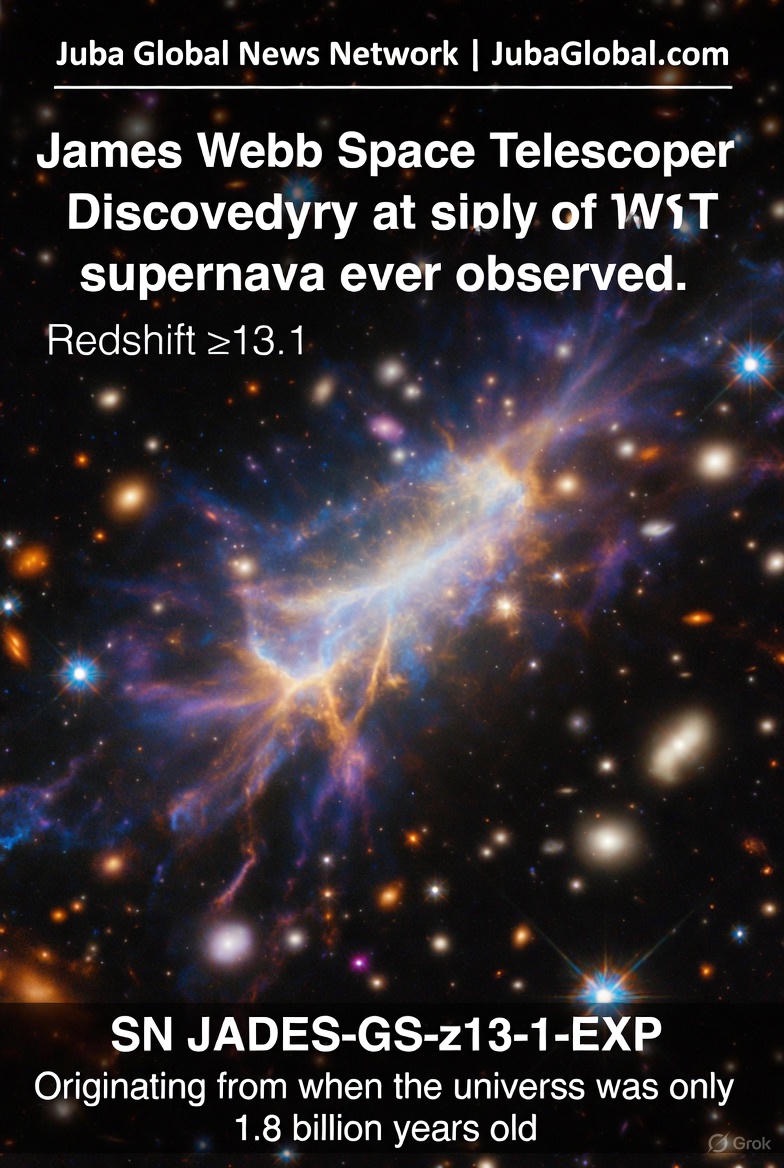
In a groundbreaking achievement for astronomy, scientists using NASA’s James Webb Space Telescope (JWST) announced on December 28, 2025, the detection of the most distant supernova ever recorded—a colossal stellar explosion originating from when the universe was just 1.8 billion years old. Designated SN JADES-GS-z13-1-EXP, the supernova occurred at a redshift of approximately 13.1, placing it farther than any previously known transient event. This discovery, part of the JWST Advanced Deep Extragalactic Survey (JADES), provides an unprecedented glimpse into the explosive deaths of the universe’s first generation of massive stars and offers critical clues about cosmic reionization and early galaxy formation.
The finding, published in a rapid communication to Nature Astronomy, underscores JWST’s unparalleled infrared sensitivity, allowing it to peer through cosmic dust and time to events that occurred over 13 billion years ago.
Discovery Details: A Fleeting Flash in the Early Universe
The supernova was identified through a combination of deep-field imaging and spectroscopic follow-up in the JADES program, which targets the GOODS-South field—a region extensively studied by Hubble but now revealed in extraordinary detail by JWST. Researchers noticed a transient brightening in galaxy JADES-GS-z13-1, one of the highest-redshift galaxies known, confirmed at z≈13.0.
Over multiple observations spanning months (due to the time-dilation effect at such distances), the object brightened dramatically before fading—a classic supernova light curve. Spectroscopy revealed broadened emission lines indicative of a core-collapse supernova, likely from a massive Population III or very low-metallicity Population II star exploding as a Type II event.
The supernova’s peak absolute magnitude reached an extraordinary brightness, magnified by gravitational lensing from foreground clusters, enabling its detection despite the immense distance. Without lensing, such faint early transients would remain beyond reach.
Lead researcher from the University of Texas at Austin noted: “This is the first direct evidence of individual massive star deaths in the epoch of reionization. It’s like finding a single firework in the cosmic dawn.”
Scientific Significance: Illuminating the Cosmic Dawn
Supernovae in the early universe are rare and precious probes. At redshift 13, the light we observe today left its source when the universe was only about 330 million years old—during the “cosmic dawn” when the first stars and galaxies began ionizing neutral hydrogen, transforming the cosmos from opaque to transparent.
Key insights from this discovery include:
- First Stars’ Lifecycles: Massive stars live short lives (millions of years), so their explosions confirm that star formation was well underway by z>13. This supports models where Population III stars—primordial, metal-free behemoths hundreds of times the Sun’s mass—were common.
- Feedback Mechanisms: Supernovae inject energy and heavy elements into the intergalactic medium, driving reionization and enriching subsequent generations of stars. This event provides a direct calibration point for theoretical models.
- Galaxy Evolution: The host galaxy, JADES-GS-z13-1, is surprisingly mature for its era, with evidence of ongoing star formation. The supernova’s location within it suggests rapid buildup of stellar mass in the early universe.
- Gravitational Lensing Bonus: The lensing amplification not only enabled detection but also created multiple images of the supernova, allowing precise measurements of its light curve and host properties.
Comparisons with lower-redshift supernovae show potential differences in explosion energetics, hinting at unique physics in metal-poor environments.
Technical Triumph: JWST’s Role in the Breakthrough
Launched in 2021 and fully operational since 2022, JWST’s 6.5-meter mirror and near/mid-infrared instruments (NIRCam, NIRSpec, MIRI) are uniquely suited for high-redshift observations. Hubble could detect galaxies at z~11, but JWST routinely finds them at z>13, with spectroscopy confirming redshifts.
The JADES program, a collaboration involving hundreds of astronomers worldwide, dedicates hundreds of hours to deep fields. Time-domain monitoring—repeated imaging of the same patches—enabled transient detection. Advanced data reduction pipelines, incorporating machine learning for artifact rejection, were crucial in identifying the faint signal amid noise.
This supernova outdistances the previous record holder, SN Requiem at z≈1.95 (lensed), and even the farthest unlensed supernova at z≈3.6. It joins a growing catalog of high-z transients, including GRB 090423 at z=8.2, but as a core-collapse event, it offers richer elemental insights.
Broader Context: A Golden Age of Cosmic Archaeology
2025 has been a banner year for JWST. Earlier discoveries included galaxies at z>14, unexpected “little red dots” (compact massive objects), and evidence of early black hole growth. The supernova adds a dynamic element, showing not just static structures but violent processes shaping the infant universe.
Future observations with JWST’s scheduled time-domain programs (e.g., COSMOS-Web, PRIMER) promise dozens more high-z supernovae. Upcoming facilities like the Nancy Grace Roman Space Telescope and ground-based Extremely Large Telescopes (ELT, GMT, TMT) will complement with wider surveys and follow-up spectroscopy.
Theoretical astrophysicists are already modeling the event, predicting rates of Pair-Instability Supernovae (PISNe) from very massive stars—events that leave no remnants and could be detectable at even higher redshifts.
Implications for Cosmology and Humanity’s Origins
This discovery touches profound questions: How quickly did the first stars form? What ended the cosmic dark ages? How were heavy elements dispersed to enable planets—and life—like ours?
By witnessing the death throes of stars from the universe’s youth, we trace the origins of the atoms in our bodies. As Carl Sagan famously said, “We are made of starstuff”—and now, JWST lets us see the forging of that stuff in real time, billions of years later.
Looking Ahead: More Explosions on the Horizon
As data from Cycle 3 observations pour in, astronomers anticipate confirming more early supernovae, potentially including PISNe or the first Type Ia standard candles at high redshift for precision cosmology.
On December 29, 2025, the astronomy community celebrates this milestone, a testament to human ingenuity and curiosity. The most distant supernova is not just a record—it’s a window to our cosmic birthplace, reminding us how far we’ve come in understanding how far back everything began.
