

Israel Says It Killed Iran’s Intelligence Minister Esmail Khatib Overnight
By: Juba Global News Network | JubaGlobal.com March 18, 2026 — Tehran, Iran / Jerusalem, Israel In the latest blow to Iran’s already battered leadership, I
By: Juba Global News Network | JubaGlobal.com
March 18, 2026 — Tehran, Iran / Jerusalem, Israel
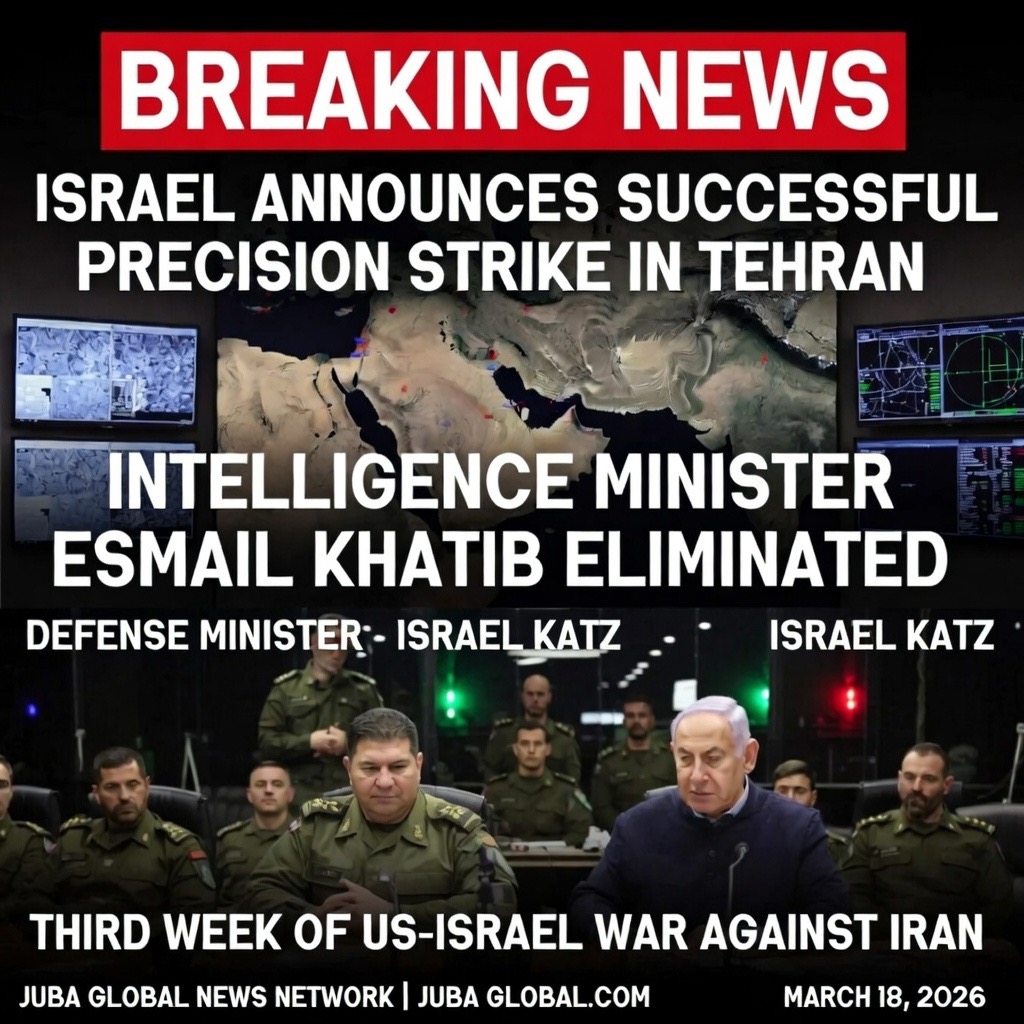
In the latest blow to Iran’s already battered leadership, Israeli Defense Minister Israel Katz announced early Wednesday that the Israeli military had “eliminated” Iran’s Intelligence Minister Esmail Khatib in a precision airstrike on Tehran overnight. The strike, described by Katz as part of an intensifying campaign to dismantle the Islamic Republic’s command structure, marks the third high-profile assassination of a senior Iranian official in just over 24 hours — and the second in as many days targeting the regime’s intelligence and security apparatus.
Khatib, who has headed Iran’s powerful Ministry of Intelligence and Security (MOIS) since 2021, was widely regarded as one of the regime’s most influential figures in internal repression, counterintelligence, and operations against perceived enemies abroad. The ministry, often seen as a rival to the Islamic Revolutionary Guard Corps (IRGC) intelligence wing, oversees domestic surveillance, arrests of dissidents, and covert actions targeting Iranian exiles and opposition groups. Khatib’s death — if confirmed — would further decapitate Iran’s security leadership amid relentless Israeli and U.S. airstrikes now entering the third week of the broader conflict.
The announcement came via Katz on Israeli state-affiliated channels and was quickly echoed by military sources. “The intensity of the strikes in Iran is increasing,” Katz stated. “Iranian Intelligence Minister Khatib was also eliminated overnight.” He added that he and Prime Minister Benjamin Netanyahu had authorized the IDF to target and kill any additional senior Iranian officials without needing further high-level approval, promising “significant surprises” across multiple fronts throughout the day. Israeli officials described the operation as a “precise strike” in Tehran, though they acknowledged assessments were ongoing to fully confirm Khatib’s fate. No immediate photographic or independent evidence was released by Israel.
Iranian state media and officials have remained largely silent on the claim so far, with no official confirmation or denial from Tehran as of mid-morning local time. Some Iranian outlets dismissed the report as “Zionist propaganda,” while others noted that the regime has historically delayed announcements of high-level losses to maintain internal stability and avoid signaling weakness. In the absence of confirmation, speculation swirled in regional media: some sources suggested Khatib may have been killed alongside senior ministry deputies during strikes on intelligence facilities, while others reported the target was struck but survival remained possible.
This development follows a rapid sequence of leadership eliminations:
- On Tuesday, Israel confirmed the killing of Ali Larijani, secretary of Iran’s Supreme National Security Council and widely viewed as the de facto leader of the country since Supreme Leader Ali Khamenei’s death on February 28. Larijani was struck alongside his son and Basij paramilitary commander Gholamreza Soleimani in what Israeli officials called a coordinated decapitation operation.
- Iran’s retaliation came swiftly: overnight into Wednesday, Tehran launched ballistic missiles and drones — including cluster-warhead variants — at central Israel, killing at least two civilians in Ramat Gan near Tel Aviv, injuring dozens, and causing fires and damage near residential areas and infrastructure.
The pattern of targeted killings has accelerated dramatically since early March, when the war expanded beyond proxy fronts into direct strikes on Iranian soil. Analysts note that Israel’s strategy appears focused on crippling Iran’s ability to coordinate defenses, proxy militias (such as Hezbollah in Lebanon), and internal control mechanisms. The loss of Khatib would severely hamper MOIS operations, particularly in countering espionage, suppressing domestic unrest, and managing foreign intelligence networks.
Tehran’s response has been defiant but strained. Following Larijani’s death, hardline voices vowed “exact revenge,” a promise partially fulfilled with the missile barrage on Israel. With Khatib reportedly eliminated, regime spokespeople face mounting pressure to project resilience amid reports of internal chaos, power vacuums, and growing public fear in Tehran. Gulf allies — Qatar, Kuwait, UAE, and Saudi Arabia — again activated air defenses to intercept Iranian projectiles, highlighting the war’s regional contagion.
The assassinations have drawn sharp international reactions. U.S. officials, while not directly commenting on the Khatib strike, have continued bunker-buster operations against Iranian missile sites along the Strait of Hormuz. A top U.S. counterterrorism official resigned Tuesday over disagreements with the administration’s Iran policy. Meanwhile, humanitarian concerns mount: civilian casualties rise in both Iran and Israel, energy markets remain volatile with oil prices elevated, and fears of wider escalation persist.
As smoke clears from overnight strikes in Tehran and sirens echo in Israeli cities, the cycle of retaliation shows no immediate signs of breaking. With Iran’s leadership core increasingly hollowed out and Israel vowing sustained pressure, the path to de-escalation appears narrower than ever.
Juba Global News Network continues to track this rapidly evolving crisis from multiple angles. Updates will follow as more details emerge. Stay informed at JubaGlobal.com.
Reporting contributed by correspondents in Jerusalem, Tehran (via regional sources), and international security analysts. Claims cross-verified with Israeli, Iranian, and Western media outlets.
