

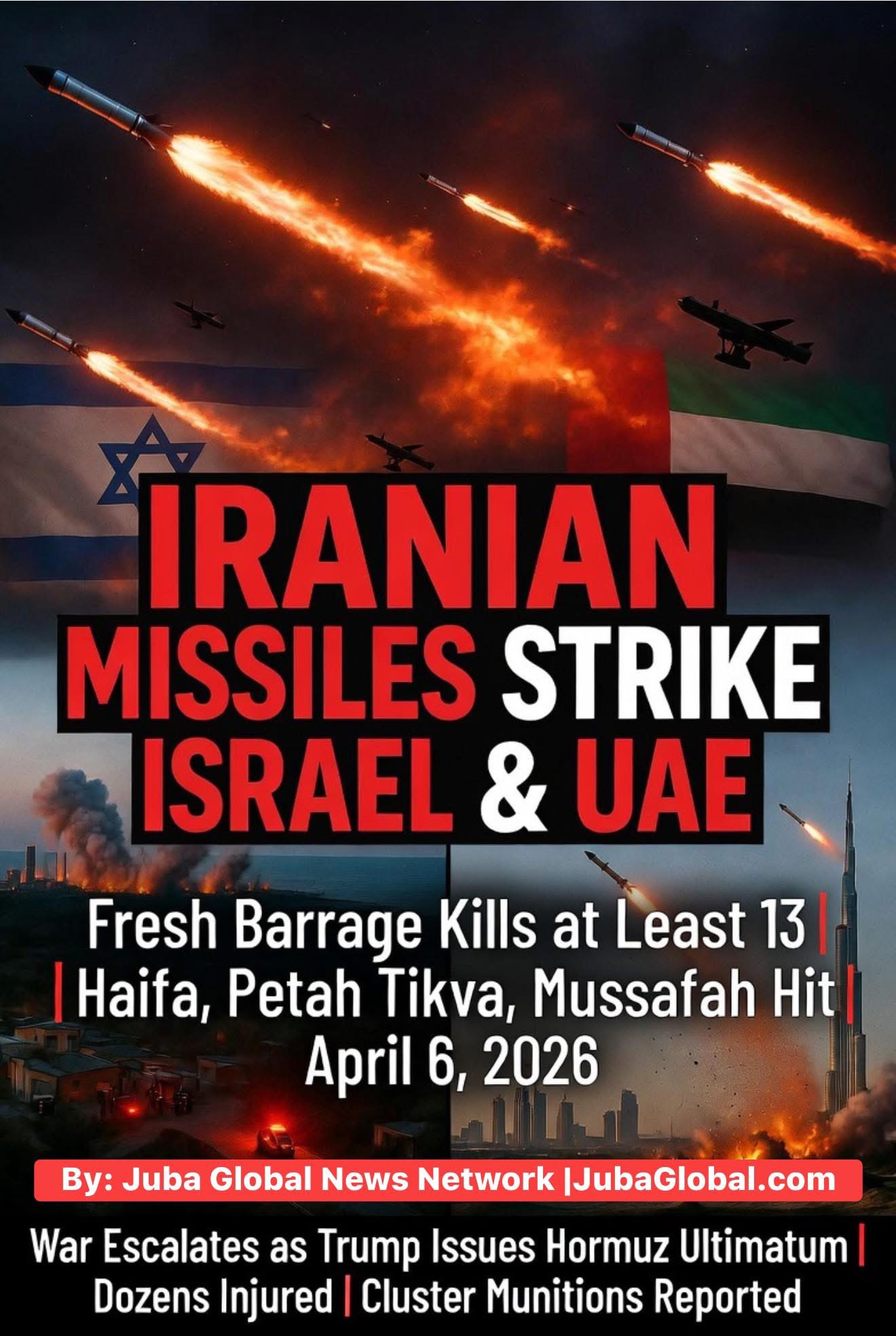
Iranian Missiles Rain Down on Israel and UAE: Fresh Barrage Kills at Least 13 as War Enters Critical Phase
By Juba Global News Network | JubaGlobal.com Published: April 6, 2026 In a dramatic escalation of the ongoing U.S.-Israel-Iran conflict, Iranian forces lau
By Juba Global News Network | JubaGlobal.com
Published: April 6, 2026
In a dramatic escalation of the ongoing U.S.-Israel-Iran conflict, Iranian forces launched a fresh wave of ballistic missiles and drones targeting multiple sites in Israel and the United Arab Emirates on April 5-6, 2026. Reports confirm at least 13 deaths and numerous injuries, with strikes hitting civilian areas, industrial zones, and residential neighborhoods despite robust air defense interceptions.
This latest barrage comes as the multi-front war, now in its sixth week, shows no signs of de-escalation. It coincides with U.S. President Donald Trump’s explosive ultimatum demanding Iran reopen the Strait of Hormuz by Tuesday evening or face devastating strikes on Iranian power plants and infrastructure.
Details of the Attacks
In Israel: Iranian missiles struck at least 15 locations across the country, with confirmed impacts in Haifa, Petah Tikva, Tel Aviv metropolitan areas, and southern industrial zones like Ramat Hovav.
• A missile attack on Haifa killed two people and wounded at least four others.
• Cluster munitions dispersed over central and northern regions, causing injuries from falling debris and secondary explosions in residential neighborhoods.
• One strike hit an industrial area in southern Israel, captured on video showing significant fire and damage.
• Israeli air defenses intercepted many incoming projectiles, but several missiles penetrated, leading to direct hits and civilian casualties. Israeli media reported damage to buildings and infrastructure in Petah Tikva and other central areas.
The Israeli Defense Forces (IDF) activated sirens across wide regions, instructing residents to seek shelter. This wave marks one of the more intense recent attacks, with reports of at least nine missiles launched in multiple smaller barrages targeting Israel specifically.
In the UAE: Iran continued its sustained campaign against Gulf states hosting U.S. military assets and infrastructure.
• Strikes and falling debris from interceptions caused casualties in the Mussafah industrial area near Abu Dhabi, where a Ghanaian national was moderately injured by shrapnel.
• A drone attack targeted a telecom center in Fujairah, marking a shift toward communication infrastructure and causing a small fire.
• Debris from intercepted missiles and drones fell on residential areas, including near the Dubai marina and Palm Jumeirah, as well as Abu Dhabi facilities.
• UAE air defenses, using advanced U.S.-supplied THAAD and Patriot systems, engaged dozens of ballistic missiles and drones. On April 5 alone, reports indicate interceptions of multiple ballistic missiles, cruise missiles, and over 50 drones.
Since the conflict began on February 28, 2026, the UAE has intercepted hundreds of Iranian projectiles — over 498 ballistic missiles, 24 cruise missiles, and more than 2,141 drones according to official tallies. While many attacks are neutralized, debris and occasional successful strikes have caused deaths and damage to civilian and industrial sites.
Casualties in this latest round across both countries are reported at a minimum of 13 killed, with dozens more injured. Exact figures may rise as rescue operations continue and damage assessments are completed.
Broader Context of the Conflict
The current war erupted after coordinated U.S. and Israeli strikes on February 28, 2026, which targeted Iranian leadership, nuclear facilities, missile production sites, and military infrastructure. The assassination of Supreme Leader Ayatollah Ali Khamenei in the initial phase triggered a massive Iranian retaliation campaign involving thousands of missiles and drones across the region.
Iran has framed its attacks as legitimate self-defense and retaliation against “U.S.-Israeli aggression.” Targets have included U.S. bases, oil infrastructure, and sites linked to American or Israeli interests in Gulf countries. The strategy appears aimed at imposing economic and political costs, widening the conflict to pressure adversaries into negotiations.
Meanwhile, U.S. and Israeli forces have conducted hundreds of strikes inside Iran, degrading missile capabilities, air defenses, and industrial assets. Recent operations included the daring U.S. special forces rescue of a downed F-15E crew member deep inside Iranian territory.
Economic and Humanitarian Impact
The conflict has severely disrupted global energy markets. Iran’s effective blockade of the Strait of Hormuz — through which nearly 20% of the world’s oil passes — has caused repeated surges in oil prices. Gulf states like the UAE, despite their advanced defenses, face ongoing threats that could affect critical infrastructure, including petrochemical plants, desalination facilities, and telecom networks.
Humanitarian concerns are mounting. Civilian areas in Israel and the UAE have been affected by both direct strikes and interception debris. In Iran, U.S.-Israeli airstrikes have caused significant casualties and infrastructure damage. Millions have been displaced across the region, with ripple effects felt in neighboring countries.
International Reactions and Diplomatic Efforts
• Israel has vowed to continue operations to degrade Iran’s offensive capabilities while defending its population.
• UAE officials have emphasized the effectiveness of their air defenses but highlighted the persistent threat and called for international support to deter further aggression.
• Iran has dismissed Trump’s Hormuz deadline as “delusional” and promised strong retaliation, warning of opening the “gates of hell.”
• Backchannel talks involving mediators from Turkey, Pakistan, Egypt, and others continue, with discussions reportedly exploring a potential 45-day ceasefire. However, core issues — Iran’s nuclear program, ballistic missiles, sanctions, and control of the Strait of Hormuz — remain major stumbling blocks.
Japan has announced plans for high-level summit talks with Iran, reflecting global concern over escalation and energy security.
Pope Leo XIV, in his first Easter message, called for an immediate end to violence in the Middle East and prayed for peace amid the multiple active conflicts.
What Comes Next?
As President Trump’s Tuesday deadline approaches, fears of further escalation are high. A failure to reopen the Strait of Hormuz could trigger massive U.S. strikes on Iranian energy and transportation targets, risking even greater civilian harm and regional instability.
Military analysts note that Iran’s missile inventory has been significantly degraded but retains the ability to launch sporadic, high-impact barrages. The use of cluster munitions and drones targeting civilian-linked infrastructure signals a broadening of tactics.
The parallel Russia-Ukraine conflict continues to draw resources and attention, while the Middle East crisis dominates global headlines and economic forecasts.
