Iran War Enters Third Week: Israel Strikes 200 Targets as Missiles Hit Northern Israel and Gulf States
By Juba Global News Network Staff JubaGlobal.com March 13, 2026 The US-Israeli war against Iran has now stretched into its third week, with no signs of de-
By Juba Global News Network Staff
JubaGlobal.com
March 13, 2026
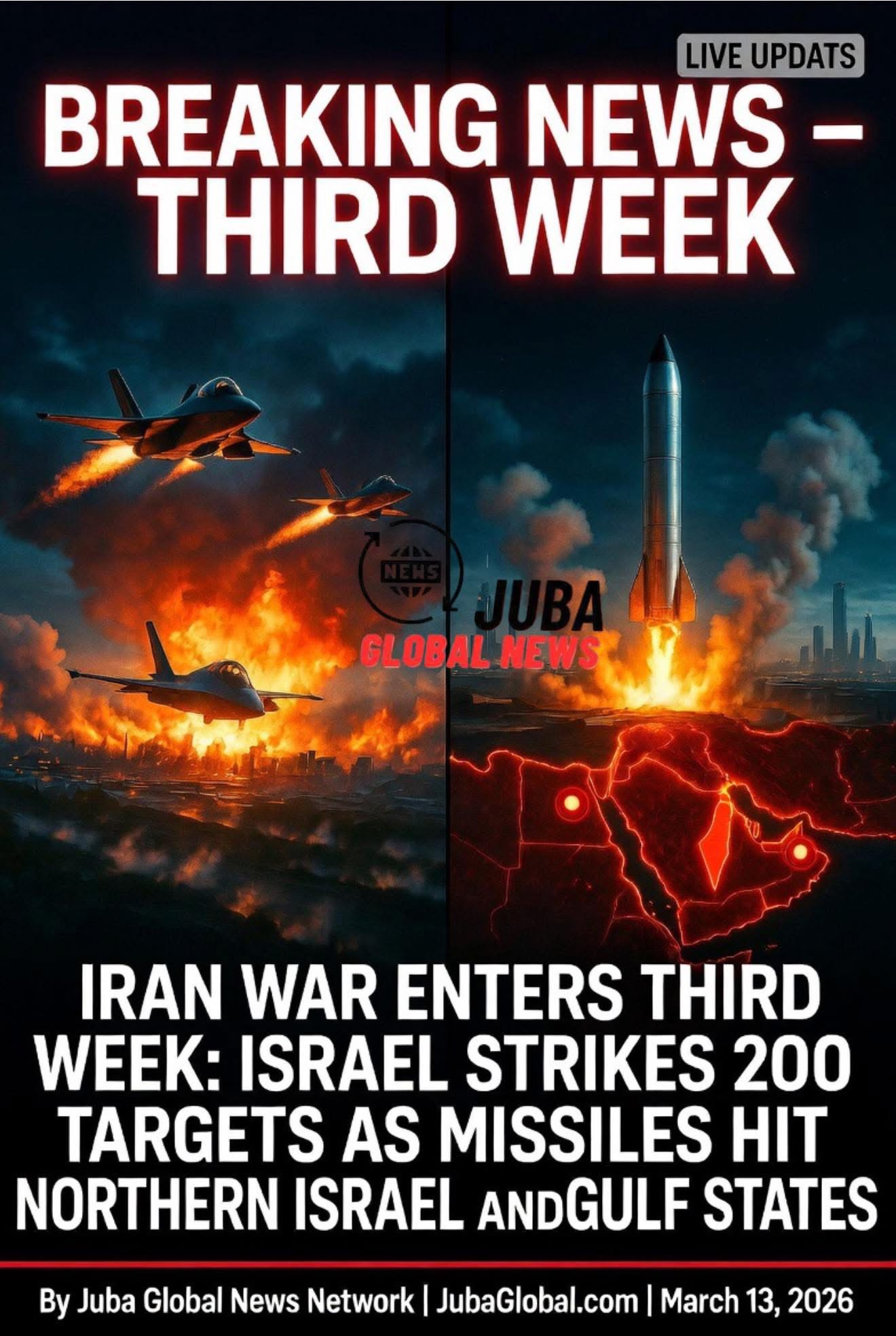
The US-Israeli war against Iran has now stretched into its third week, with no signs of de-escalation as fresh Israeli airstrikes pounded more than 200 targets across the Islamic Republic and Iranian missiles slammed into residential areas of northern Israel. At the same time, Tehran unleashed new waves of drones and missiles against Gulf Arab states hosting US military facilities, triggering explosions and black smoke in Dubai, intercepted barrages over Saudi Arabia, and heightened alerts across the region.
The conflict, which erupted on February 28 with surprise US-Israeli strikes that killed Iran’s Supreme Leader Ali Khamenei and top IRGC commanders, shows every sign of spiraling further. Israeli Prime Minister Benjamin Netanyahu and US President Donald Trump have both signaled continued resolve, while Iran’s new Supreme Leader Mojtaba Khamenei vowed unrelenting revenge.28
Massive Israeli Offensive: Over 200 Targets Hit in 24 Hours
In the past day alone, the Israel Defense Forces (IDF) announced that its fighter jets conducted hundreds of strike sorties, hitting more than 200 military and strategic targets in western and central Iran. Among the most significant was the nuclear-linked Taleghan compound at the Parchin military complex southeast of Tehran — a site Israel says Iran secretly rebuilt after previous strikes and used for high-explosive testing tied to its former nuclear weapons program.26
Satellite imagery released by independent analysts confirmed three large impact craters at the heavily fortified Taleghan 2 facility, which had been encased in concrete and buried under soil. The IDF described the operation as part of “Operation Roar of the Lion,” aimed at systematically degrading Iran’s missile production, air defenses, and command infrastructure.
Netanyahu issued a stark warning to Iran’s new leadership: “I wouldn’t issue life insurance policies on any of the leaders of the terrorist organizations. This is their patron of terrorism.” The strikes come amid Israeli claims that Iran’s ballistic missile arsenal has already been reduced by roughly 80 percent since the war began.
Iranian officials have accused the US and Israel of “carpet bombing” civilian areas, with strikes hitting not only military sites but also hospitals, schools, oil depots, and energy infrastructure around Tehran. Iranian Deputy Health Minister Ali Jafarian reported that 31 major clinical facilities have been damaged, with 12 now completely inactive. At least 1,395 Iranians have been killed, many civilians trapped under rubble.25
Iranian Retaliation Reaches Israeli Soil
Iran fired multiple ballistic missiles toward Israel overnight, with one confirmed impact in a residential area of northern Israel early Friday morning. Video footage captured the moment of detonation, showing flames erupting amid damaged vehicles and buildings. Sirens blared across Jerusalem, Tel Aviv, and northern communities as Israeli air defenses intercepted most incoming projectiles, but the strike marked the latest direct hit on civilian zones.27
Hezbollah, Iran’s key proxy in Lebanon, joined the barrage with over 100 rockets, forcing millions of Israelis into bomb shelters. Israeli officials report at least 13 deaths and nearly 2,000 injuries across the country since February 28.
Iran’s military also claimed successful drone strikes on Israeli airbases at Palmachim and Ovda, as well as the Shin Bet domestic security headquarters. Israel has not yet confirmed damage from those specific claims.25
Gulf States Under Fire: Explosions in Dubai and Beyond
The war’s ripple effects hit America’s Gulf allies hardest on Friday. Iran launched dozens of drones in multiple waves toward Saudi Arabia; Riyadh reported intercepting nearly 50. In the UAE, black smoke billowed from an industrial zone in Dubai after debris from interceptions sparked fires. Sirens sounded in Bahrain warning of incoming threats traced back toward Dubai.
The UAE alone has faced more than 1,800 drones and missiles since the conflict began, with recent strikes damaging areas near Dubai International Airport and even hitting the Dubai Creek Harbour Tower. Two foreign workers were killed in Oman when a drone was downed.3028
Iran’s new supreme leader, Mojtaba Khamenei, had warned Gulf nations just a day earlier to expel US bases or face consequences, calling American protection “nothing more than a lie.” Tehran has effectively shut down shipping through the Strait of Hormuz, the chokepoint for one-fifth of global oil and LNG, sending energy markets into turmoil.
Humanitarian Crisis and Civilian Toll Mount
Iranian parliament speaker Mohammad Baqer Qalibaf warned that any US aggression against Iranian islands in the Gulf — including the critical oil terminal Kharg Island — would force Tehran to “abandon all restraint.”
Inside Iran, the Red Crescent Society reports nearly 20,000 civilian buildings damaged, including 16,000 homes. Electricity shortages plague cities like Karaj, while air quality in Tehran has deteriorated sharply from strikes on energy infrastructure. Analysts note the tactics mirror Israel’s operations in Gaza, with systematic targeting of state institutions and public services.
In Israel, while military losses remain limited, civilian life has been upended by constant alerts and shelter runs.
Global and Diplomatic Fallout
President Trump, speaking after fresh Gulf attacks, threatened “major new retaliation,” boasting that the campaign against Iran was “moving very rapidly” and “doing very well.” Diplomatic efforts continue, with Russian leaders in close contact with Tehran and urging an immediate halt. Iranian President Masoud Pezeshkian has demanded reparations, recognition of Iran’s rights, and guarantees against future attacks in calls with Russia and Pakistan.25
Oil prices remain elevated above $100 per barrel as the Strait of Hormuz disruption and regional strikes halt exports. Global shipping routes have been rerouted, air travel disrupted, and stock markets volatile.
What Comes Next?
As the war enters its third week, both sides appear locked in a grinding attritional fight. Israel continues to pound Iranian missile infrastructure, while Iran relies on its remaining ballistic arsenal and proxy forces to impose costs on Israel and its Gulf partners. The involvement of Hezbollah, potential Houthi escalation, and the risk of direct US-Iran naval clashes in the Gulf keep the conflict on a knife-edge.
Juba Global News Network will continue providing live updates from the region. The human and economic cost is already staggering — and with no ceasefire in sight, the world watches anxiously as the Middle East war threatens to redraw the global energy and security landscape.
Stay informed. Visit JubaGlobal.com for continuing coverage.
#IranWar #MiddleEastCrisis #IsraelStrikes #GulfAttacks #GlobalNews