

Israeli military reportedly acknowledges ~70,000 killed in Gaza — Shift in reporting on conflict casualties, previously disputed; Rafah crossing with Egypt set to reopen Sunday for aid.
By Juba Global News Network Staff JubaGlobal.com Juba, South Sudan – January 30, 2026 In a development that has sparked cautious optimism amid one of the m
By Juba Global News Network Staff
JubaGlobal.com
Juba, South Sudan – January 30, 2026
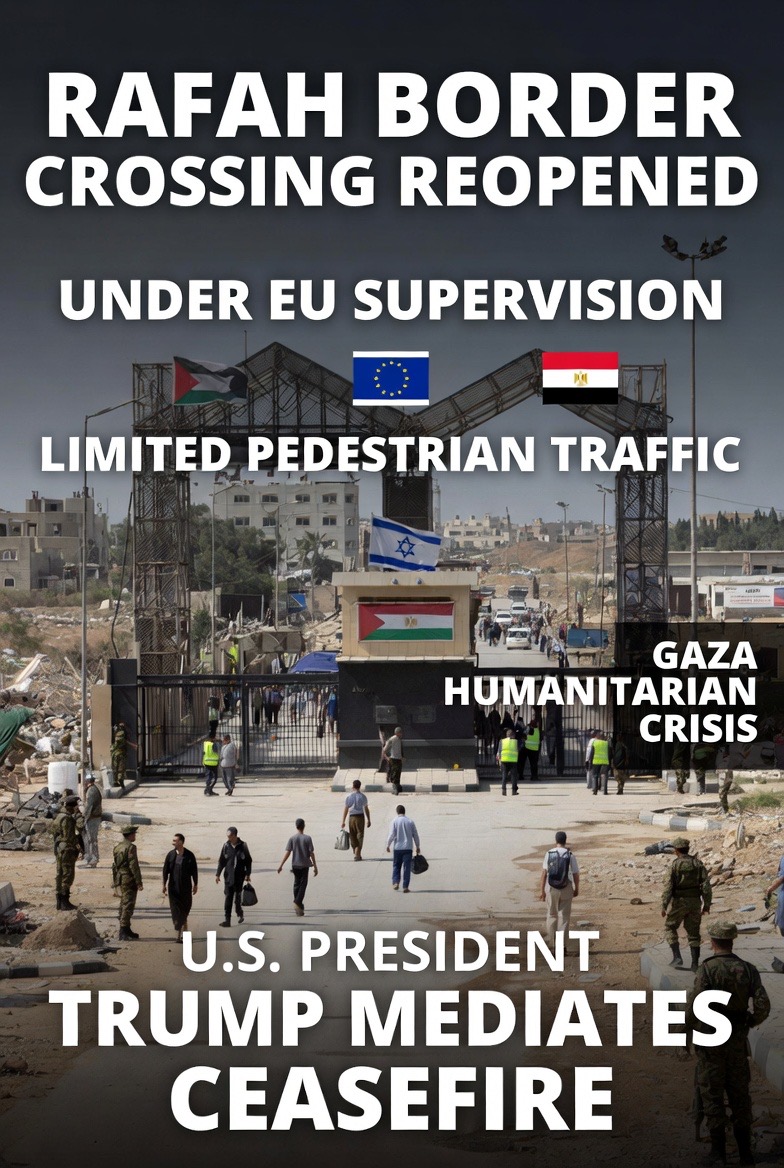
In a development that has sparked cautious optimism amid one of the most protracted humanitarian crises in recent history, Israel has officially announced the reopening of the Rafah border crossing between the Gaza Strip and Egypt. Set to commence operations this Sunday, February 1, 2026, the move ends nearly two years of near-total closure and represents a key milestone in the fragile U.S.-brokered ceasefire framework advanced under President Donald Trump’s administration.
The announcement, delivered by Israel’s Coordinator of Government Activities in the Territories (COGAT)—a defense ministry unit responsible for civilian affairs in the Palestinian territories—marks the first significant easing of movement in and out of Gaza since Israeli forces seized control of the crossing in May 2024. According to COGAT’s statement released on Friday, the Rafah crossing will reopen “in both directions, for limited movement of people only.”
Entry and exit will be strictly regulated: all individuals must undergo prior security clearance by Israel, with operations coordinated alongside Egyptian authorities and supervised by a European Union mission. The mechanism mirrors arrangements briefly tested in January 2025, emphasizing tight Israeli oversight to prevent any resurgence of militant activities or arms smuggling—concerns that prompted the initial seizure of the crossing.
A Lifeline Severed: The Impact of Prolonged Closure
For the more than 2 million residents of Gaza, the Rafah crossing has historically served as the territory’s primary window to the outside world. Unlike the Kerem Shalom and Erez crossings controlled directly by Israel, Rafah—located at Gaza’s southern border with Egypt’s Sinai Peninsula—offered Palestinians a route largely free from Israeli checkpoints for travel, medical evacuations, family reunifications, and the influx of humanitarian supplies.
The crossing’s near-total shutdown since May 2024 exacerbated an already dire situation. Aid organizations, including the United Nations Relief and Works Agency (UNRWA) and the World Health Organization, repeatedly warned that restricted access contributed to skyrocketing rates of malnutrition, untreated chronic illnesses, and preventable deaths. Thousands of wounded Palestinians requiring specialized treatment abroad remained stranded, while tens of thousands of Gazans who fled during the height of hostilities were unable to return home.
The closure formed part of Israel’s broader military strategy following the October 7, 2023, attacks by Hamas, which killed around 1,200 people in Israel and led to the capture of hostages. Israeli operations aimed to dismantle Hamas infrastructure, including alleged smuggling tunnels beneath Rafah. However, the prolonged blockade drew widespread international criticism, with accusations that it amounted to collective punishment and severely hampered humanitarian relief efforts.
The Human Cost: Acknowledgment of a Staggering Toll
The Rafah announcement arrives against the backdrop of Israel’s recent acknowledgment of the war’s devastating scale. For the first time, Israeli military sources have indicated that the death toll in Gaza—long disputed—is broadly accurate when aligned with figures from the Gaza Health Ministry.
Reports from Israeli media outlets, including Haaretz and The Times of Israel, cite senior security officials estimating that approximately 70,000 to 71,000 Palestinians have been killed by Israeli military actions since October 2023. This figure, excluding those still missing and presumed buried under rubble, closely matches the Gaza Health Ministry’s tally of over 71,000 direct deaths, with additional thousands believed trapped beneath destroyed buildings. While Israel continues to review breakdowns between civilians and combatants, the shift represents a departure from previous official skepticism toward the ministry’s data, which the United Nations and several human rights organizations have long deemed reliable.
The acknowledgment underscores the immense human suffering endured throughout the conflict and adds urgency to efforts aimed at stabilizing the region.
How the Reopening Will Work—and Its Limitations
Initial operations will remain highly restricted. Officials indicate that only dozens of individuals will be permitted to cross each day in the early stages—potentially 150–200 in total—prioritizing:
- Medically evacuated patients and their companions seeking treatment in Egypt or beyond.
- Palestinians who fled Gaza during the war and are now cleared to return.
- Limited family reunifications under exceptional humanitarian grounds.
No commercial goods, humanitarian aid convoys, or large-scale traffic will be allowed at first. Discussions are ongoing regarding exact daily quotas and expansion timelines. A Palestinian administrative committee official involved in Gaza governance described the Sunday opening as a “trial run,” with full bidirectional flow potentially beginning Monday.
The involvement of the European Union mission is intended to provide neutral oversight and build confidence among all parties. Egypt, which has historically maintained strict controls on its side due to security threats in Sinai, has signaled readiness to cooperate under the ceasefire terms.
Broader Implications in a Fragile Ceasefire
This development is widely viewed as entering the second phase of the U.S.-mediated ceasefire, which has held tenuously since late 2025. The recovery of the remains of the last known Israeli hostage earlier this week removed a major Israeli precondition for advancing normalization measures at Rafah.
For Palestinians, the reopening offers a rare glimmer of hope after years of isolation. Humanitarian groups have hailed the step as essential for addressing urgent medical needs and reuniting families. Yet many express caution, noting that without eventual expansion to include aid shipments, the impact on Gaza’s broader crisis—widespread destruction, displacement, and shortages—will remain limited.
From Israel’s perspective, maintaining security veto power over crossings aligns with long-standing demands to prevent Hamas rearmament. Prime Minister Benjamin Netanyahu has emphasized that any easing will be “limited and controlled,” reflecting domestic political pressures to avoid perceptions of concessions.
As the world watches Sunday’s developments, the Rafah crossing’s partial reopening stands as both a practical measure and a symbolic one—a tentative bridge in a region long divided by conflict, blockade, and mistrust.
Juba Global News Network will continue to monitor the situation and provide updates as operations begin. For the latest developments, follow our live coverage at JubaGlobal.com.