Hong Kong National Security Trial Begins for Tiananmen Vigil Organizers: A Landmark Case Under Beijing’s Crackdown
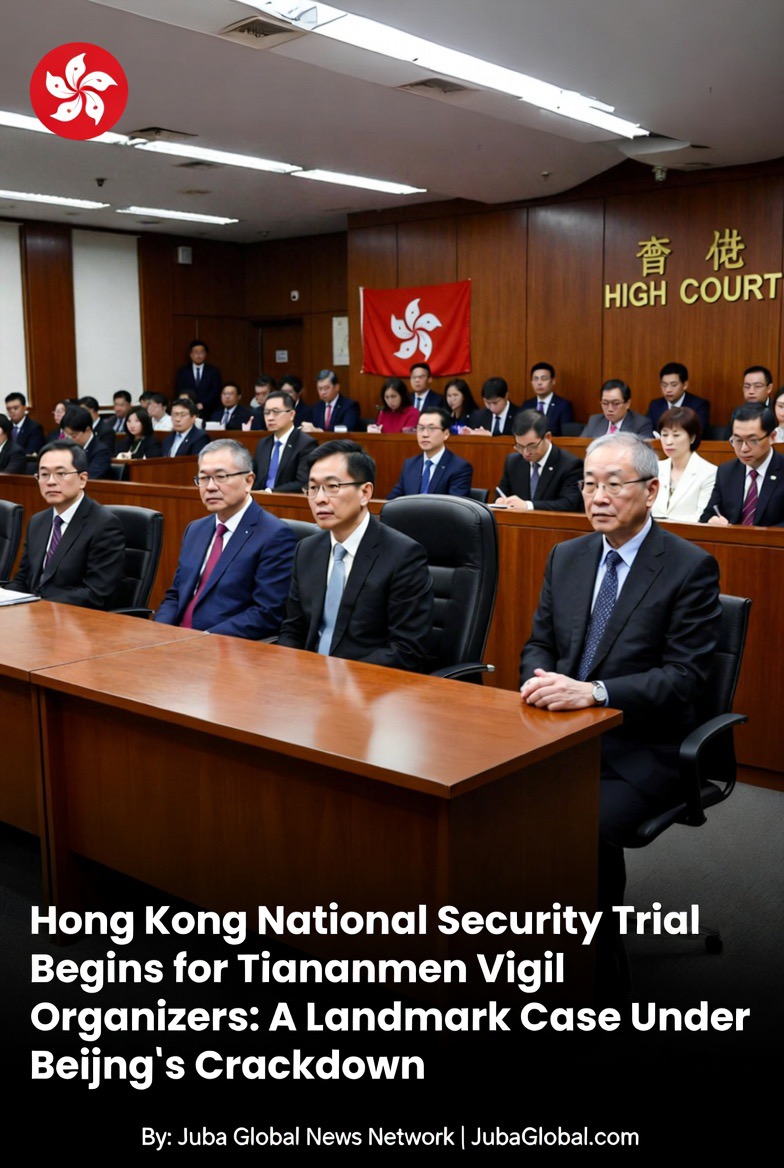
January 22, 2026 — In a courtroom in Hong Kong’s High Court today, one of the most symbolically powerful national security trials since the 2020 imposition of Beijing’s sweeping security law officially commenced. Three former leaders of the now-dissolved Hong Kong Alliance in Support of Patriotic Democratic Movements of China—Chow Hang-tung, Lee Cheuk-yan, and Albert Ho—stand accused of “inciting subversion of state power” through their decades-long organization of the city’s annual June 4 candlelight vigils commemorating the victims of the 1989 Tiananmen Square crackdown.
The case, which has already been listed as one of the most closely watched political prosecutions in Hong Kong’s post-2019 era, is being heard by three hand-picked national security judges without a jury—a standard feature of cases brought under Article 22 of the National Security Law. If convicted, each defendant faces a maximum sentence of life imprisonment, although prosecutors are seeking terms of up to 10 years.
The Defendants and the Charges
- Chow Hang-tung (40), former vice-convener of the Alliance and a trained lawyer, has been detained since September 2021—over 1,600 days as of today—after multiple bail applications were rejected on national security grounds. She pleaded not guilty and remains one of the most vocal critics of the security law from inside prison.
- Lee Cheuk-yan (68), veteran trade unionist, former Legislative Council member, and one of Hong Kong’s most respected pro-democracy figures, also entered a not-guilty plea. Known for his calm demeanor and long record of labor and human-rights advocacy, Lee has spent much of the past four years in custody.
- Albert Ho (74), former chairman of the Democratic Party and a senior counsel, chose to plead guilty—potentially in the hope of receiving a reduced sentence. Ho, who has been a fixture in Hong Kong’s democratic movement since the 1980s, is widely respected across political lines.
The prosecution alleges that the three defendants, through their leadership roles in the Alliance, repeatedly incited others to subvert state power by:
- Maintaining the organization’s founding objective of “ending one-party dictatorship” in China
- Continuing to organize and promote the annual Victoria Park vigil after public commemorations were banned in 2020
- Using the vigil platform to criticize the Chinese Communist Party and advocate for political reform on the mainland
Prosecutors argue that these actions violate Article 22 of the National Security Law, which criminalizes “incitement to subversion” even when carried out through peaceful assembly or speech.
Historical Weight of the Tiananmen Vigil
For more than three decades, the June 4 candlelight vigil in Victoria Park was the largest and most consistent public commemoration of the Tiananmen massacre anywhere under Beijing’s jurisdiction. Tens of thousands of Hong Kong residents gathered each year to light candles, sing protest songs, hear survivor testimonies, and demand accountability from the Chinese government.
The vigil was not merely an act of remembrance; it was a living assertion of Hong Kong’s distinct identity and relative political freedoms under the “one country, two systems” framework. Its annual recurrence stood in stark contrast to the enforced silence on the mainland.
After the 2019 anti-extradition protests and the subsequent imposition of the national security law, authorities banned the vigil citing COVID-19 restrictions—a prohibition that has never been lifted. Police arrested participants who attempted small-scale commemorations, and the Alliance itself was forced to disband in 2021 after its assets were frozen.
The current trial is widely viewed as the final legal extinguishment of organized public memory of June 4 in Hong Kong.
The Trial’s Broader Context
The proceedings unfold against a backdrop of dramatic contraction of civic space in Hong Kong:
- Almost all major pro-democracy organizations, trade unions, and media outlets have been disbanded or silenced
- Independent journalism has been severely curtailed following the closure of Apple Daily and the arrests of dozens of journalists and editors
- Over 300 individuals have been arrested under the national security law, with a near-100% conviction rate in completed cases
- The last remaining elected district council seats that were once controlled by pro-democracy candidates were swept by pro-establishment figures in the 2023 “patriots-only” election
Chow Hang-tung, in particular, has become an international symbol of resistance. Despite prolonged solitary confinement and repeated bail denials, she has continued to write essays and legal arguments from prison, many of which have been smuggled out and published abroad.
International Reactions
Western governments, human rights organizations, and press freedom groups issued strong statements on the opening day of the trial:
- The U.S. State Department called the case “a further erosion of the rights and freedoms promised to Hong Kong” and urged Beijing to release the defendants.
- The European Union described the prosecution as “the criminalization of peaceful remembrance and civic participation.”
- Amnesty International labeled the trial “a grotesque attempt to erase the memory of Tiananmen from public consciousness.”
- The Committee to Protect Journalists and Reporters Without Borders highlighted the case as part of a pattern of using national security legislation to silence historical truth-telling.
China’s Ministry of Foreign Affairs and Hong Kong government officials defended the prosecution, insisting that the case is purely about upholding national security and has nothing to do with suppressing free speech or historical commemoration.
What the Trial Means for Hong Kong’s Future
Legal scholars and political analysts see the case as a definitive marker:
- It confirms that even non-violent, long-standing civic traditions—once tolerated under British rule and the early post-handover period—are now prosecutable offenses.
- It demonstrates Beijing’s determination to eliminate any organized platform that could serve as a focal point for dissent or alternative historical narratives.
- It sends a chilling message to younger generations that certain topics (Tiananmen, one-party rule, democratic reform on the mainland) are permanently off-limits.
Regardless of the verdicts—widely expected to be guilty—the trial itself is already a form of historical erasure. By turning the organizers of the world’s largest annual Tiananmen vigil into national security defendants, Beijing is attempting to close the final public chapter of June 4 memory in the only Chinese territory where it was ever openly observed.
As the proceedings continue over the coming months, Hong Kong—and the world—will witness not just a legal case, but a stark illustration of how far the city’s political and civic landscape has been transformed in less than six years.