

Global Travel in Chaos: Airfares Soar, Trips Diverted Due to Iran War Disruptions
By Juba Global News Network Staff JubaGlobal.com March 13, 2026 The escalating US-Israeli war against Iran has plunged international air travel into unprec
By Juba Global News Network Staff
JubaGlobal.com
March 13, 2026
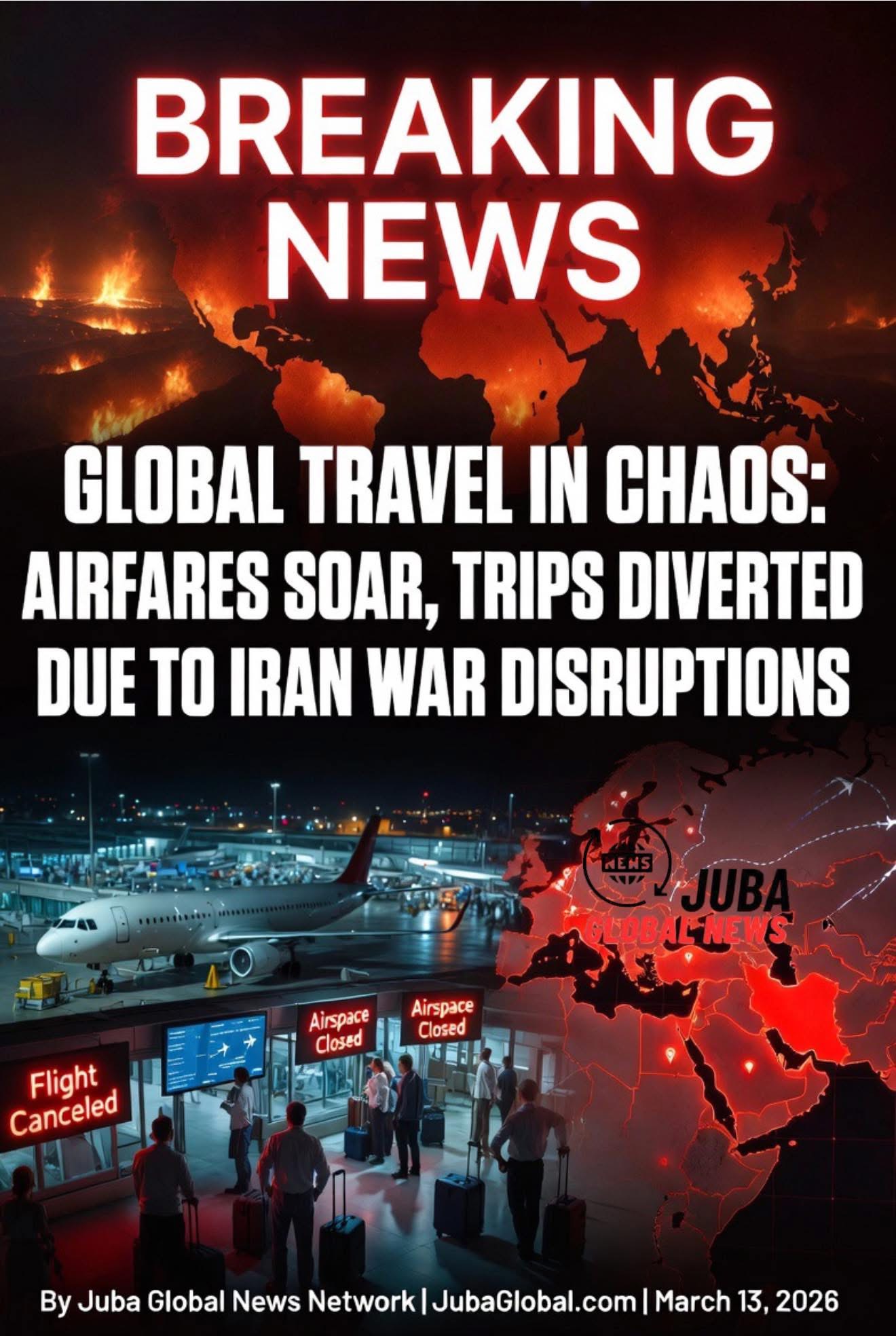
The escalating US-Israeli war against Iran has plunged international air travel into unprecedented disarray, with airlines rerouting dozens of long-haul flights, canceling hundreds of others, imposing massive fuel surcharges, and driving average airfares to levels not seen since the immediate aftermath of the 2022 energy shock. As the conflict enters its third week, the combination of closed airspace over large parts of the Middle East, missile and drone threats, skyrocketing jet fuel prices, and insurance premiums that have tripled in days has turned dream vacations, business trips, and family reunions into logistical nightmares for millions of travelers worldwide.
Airspace Closures and Rerouting Havoc
Since February 28, when the opening strikes killed Iran’s Supreme Leader and triggered retaliatory barrages, civil aviation authorities have progressively shut down or severely restricted airspace across Iran, Iraq, parts of Syria, Lebanon, and — most critically — the Persian Gulf region. The United Arab Emirates, Qatar, Bahrain, Kuwait, and Oman have all issued NOTAMs (Notices to Airmen) warning of “high risk of missile activity” and “unpredictable military operations,” forcing carriers to avoid the entire Gulf airspace corridor.
Major long-haul routes that once crossed Iranian or Gulf airspace — including Europe to India, Southeast Asia to the Middle East, and transcontinental flights from North America to Asia via the “great circle” path — are now being diverted south over Saudi Arabia (when permitted), west over Egypt and the Mediterranean, or — increasingly — around the entire African continent. These detours add anywhere from 2 to 7 hours to flight times and burn 15–40% more fuel, costs that airlines are passing directly to passengers.
Emirates, Qatar Airways, Etihad, Turkish Airlines, Lufthansa, British Airways, and Air France-KLM have all announced “temporary route adjustments” lasting “until further notice.” Singapore Airlines, Cathay Pacific, and Qantas have suspended or heavily curtailed flights to Gulf destinations altogether. Delta, United, and American have canceled or rerouted codeshare flights involving Gulf partners.
Ticket Prices Explode
Industry data compiled by travel analytics firms shows average one-way fares on affected routes have risen 80–250% in the past two weeks:
- New York to Dubai: up from ~$650 to $1,800–$2,400
- London to Mumbai: up from ~£450 to £1,200–£1,800
- Frankfurt to Bangkok: up from €550 to €1,400–€2,100
- Los Angeles to Singapore (via rerouted paths): up from $900 to $2,200+
Fuel surcharges alone have jumped from $100–$200 per ticket to $400–$800 on many long-haul routes. Dynamic pricing algorithms, reacting in real time to jet fuel costs (now tracking crude oil above $100/barrel), are pushing last-minute bookings even higher.
Travel insurance providers have added war-risk exclusions or hiked premiums by 300–500% for trips including the Middle East, Gulf states, Israel, Lebanon, or Iran. Many policies now explicitly exclude coverage for flight cancellations or delays caused by “acts of war” or “hostile military action.”
Passenger Stories and Cancellations
Social media and travel forums are filled with stories of ruined plans:
- A family of five from Chicago saw their spring-break trip to Dubai turn into a 36-hour odyssey via London–Cairo–Nairobi–Dubai, with the total cost nearly tripling.
- A German business delegation canceled a critical conference in Abu Dhabi after their return flight via Doha was scrapped; alternative routing added €4,000 per person and two extra days.
- Thousands of Indian and Pakistani workers in the Gulf are stranded as repatriation flights are grounded or delayed indefinitely.
- Honeymooners in Europe report losing non-refundable deposits after airlines canceled connecting flights through Istanbul or Doha without offering viable alternatives.
Major online travel agencies (Expedia, Booking.com, Kayak) have added prominent warnings: “Due to ongoing regional conflict, many flights to/from the Middle East may be canceled, rerouted, or significantly more expensive. Check with airlines directly.”
Airlines Under Strain
Carriers are burning through cash at alarming rates. Extra fuel burn, higher insurance, crew fatigue from longer sectors, and compensation payouts under EU261/UK261 and similar regulations are compounding losses already incurred from two weeks of disrupted operations. Several low-cost carriers have warned they may ground aircraft or cut routes entirely if the situation persists into April.
Airport operators in Dubai, Doha, Abu Dhabi, Bahrain, and Riyadh report sharp drops in passenger throughput — down 60–85% on international arrivals — while European and Asian hubs face severe congestion from diverted flights.
Broader Travel Industry Fallout
Cruise lines have rerouted or canceled Gulf and Red Sea itineraries. Luxury tour operators specializing in the Middle East have suspended departures until at least June. Hotel occupancy in Dubai and Abu Dhabi has plummeted as conference cancellations cascade and leisure travelers stay away.
The International Air Transport Association (IATA) has called the disruption “one of the most severe for global connectivity since the 9/11 attacks,” estimating industry-wide revenue losses in the billions if the conflict continues through Q2 2026.
Advice for Travelers
Travel experts and government advisories now recommend:
- Avoid all non-essential travel to or through the Middle East, Gulf states, Israel, Lebanon, and Iran.
- Book flexible or refundable tickets when possible.
- Purchase comprehensive travel insurance that explicitly covers war, terrorism, and civil unrest (though coverage is increasingly limited).
- Monitor airline and government alerts daily — situations change hourly.
- Consider alternative destinations in Europe, Southeast Asia, or the Americas for upcoming trips.
As missiles continue to fly, oil prices remain elevated, and airspace remains contested, the dream of seamless global travel feels more distant than ever. For millions, the Iran war is no longer just a geopolitical headline — it is a very personal disruption to plans, budgets, and peace of mind.
Juba Global News Network will continue tracking the aviation crisis as the conflict evolves.
Stay informed. Visit JubaGlobal.com for live travel alerts and updates.
#TravelChaos #IranWarImpact #AviationCrisis #Airfares #MiddleEastTravel #GlobalTravel #JubaGlobal
