

Global Supply Chain Disruptions Worsen as Tanker Rerouting, Insurance Rates Explode, and Asian Economies Brace for Shortages
By Juba Global News Network | JubaGlobal.comMarch 15, 2026 The cascading effects of Iran’s closure of the Strait of Hormuz and the ongoing US-Israel milita
By Juba Global News Network | JubaGlobal.comMarch 15, 2026
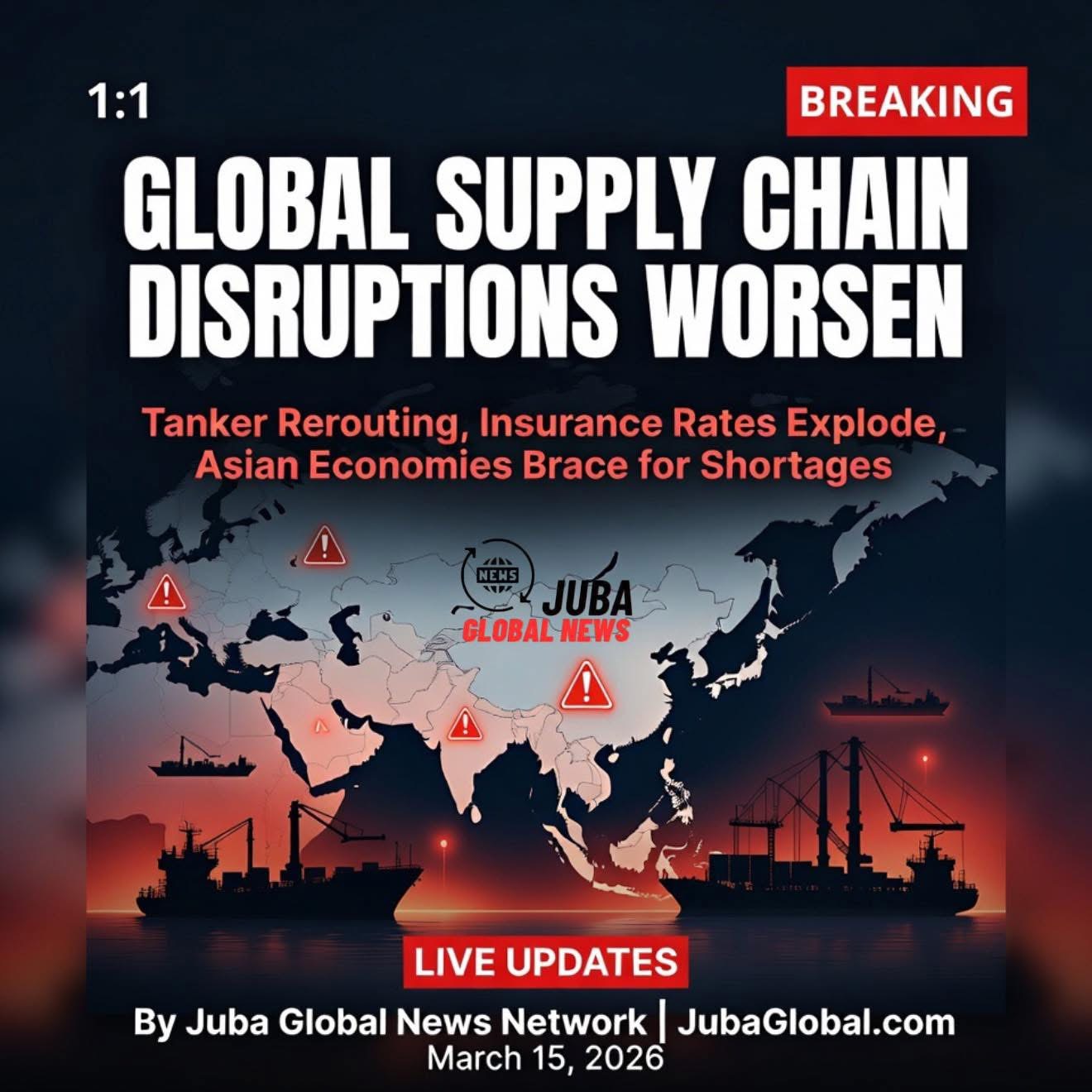
The cascading effects of Iran’s closure of the Strait of Hormuz and the ongoing US-Israel military campaign are now rippling far beyond oil prices, triggering the most severe global supply-chain shock since the early months of the COVID-19 pandemic. With nearly all major tanker operators declaring force majeure on Persian Gulf voyages, shipping insurance premiums surging 500–700 percent, and voyage times extended by up to 14 days via the Cape of Good Hope, manufacturers, retailers, and governments worldwide are scrambling to secure alternative supplies and ration critical feedstocks.
The International Energy Agency (IEA) released an emergency assessment on March 15 estimating that seaborne crude and product flows through the Strait have fallen by more than 85 percent since late February. Approximately 21 million barrels per day—roughly one-fifth of global oil consumption—normally transit the 21-mile-wide chokepoint. Current rerouting has already added an estimated 1.2–1.5 million barrels per day of effective supply loss due to longer transit times and vessel unavailability, even as Saudi Arabia, the UAE, and the United States have begun releasing strategic reserves.
Major Asian importers are bearing the brunt. China, Japan, South Korea, and India together source 70–85 percent of their crude from the Gulf. Chinese state-owned refiners have reportedly cut throughput at several coastal plants by 15–25 percent, while independent “teapot” refineries in Shandong province have been forced to idle units due to unpriced feedstock. Japan’s Ministry of Economy, Trade and Industry announced the release of 4.2 million barrels from national stockpiles—the first drawdown since the 2011 Fukushima crisis—while South Korea warned of possible rolling refinery cuts and jet-fuel rationing for civilian aviation if disruptions persist beyond mid-April.
In Europe, diesel and naphtha prices have risen even faster than crude benchmarks. German chemical giant BASF issued a force majeure notice on several key intermediates, citing “unprecedented feedstock cost volatility and availability constraints.” French President Emmanuel Macron convened an emergency EU energy ministers’ meeting in Brussels, where officials discussed coordinated release of strategic petroleum reserves and emergency LNG diversion from the United States.
Shipping lines have been hit hardest. Maersk, MSC, CMA CGM, and Hapag-Lloyd have collectively suspended or rerouted more than 120 Gulf-bound voyages in the past two weeks. The Baltic Dry Index (capesize segment) has spiked 240 percent in 18 days—the fastest rise on record—as charter rates for very large crude carriers (VLCCs) climb toward $180,000 per day. War-risk premiums for vessels entering the Persian Gulf have reached levels last seen during the 1980s Tanker War, with some underwriters refusing coverage entirely.
Manufacturers reliant on petrochemical feedstocks are already curtailing output. Indian polymer producers have announced 20–30 percent production cuts, while South Korean petrochemical complexes face potential shutdowns of naphtha crackers. European fertilizer producers warn of imminent ammonia and urea shortages that could impact spring planting in the Northern Hemisphere. Automotive plants in Germany, Japan, and the United States are preparing contingency plans for plastic-component shortages.
US consumers are beginning to feel secondary effects. While domestic crude production remains robust, refinery margins have widened dramatically on imported product constraints, pushing retail gasoline prices toward $4.30–$4.60 per gallon in the Midwest and Northeast. Jet fuel surcharges are appearing on international routes, and trucking companies have announced 8–12 percent rate increases effective April 1.
President Donald Trump addressed the supply-chain crisis during a brief White House remarks session on March 15: “We have more oil and gas than anyone. We’re pumping record amounts. The world needs to help secure the Strait so prices come down fast. If they don’t, we’ll do what we have to do—alone if necessary—and the American energy industry will fill the gap.”
Analysts at Goldman Sachs and Morgan Stanley now project Brent crude averaging $115–$130 per barrel through Q2 2026 in their base-case scenarios if the Strait remains closed, with tail risks pushing toward $180+ in a worst-case escalation. The World Bank warned that sustained $120+ oil could shave 0.8–1.2 percentage points off global GDP growth in 2026, with developing economies hit hardest.
Back-channel diplomacy continues. Omani and Qatari mediators report that Iran has floated a proposal to allow limited tanker traffic (estimated 4–6 million barrels per day) in exchange for partial sanctions relief and a temporary halt to coalition strikes on oil-adjacent infrastructure. US officials have described the offer as “insufficient” but have not rejected talks outright.
As container ships, bulk carriers, and product tankers reroute around Africa, the world is witnessing the fragility of just-in-time global supply chains when the narrowest of maritime bottlenecks is weaponized. The coming weeks will determine whether diplomacy reopens the Strait, strategic reserves bridge the gap, or the world enters a prolonged period of energy rationing, inflation, and industrial slowdown.
Juba Global News Network’s supply-chain desk is tracking vessel movements, refinery run-rates, inventory draws, and force majeure notices in real time. For live AIS tanker maps, petrochemical price trackers, reserve-release timelines, and exclusive interviews with shipping executives, visit JubaGlobal.com.
Related Coverage:
- Global oil prices surge past $105 amid Hormuz blockade fears
- Trump urges multinational naval coalition to secure Strait
- Mojtaba Khamenei vows “crushing revenge” in major address
- Hezbollah rocket barrages intensify as Lebanon incursion looms
- FBI warns of heightened domestic terror risk from Iran-linked actors
Stay informed. Stay prepared. Juba Global News Network — reporting the truth from ports, refineries, and capitals worldwide.
