

Funding Gaps Threaten 2 Million Displaced in South Sudan: IOM Sounds Alarm Amid Sudan Spillover
By Juba Global News Network | JubaGlobal.com Published: February 26, 2026 South Sudan, the world’s youngest nation, continues to grapple with one of the mo
By Juba Global News Network | JubaGlobal.com
Published: February 26, 2026
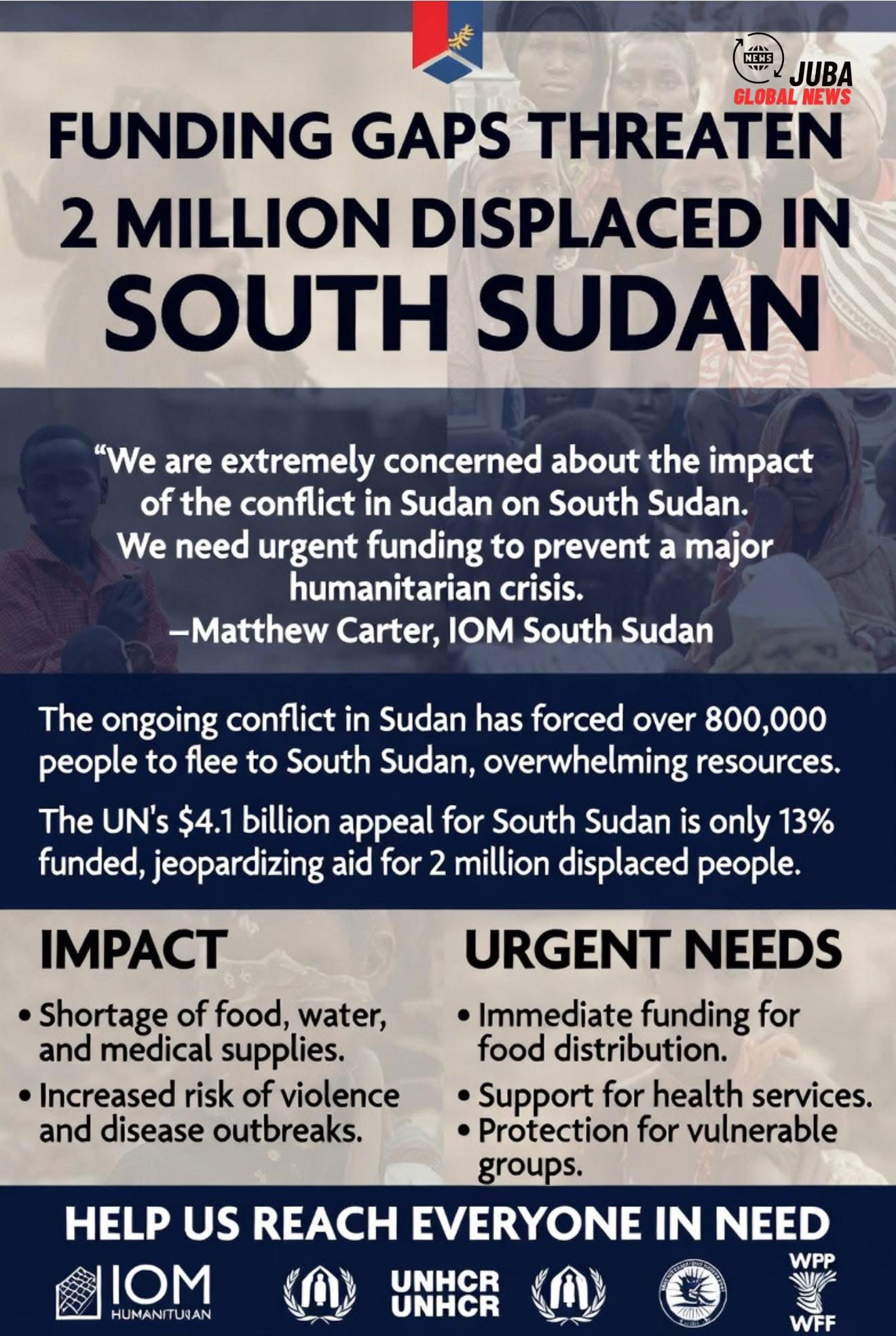
South Sudan, the world’s youngest nation, continues to grapple with one of the most protracted and severe humanitarian crises on the planet. As of late February 2026, the International Organization for Migration (IOM) has issued a stark warning: critical funding shortfalls are placing the lives of over 1.9 million displaced people at immediate risk. With humanitarian needs surging due to ongoing internal conflicts, climate shocks, and massive inflows from neighboring Sudan’s devastating war, the gap in resources threatens to reverse hard-won progress toward stability and durable solutions for millions.
The Scale of Displacement in South Sudan
South Sudan remains among the top global displacement crises. According to IOM’s Displacement Tracking Matrix (DTM), more than 1.9 million people are currently internally displaced within the country. This figure includes those uprooted by inter-communal violence, localized conflicts in states like Jonglei and Upper Nile, recurrent flooding, and food insecurity that has pushed communities to flee their homes.
Compounding this internal crisis is the massive spillover from Sudan’s civil war, now in its third year since erupting in April 2023. Since the conflict began, more than 1.3 million people have crossed into South Sudan from Sudan. Remarkably, 67% of these arrivals are South Sudanese returnees—individuals who had sought refuge in Sudan during earlier South Sudanese conflicts but are now fleeing back amid the chaos there. These returnees arrive in border areas already strained by limited infrastructure, overstretched services, and fragile security.
The result is a compounding burden: nearly 10 million people in South Sudan—roughly two-thirds of the population—require humanitarian assistance in 2026. This includes internally displaced persons (IDPs), returnees, host communities, and refugees. Border communities in Upper Nile and Unity states, in particular, face acute pressure as new arrivals overwhelm reception centers, transit sites, and local resources.
IOM’s Dire Warning and the $29 Million Funding Gap
On February 25, 2026, IOM released a urgent statement from Geneva and Juba highlighting the crisis. The agency requires just over $131 million to implement its 2026 humanitarian response plan in South Sudan. Yet it faces a $29 million funding shortfall—a gap that directly jeopardizes life-saving operations.
“Critical funding shortfalls are putting the lives of over 1.9 million displaced people in South Sudan at risk,” the IOM statement declared. The warning comes as global humanitarian budgets face unprecedented pressure, with major donors—including the United States under the current administration—slashing foreign aid allocations. This broader squeeze on international funding has left agencies like IOM struggling to meet escalating demands across multiple crises.
IOM Deputy Director General for Operations, Ugochi Daniels, who is currently visiting South Sudan, emphasized the stakes: “South Sudan is carrying an extraordinary burden, and funding shortfalls risk undermining progress toward durable solutions for millions.”
Without the missing funds, IOM’s core activities—such as camp coordination, shelter provision, water and sanitation services (WASH), health support, protection monitoring, and movement assistance—face severe cuts. These services are essential for preventing disease outbreaks (including cholera and malaria), ensuring safe relocation for returnees, and supporting vulnerable groups like women, children, and the elderly who make up the majority of displaced populations.
The Sudan Spillover: A Crisis Within a Crisis
The war in Sudan between the Sudanese Armed Forces (SAF) and the Rapid Support Forces (RSF) has created the world’s largest displacement emergency, with over 15 million people displaced since April 2023. South Sudan has borne a disproportionate share of the cross-border impact.
Returnees from Sudan often arrive malnourished, traumatized, and without possessions after treacherous journeys. Many cross at informal border points lacking adequate screening or support, increasing risks of exploitation, gender-based violence, and disease transmission. In areas like Renk in Upper Nile State, transit centers have seen surges in arrivals, straining already limited capacity.
This influx exacerbates local tensions. Host communities, themselves affected by food shortages and climate extremes, sometimes resent the competition for scarce resources. Meanwhile, returnees face challenges reintegrating into areas where infrastructure has deteriorated and land disputes remain unresolved.
Broader Context: Intersecting Crises in South Sudan
The funding gap does not exist in isolation. South Sudan’s humanitarian landscape is shaped by multiple overlapping emergencies:
• Conflict and Insecurity: Renewed clashes in Jonglei State have displaced hundreds of thousands in early 2026 alone, with IOM verifying over 225,000 displaced in the state by mid-February. Forced recruitment, inflammatory rhetoric, and inter-communal violence raise fears of escalating atrocities.
• Climate and Food Insecurity: Recurrent flooding and drought have destroyed crops and livestock, contributing to acute malnutrition. Nearly half the population faces severe hunger.
• Health Outbreaks: Damaged infrastructure and overcrowding in displacement sites fuel cholera, malaria, and other preventable diseases.
• Political Delays: The extension of the transitional period to 2027 has delayed elections, prolonging uncertainty and hindering long-term recovery.
These factors create a vicious cycle: displacement drives needs higher, but funding shortfalls limit response capacity, prolonging vulnerability and potentially sparking further instability.
Calls for Action and Paths Forward
IOM and partners urge donors to prioritize South Sudan in 2026 funding appeals. Key recommendations include:
• Immediate bridging funds to close the $29 million IOM gap and prevent service disruptions.
• Increased support for cross-border coordination with Sudan to manage return flows humanely.
• Investment in durable solutions, such as community stabilization, livelihood programs, and infrastructure in border areas.
• Greater focus on protection for vulnerable groups, including women and children facing heightened risks.
South Sudan’s government, through entities like the Relief and Rehabilitation Commission (RRC), continues to lead response efforts, but relies heavily on international partners amid limited domestic resources.
As Ugochi Daniels noted during her visit, South Sudan cannot shoulder this burden alone. Without sustained global solidarity, the world’s youngest nation risks sliding deeper into crisis—with consequences that could reverberate across the Horn of Africa.
Juba Global News Network will continue monitoring developments in South Sudan’s humanitarian landscape. For the latest updates, visit JubaGlobal.com.
Sources: IOM official statements (February 25, 2026), DTM data, UN reports, and related humanitarian analyses.
