

Expiration of U.S.-Russia New START Treaty Sparks Fears of a New Nuclear Arms Race
By: Juba Global News Network | JubaGlobal.com On February 5, 2026, the New Strategic Arms Reduction Treaty (New START)—the last remaining bilateral nuclear
By: Juba Global News Network | JubaGlobal.com
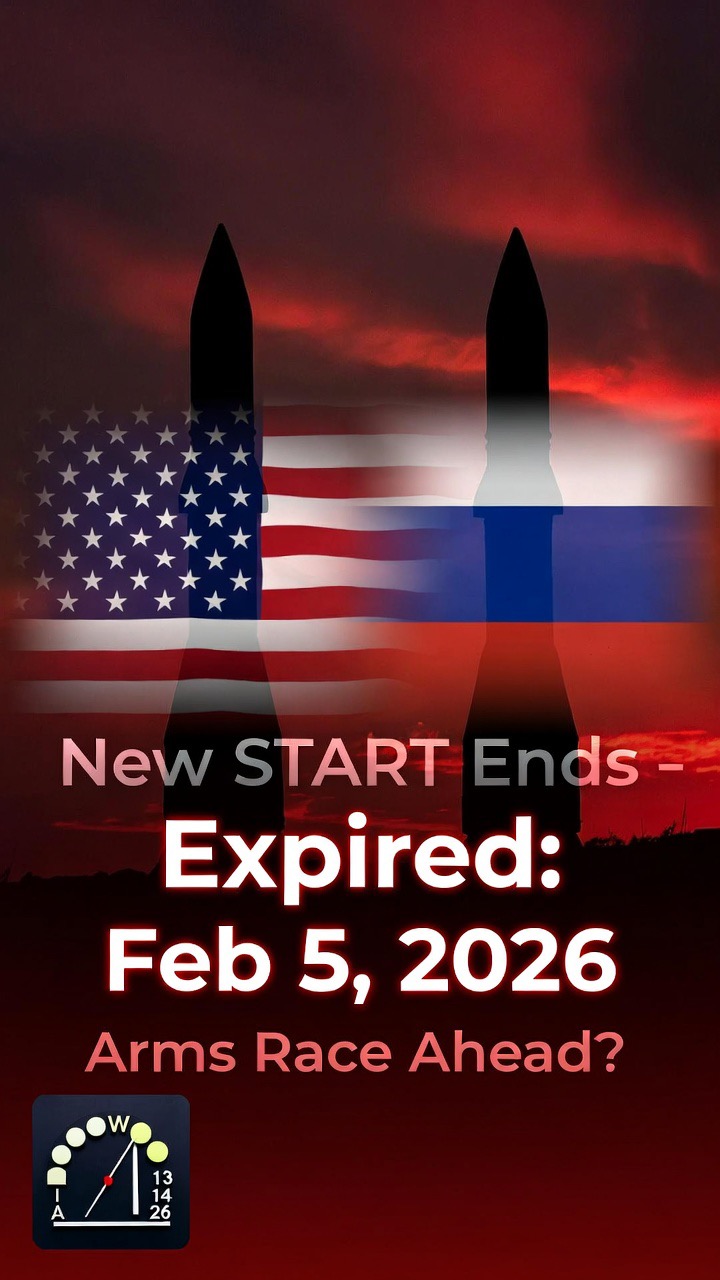
On February 5, 2026, the New Strategic Arms Reduction Treaty (New START)—the last remaining bilateral nuclear arms control agreement between the United States and Russia—officially expired at midnight GMT. For the first time in more than half a century, the world’s two largest nuclear powers are no longer bound by verifiable limits on their strategic nuclear arsenals, ushering in an era of unprecedented uncertainty and heightened global nuclear risk.
The treaty, originally signed in 2010 by Presidents Barack Obama and Dmitry Medvedev and extended for five years in 2021 under the Biden administration, capped each side at 1,550 deployed strategic nuclear warheads on up to 700 deployed intercontinental ballistic missiles (ICBMs), submarine-launched ballistic missiles (SLBMs), and heavy bombers, with an overall limit of 800 deployed and non-deployed launchers. It also established robust verification mechanisms, including on-site inspections, data exchanges, and notifications—elements that provided transparency and predictability in U.S.-Russian strategic relations since the Cold War era.
With the treaty’s expiration, these constraints vanish. Experts warn this could accelerate nuclear modernization programs, enable rapid “uploading” of additional warheads onto existing delivery systems, and fuel a dangerous three-way arms competition involving the United States, Russia, and China.
The Road to Expiration: Failed Negotiations and Geopolitical Tensions
New START was designed with a 10-year term (expiring February 5, 2021) and one possible five-year extension, which both parties exercised amid hopes for a follow-on agreement. However, Russia’s full-scale invasion of Ukraine in February 2022 severely damaged bilateral trust. In 2023, Moscow suspended its participation in treaty inspections and data exchanges, citing Western support for Ukraine and concerns over NATO’s nuclear posture. The U.S. responded with countermeasures, declaring Russia’s actions a material breach.
Despite these strains, informal adherence to the numerical limits persisted for a time. In September 2025, Russian President Vladimir Putin proposed that both nations continue observing New START’s central limits for one year post-expiration, with potential for extension if the U.S. reciprocated without undermining strategic balance. President Donald Trump initially described the idea as sounding “like a good idea,” but later remarked, “If it expires, it expires. We’ll do a better agreement,” emphasizing inclusion of China in future talks. No formal U.S. response materialized, and negotiations never advanced.
The treaty could not be extended further without re-ratification—a politically improbable path given U.S. Senate requirements and ongoing tensions. As a result, February 5, 2026, marked the end without a successor framework.
Immediate Implications: Loss of Transparency and Verification
The treaty’s demise eliminates critical stabilizing mechanisms:
• No more biannual data exchanges on deployed forces.
• No on-site inspections to verify compliance.
• No notifications for missile tests or movements.
This “transparency gap” increases the risk of miscalculation. Without reliable information on the other’s arsenal size, composition, or readiness, each side may assume the worst, prompting precautionary buildups or heightened alert postures.
UN Secretary-General António Guterres described the expiration as a “grave moment for international peace and security,” noting that for the first time in over 50 years, the world lacks binding limits on U.S. and Russian strategic nuclear forces. He urged both nations to return swiftly to negotiations.
The Emerging Three-Way Dynamic: Russia, U.S., and China
Russia continues modernizing its arsenal, including systems like the Sarmat ICBM and Avangard hypersonic glide vehicles—previously constrained under New START. Experts estimate Russia could add hundreds of warheads relatively quickly by uploading spares onto existing missiles.
The U.S. is pursuing its own modernization program (e.g., Columbia-class submarines, Sentinel ICBMs, B-21 bombers), framed as replacing aging systems rather than expansion. However, without limits, pressure could mount to increase deployed warheads to maintain deterrence parity.
China’s rapid buildup adds urgency. Beijing has roughly doubled its nuclear arsenal in recent years (from ~300 to ~600 warheads) and is projected to reach parity with U.S./Russian ICBM numbers by 2030. China has shown no interest in joining trilateral talks, viewing its smaller force as defensive.
This creates a “two-tier deterrence” challenge for the U.S.: countering combined Russian and Chinese threats. Analysts fear an unconstrained multipolar arms race—costly, destabilizing, and prone to escalation amid crises like Ukraine or Taiwan.
Expert Warnings and Calls for Action
Arms control specialists highlight risks:
• Rapid escalation in a crisis due to misperceptions.
• Environmental and economic costs of renewed buildups.
• Erosion of global non-proliferation norms.
Many advocate short-term measures: mutual observance of New START limits informally, risk-reduction channels (e.g., military-to-military talks), and European leadership in pushing for renewed dialogue. Others note the legal obligation under the Nuclear Non-Proliferation Treaty to pursue disarmament negotiations remains intact.
President Trump has signaled interest in a “better” deal encompassing China, but no concrete steps have emerged. Russia maintains it will act “responsibly” as a nuclear power.
As the world enters this uncharted post-New START era, the absence of guardrails amplifies nuclear dangers at a time of geopolitical volatility. Whether this becomes a prolonged suspension of arms control or a catalyst for new frameworks will depend on political will in Washington, Moscow, and beyond. For now, the clock has ticked closer to midnight.
Juba Global News Network will continue tracking developments in nuclear policy and strategic stability.
