European Allies Coordinate Response to U.S. Actions on Greenland and Venezuela Amid Growing Transatlantic Strain
By: Juba Global News Network | JubaGlobal.com
January 8, 2026
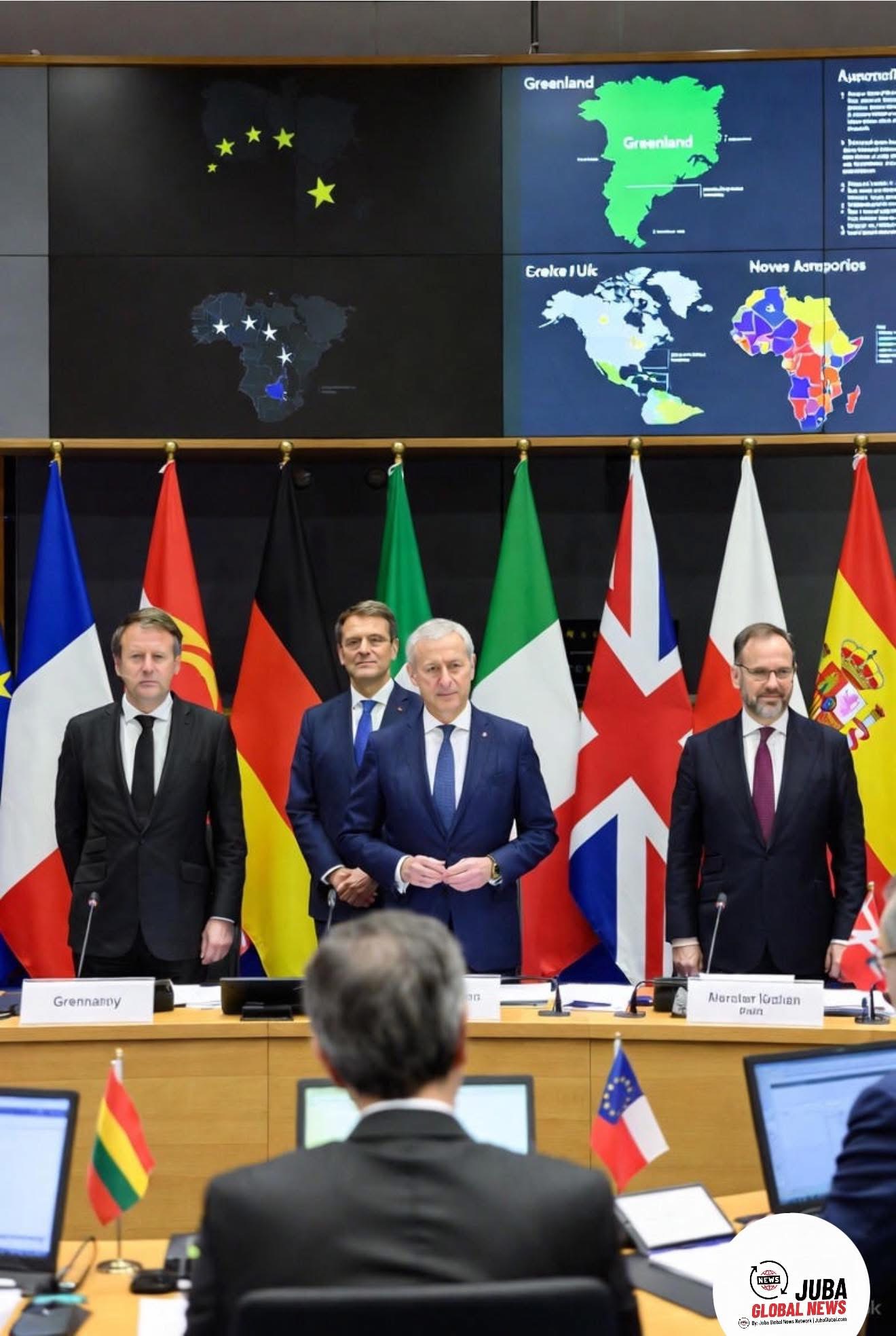
European capitals are in a state of quiet but intense diplomatic activity as leaders from France, Germany, Italy, the United Kingdom, Poland, Spain, and Denmark coordinate a unified response to the Trump administration’s aggressive foreign policy moves in Greenland and Venezuela. Senior officials describe the atmosphere as one of “profound concern,” with some privately warning that the transatlantic relationship is facing its most serious test since the Iraq War era.
The immediate triggers are twofold: the White House’s explicit refusal to rule out military options in pursuing Greenland’s acquisition and the dramatic U.S. seizure of Venezuelan-linked oil tankers in international waters. Yet the deeper anxiety stems from a broader pattern—U.S. withdrawals from dozens of international organizations, escalating trade rhetoric, and a perceived retreat from the rules-based order that Europe has long relied upon.
French President Emmanuel Macron hosted a virtual meeting Tuesday evening with German Chancellor Olaf Scholz, Italian Prime Minister Giorgia Meloni, British Prime Minister Keir Starmer, Spanish Prime Minister Pedro Sánchez, Polish Prime Minister Donald Tusk, and Danish Prime Minister Mette Frederiksen. Sources familiar with the discussion say participants agreed on a joint statement reaffirming that “Greenland belongs to its people” and that any attempt to alter its status by force would be unacceptable. The statement stopped short of explicit threats but signaled readiness to explore “all necessary measures” to defend Danish sovereignty and NATO principles.
Greenland: The Red Line
Denmark views the U.S. posture on Greenland as an existential issue. Prime Minister Frederiksen told lawmakers Wednesday that any coercive action would constitute “the end of NATO as we know it,” given that it would violate Article 5’s spirit of collective defense among allies. Copenhagen has accelerated contingency planning, including quiet consultations with NATO Secretary General Mark Rutte about potential alliance responses.
Germany and France, Europe’s traditional engine of integration, are pushing for a calibrated approach: strong public messaging combined with private channels to de-escalate. Scholz emphasized in a press conference that “dialogue remains open,” while Macron’s office reiterated France’s commitment to Greenlandic self-determination and Arctic stability.
The United Kingdom, post-Brexit and keen to maintain its “special relationship” with Washington, has adopted a more cautious tone. Starmer’s government supports Denmark diplomatically but has avoided direct criticism of the Trump administration, focusing instead on shared concerns over Russian and Chinese Arctic ambitions.
Venezuela: Economic and Security Ripples
The U.S. tanker seizures have also raised European hackles. While few European leaders mourn Nicolás Maduro’s regime, the unilateral nature of the operations—conducted in international waters and involving a Russian-flagged vessel—has evoked memories of past U.S. interventions that destabilized Latin America.
European officials worry about secondary effects: disrupted oil supplies, potential Russian retaliation, and the precedent of great-power naval enforcement. Energy ministers from France, Germany, and Italy held separate talks Wednesday to assess exposure to Venezuelan crude flows (minimal directly, but significant via shadow fleet routes to Asia that influence global pricing).
More broadly, Europe fears being squeezed between U.S. assertiveness and Russian aggression. With the Ukraine war entering its fourth year, European NATO members remain heavily dependent on American security guarantees and military aid. Several Eastern European leaders, including Poland’s Tusk, have urged restraint in public criticism to avoid jeopardizing continued U.S. support against Moscow.
Security Guarantees for Ukraine: The Delicate Balance
The coordination extends to Ukraine. European officials are quietly advancing proposals for bilateral or multilateral security guarantees to Kyiv—potentially including troop deployments or long-term arms commitments—while carefully calibrating language to avoid alienating Washington.
France and the UK have taken the lead, building on their 2024 Lancaster House initiatives, while Germany remains hesitant about permanent troop presence. The goal is to demonstrate European resolve without appearing to preempt U.S. commitments. One senior diplomat described the strategy as “hedging with care”: preparing for scenarios where U.S. reliability wanes, but not provoking a rupture.
Toward a Cohesive European Posture?
Analysts see the current moment as a potential inflection point for European strategic autonomy. The European External Action Service is drafting options for a common position ahead of Secretary of State Marco Rubio’s planned meetings with Danish leaders next week. Possibilities include:
- A joint EU-NATO statement reaffirming alliance solidarity with Denmark.
- Accelerated investment in Arctic capabilities, including icebreakers and monitoring stations.
- Quiet exploration of economic countermeasures should tensions escalate further.
Yet divisions persist. Southern European nations prioritize migration and Mediterranean stability, while Northern and Eastern members focus on Arctic and Russian threats. The UK’s non-EU status complicates coordination.
Public opinion adds another layer. Polls in Germany and France show growing fatigue with U.S. unpredictability, while Danish voters overwhelmingly reject any notion of Greenland’s sale or annexation.
As Europe calibrates its response, the coming weeks will test whether the transatlantic partnership can weather this latest storm—or whether 2026 marks the beginning of a more fragmented Western alliance.
Juba Global News Network will continue monitoring diplomatic developments across European capitals.