

EU and India Seal Historic ‘Mother of All Deals’: Landmark Free Trade Agreement Finalized Amid Global Trade Shifts
By: Juba Global News Network | JubaGlobal.com January 27, 2026 In a major development reshaping global trade dynamics, the European Union and India announc
By: Juba Global News Network | JubaGlobal.com
January 27, 2026
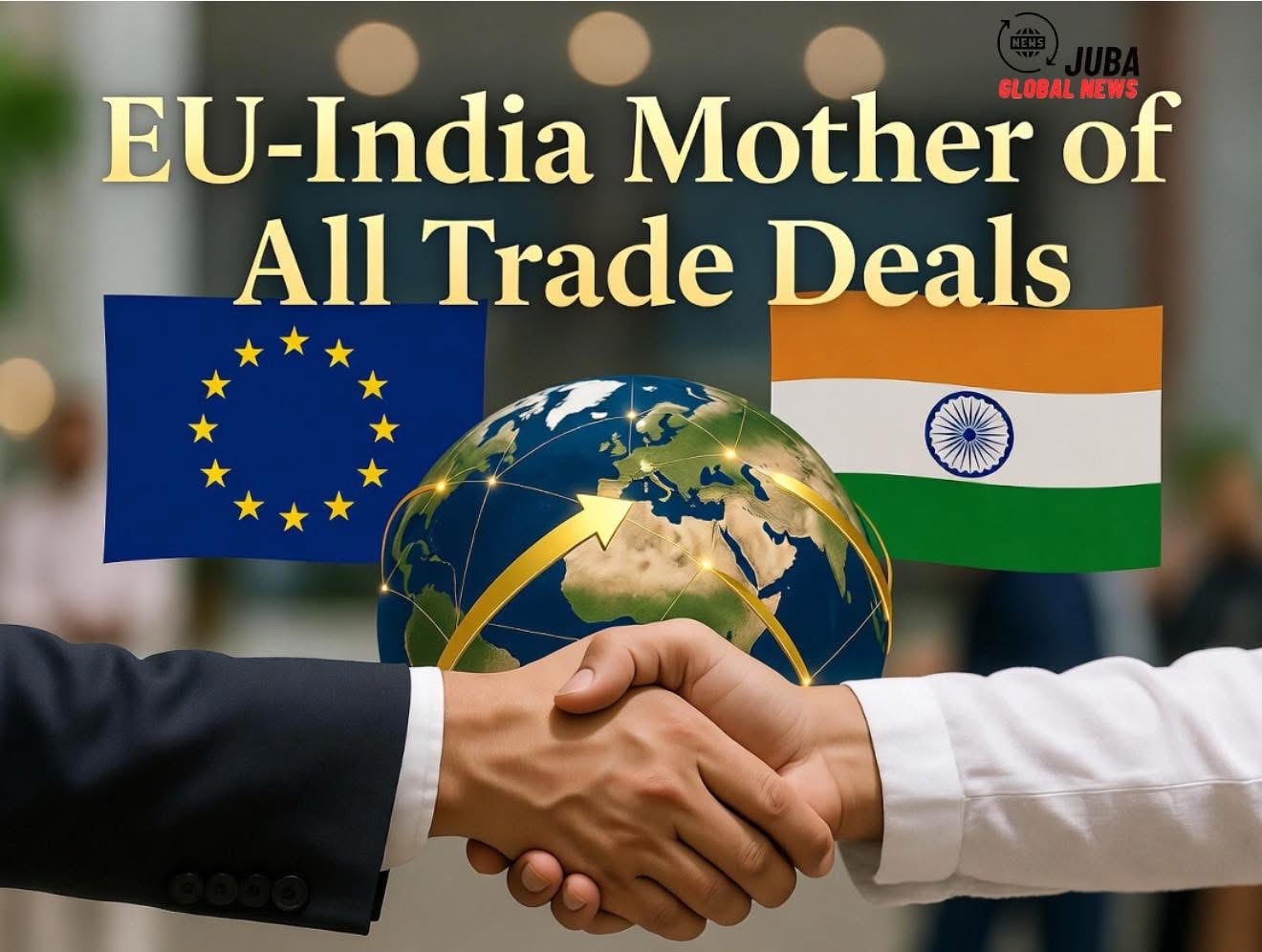
In a major development reshaping global trade dynamics, the European Union and India announced the conclusion of negotiations on a comprehensive Free Trade Agreement (FTA) on January 27, 2026. Described by European Commission President Ursula von der Leyen as the “mother of all deals,” the pact creates a vast free trade zone encompassing nearly two billion people and representing about 25% of global GDP and one-third of world trade. The agreement, reached after nearly two decades of on-and-off talks, accelerates economic integration between the world’s largest single market and the world’s most populous nation, while serving as a strategic counterbalance to rising protectionism elsewhere.
The breakthrough came during an EU-India summit in New Delhi, where Prime Minister Narendra Modi, von der Leyen, and European Council President Antonio Costa jointly hailed the accord. Modi called it a “historic” milestone that opens new pathways for growth, investment, and strategic cooperation. Von der Leyen emphasized that the deal benefits both sides by fostering deeper ties in a turbulent global environment.
The Road to Agreement: From Stalemate to Breakthrough
Negotiations for an EU-India FTA first began in 2007 but were suspended in 2013 over disagreements on market access, tariffs, and regulatory issues. Talks resumed in 2022 with renewed urgency, driven by supply chain disruptions, geopolitical tensions, and the need for diversified trade partnerships. The final formal negotiating round occurred in October 2025, followed by intensive technical and political discussions that culminated in the January 2026 breakthrough.
The accelerated pace in recent months has been widely attributed to external pressures, including aggressive U.S. tariff policies under the second Trump administration. Analysts view the pact as a deliberate hedge against volatile American trade measures, allowing both the EU and India to secure alternative markets and reduce dependence on U.S. imports and exports.
Key Provisions: Tariff Reductions and Market Access
The agreement delivers substantial tariff eliminations and reductions:
- EU Exports to India: Tariffs will be eliminated or significantly reduced on 96.6% of EU goods by value. This includes major categories such as machinery, electrical equipment, chemicals, pharmaceuticals, plastics, iron and steel, and automobiles (with duties on cars phased down from as high as 110% to as low as 10% over time in some cases).
- Indian Exports to the EU: The EU will eliminate or reduce tariffs on 99.5% of Indian goods over a transitional period (typically seven years). Benefiting sectors include textiles and apparel, marine products (currently facing up to 26% duties), gems and jewelry, chemicals, plastics/rubber, and processed foods.
- Other Elements: The deal includes provisions for services trade, investment protection, intellectual property rights, sustainable development, and climate cooperation. The EU has committed €500 million in support over the next two years to aid India’s greenhouse gas reduction efforts and sustainable industrial transformation.
Officials project the FTA will double EU goods exports to India by 2032, save billions in annual tariffs, and create millions of jobs across both regions. India’s ready-made garment sector alone could see up to $4.5 billion in additional export potential.
Strategic Implications: A Multipolar Trade Pivot
The timing of the announcement—coming amid U.S. tariff threats against multiple partners, including recent escalations involving South Korea—has fueled speculation that the deal serves as a geopolitical statement. Media outlets have described it as a “rebuff to Trump,” with the pact providing India and the EU greater leverage in an era of fragmented global trade.
For India, the agreement bolsters its ambition to become a global manufacturing hub and diversifies export destinations beyond traditional partners. For the EU, it secures access to one of the world’s fastest-growing markets and strengthens strategic autonomy in trade policy.
Critics, however, have raised concerns over potential impacts on labor standards, environmental protections, and sensitive agricultural sectors. Some Indian stakeholders worry about competition for domestic industries, while EU farmers and small businesses may face increased import pressure. Both sides have included safeguards, quotas (e.g., larger auto import quotas for the EU than in previous deals), and phased implementation to mitigate disruptions.
Next Steps: Ratification and Implementation
The negotiated text will now undergo legal scrubbing, translation into all official EU languages, and internal approvals. For the EU, this involves submission to the Council, followed by formal signing (expected later in 2026), European Parliament consent, and Council decision on conclusion. India will proceed with its domestic ratification process.
Implementation is anticipated in early 2027, pending these steps. A dedicated implementation platform is planned for launch in the first half of 2026 to monitor compliance and address issues.
Broader Context in a Changing Global Order
The EU-India FTA joins other recent mega-deals and realignments, highlighting a shift toward multipolar trade networks. As protectionist pressures mount in some quarters, partnerships like this one aim to promote open, rules-based commerce while hedging against uncertainty.
With bilateral trade already exceeding €120 billion annually (and $136.5 billion in goods for India’s fiscal year through March 2025), the agreement promises to unlock significant new growth. Whether it fully realizes its potential will depend on effective implementation and continued political commitment.
As leaders in New Delhi celebrated the “mother of all deals,” the world watches to see how this landmark pact influences global supply chains, investment flows, and the future of international trade.
Juba Global News Network tracks major geopolitical and economic developments worldwide. This article is compiled from official statements by the European Commission, Indian Ministry of Commerce, and reporting from Reuters, Bloomberg, CNN, The Guardian, Al Jazeera, BBC, AP News, and other sources as of January 27, 2026.
