

Diplomatic Thaw or High-Stakes Bluff? US and Iran Signal Progress Toward Talks Amid Gulf Tensions and Military Buildup
By: Juba Global News Network | JubaGlobal.com February 1, 2026 – Forest Hills, Michigan (via wire reports from Washington, Tehran, and regional capitals) I
By: Juba Global News Network | JubaGlobal.com
February 1, 2026 – Forest Hills, Michigan (via wire reports from Washington, Tehran, and regional capitals)
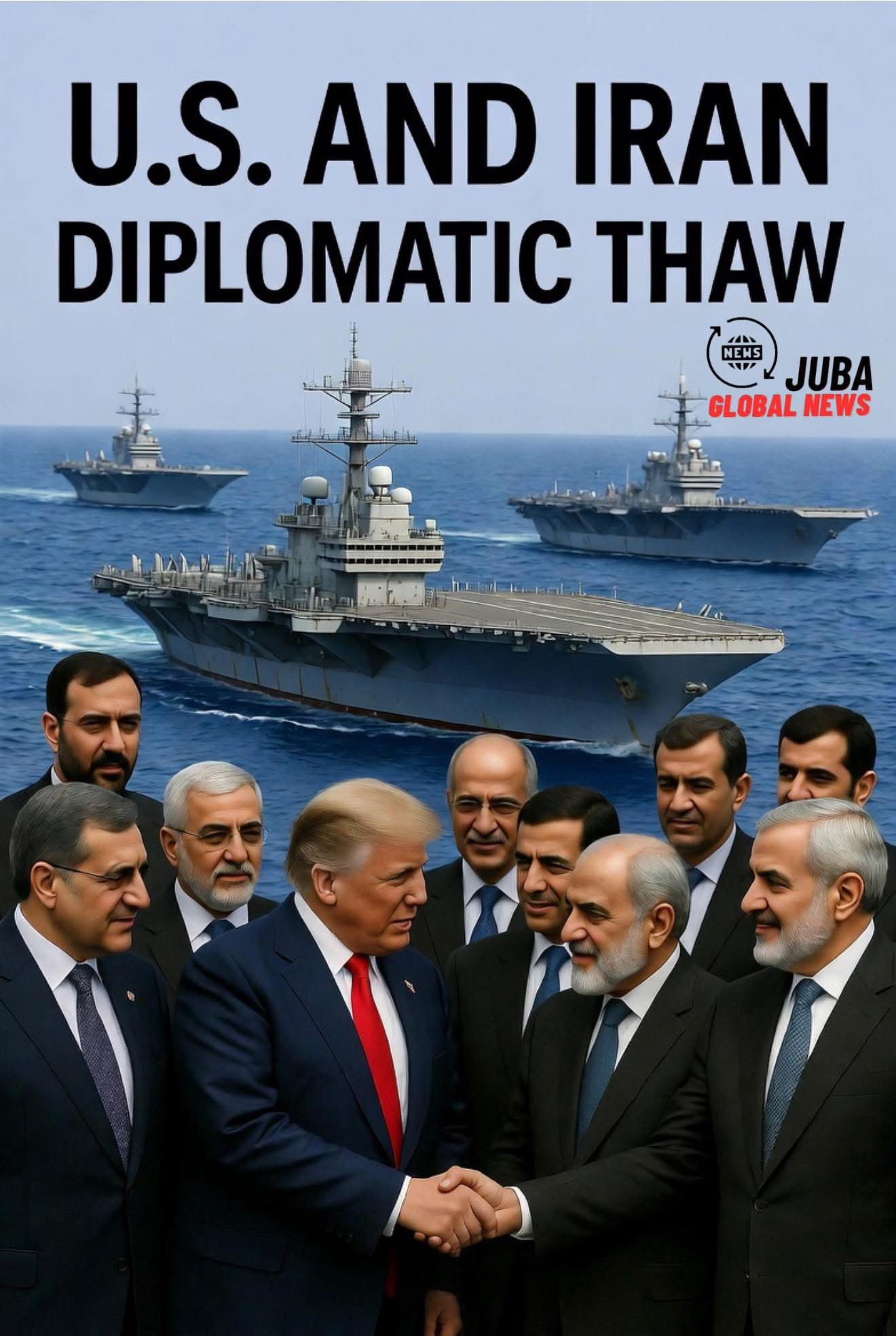
In a surprising turn amid weeks of escalating rhetoric and military posturing, the United States and Iran have both publicly acknowledged progress toward establishing a framework for negotiations. This development, reported on January 31 and February 1, 2026, comes as U.S. President Donald Trump deploys a massive naval “armada” to the Persian Gulf while repeatedly warning Tehran that time is running out to avert military action.
The signals of dialogue emerged first from Tehran. Ali Larijani, Secretary of Iran’s Supreme National Security Council and a close ally of Supreme Leader Ayatollah Ali Khamenei, posted on X (formerly Twitter) that “contrary to the artificially manufactured media war narrative, the formation of a framework for negotiations is progressing.” Larijani’s statement followed his recent meetings in Moscow with Russian President Vladimir Putin and separate talks in Tehran with Qatari officials aimed at regional de-escalation.
Hours later, President Trump confirmed the outreach during remarks to reporters and in interviews. “They are talking to us — seriously talking to us,” Trump said, adding that Iran appeared interested in making a deal rather than facing U.S. military consequences. He referenced the ongoing deployment of U.S. forces, including the USS Abraham Lincoln carrier strike group and additional warships, describing it as a “big, powerful armada” heading toward the region. Trump emphasized his core demands: a new nuclear agreement that permanently prevents Iran from acquiring nuclear weapons, and an end to what he has called the regime’s violent suppression of anti-government protesters.
The backdrop to these developments is a sharp rise in U.S.-Iran tensions since late 2025. Nationwide protests in Iran against economic hardship, internet blackouts, and alleged regime brutality have drawn international condemnation. The Trump administration has imposed fresh sanctions on Iranian officials involved in the crackdown, including Interior Minister Eskandar Momeni and several Islamic Revolutionary Guard Corps (IRGC) commanders. Trump has repeatedly threatened that any failure to negotiate would lead to strikes “far worse” than previous U.S. or joint U.S.-Israeli actions against Iranian nuclear sites.
Iranian officials, while signaling openness to talks, have maintained firm red lines. Foreign Minister Abbas Araghchi stated that Tehran is prepared for “fair and equitable” negotiations but only without the “shadow of threats.” He reiterated that Iran’s ballistic missile program and defensive capabilities are non-negotiable, though the country remains willing to discuss its nuclear activities if mutual respect is shown. Iran’s army chief has warned that any U.S. military strike would prompt a “comprehensive” response.
The Path to Potential Talks
No formal, direct negotiations have been confirmed, and sources indicate that current communications remain indirect—possibly mediated through regional players like Qatar, Turkey, or even Oman (which has historically facilitated U.S.-Iran backchannels). Reports suggest preliminary discussions may involve resuming elements of the 2015 Joint Comprehensive Plan of Action (JCPOA), from which Trump withdrew in 2018 during his first term. However, the current U.S. position appears more maximalist, demanding not just curbs on enrichment but a complete denial of nuclear weapon capability, alongside concessions on regional behavior.
Iran’s willingness to engage, despite domestic hardliners’ opposition, likely stems from multiple pressures: severe economic strain from sanctions and internal unrest, the high cost of prolonged internet shutdowns (estimated at tens of millions daily), and the risk of devastating U.S. strikes on nuclear infrastructure or leadership targets. Analysts note that Tehran’s outreach follows a pattern seen in past crises—using diplomacy to buy time while preparing for escalation.
On the U.S. side, Trump’s approach blends “maximum pressure” with opportunistic diplomacy. He has kept Gulf allies (Saudi Arabia, UAE) in the loop on military preparations but reportedly withheld full details of any negotiation track, citing security risks. The president has framed the situation as a binary choice for Iran: negotiate a “fair and equitable deal” or face consequences, echoing his 2018–2020 strategy that led to the assassination of IRGC Quds Force commander Qasem Soleimani.
Regional and Global Implications
The Persian Gulf remains on edge. Oil prices have fluctuated with each new threat or signal of de-escalation, given the Strait of Hormuz’s critical role in global energy flows. European powers and China have urged restraint, while Russia and some Gulf states quietly facilitate backchannel talks.
Critics warn that the public signaling could be a high-stakes bluff on both sides—Trump projecting strength to domestic audiences and pressuring Tehran, while Iran buys time to assess U.S. resolve. Skeptics in Washington point out that previous “framework” talks have stalled over irreconcilable demands, and any deal would face fierce opposition from Israel’s government and U.S. congressional hawks.
As of early February 1, 2026, no breakthrough has been announced, and military assets continue to flow into the region. Yet the mutual acknowledgment of dialogue represents the first public crack in months of brinkmanship. Whether it leads to substantive negotiations—or collapses into conflict—may hinge on the next few days of quiet diplomacy behind closed doors.
Juba Global News Network will continue monitoring developments in this rapidly evolving situation.
Sources: Al Jazeera, Times of Israel, The Hindu, Axios, France 24, Reuters, BBC, The National, CNN, and official statements from U.S. and Iranian officials.
