

Devastation in the Heart of Juba: The Nyakuron West Custom Market Fire and the Compassionate Response from South Sudan’s Leadership
By Juba Global News Network, Editorial December 2, 2025 In the sweltering heat of Juba, South Sudan’s vibrant capital, where the Nile’s gentle
By Juba Global News Network, Editorial
December 2, 2025

In the sweltering heat of Juba, South Sudan’s vibrant capital, where the Nile’s gentle flow meets the pulse of a nation rebuilding from decades of strife, tragedy struck with ferocious intensity on the evening of December 1, 2025. A raging inferno engulfed the Nyakuron West Custom Market, one of the city’s most vital commercial hubs, reducing dozens of shops to smoldering ruins and claiming at least one young life. As dawn broke on December 2, the air still carried the acrid scent of charred wood and melted metal, a grim reminder of the fragility of livelihoods in a country where markets like this one serve as the economic lifeline for thousands of families.
The Office of the Senior Presidential Envoy, Salva Adut Kiir, issued a poignant statement that captured the raw emotion of the moment. “Deeply moved after witnessing firsthand the aftermath of Monday evening’s devastating fire at Nyakuron West Custom Market,” the office declared, underscoring the personal toll of the disaster. 0 In a brief but heartfelt address, representatives noted the staggering scale of destruction, with residual heat still radiating from the debris-strewn site, as if the ground itself mourned the loss. This response from one of President Salva Kiir’s closest advisors highlights not just the immediate human cost but also the broader challenges facing South Sudan’s informal economy—a sector that employs over 80% of the workforce and fuels daily survival amid ongoing economic pressures.
The Blaze That Shook Juba: A Timeline of Chaos
Nyakuron West Custom Market, nestled in the bustling Nyakuron neighborhood just a stone’s throw from the South Sudan Broadcasting Corporation (SSBC) compound, is more than a marketplace; it’s a microcosm of South Sudanese resilience. Stalls brim with imported goods from Uganda and Kenya—fabrics in vibrant kente patterns, sacks of maize flour, second-hand electronics humming with promise, and spices that fill the air with earthy aromas. Vendors, many of them women and displaced families from rural areas, eke out a living here, turning over profits that pay for school fees, medical bills, and the occasional family feast. On any given day, the market teems with haggling voices, the clatter of metal scales, and the laughter of children weaving through the crowds.
But on that fateful Monday evening, around 7 p.m. local time, tranquility shattered. Eyewitnesses described a sudden whoosh of flames erupting from a cluster of shops near the SSBC perimeter, possibly ignited by an electrical fault—a common culprit in Juba’s aging infrastructure, where power surges and overloaded wires are as routine as the tropical rains. 1 The fire spread with terrifying speed, fanned by dry season winds and the market’s tightly packed layout of wooden and thatched stalls. “It was like a dragon awakening,” recounted one trader, Mary Achan, in interviews with local media, her voice trembling as she surveyed the ashes of her 15-year-old fabric stall. 0 Within minutes, the blaze had consumed multiple sections, leaping from shop to shop and threatening nearby residential compounds and the state broadcaster’s facilities.
Emergency responders, including Juba’s under-resourced fire brigade, mobilized swiftly but faced an uphill battle. Fire trucks, limited in number and often hampered by poor road conditions, arrived amid chaotic scenes of vendors desperately dousing flames with buckets of Nile water hauled from nearby pumps. Police and municipal officials cordoned off the area, but not before the fire had gutted an estimated 20 to 30 shops, according to preliminary reports from the Juba City Council. 3 The inferno raged for over two hours, with firefighters working tirelessly to prevent it from encroaching on the SSBC—a near-miss that could have disrupted national communications at a time when South Sudan grapples with political tensions and upcoming elections.
Tragically, the toll extended beyond property. Police spokesperson Maj. Gen. James Monday Enoka confirmed the death of a five-year-old child, trapped in the chaos as the flames encroached on adjacent homes. 1 “When the fire started, the child burned to death,” Enoka told reporters somberly on Tuesday morning, his words hanging heavy in the humid air. No other casualties were immediately reported, but the psychological scars—families huddled in shock, children wide-eyed at the flickering ruins—will linger far longer than the physical ones.
Echoes of Recurring Nightmares: A Pattern of Peril in Juba’s Markets
This was no isolated incident; the Nyakuron West Custom Market fire is but the latest chapter in a harrowing saga of blazes that have repeatedly ravaged Juba’s commercial heart. South Sudan’s markets, born from the ashes of civil war and economic isolation, are tinderboxes waiting to ignite. In 2015, a similar conflagration tore through Custom Market, destroying at least 15 shops and leaving traders to rebuild with loans from informal moneylenders at exorbitant rates. 3 Four years later, in 2019, another outbreak claimed dozens more stalls, with losses estimated in the hundreds of millions of South Sudanese Pounds—a currency so volatile that its value evaporates like morning mist.
December 2023 brought yet another blow: 62 shops reduced to rubble, with vendors blaming delayed fire brigade responses for exacerbating the damage. 4 “We called for help, but by the time they came, our dreams were gone,” lamented one affected merchant at the time. These fires aren’t mere accidents; they are symptoms of deeper systemic failures. Juba’s rapid urbanization, fueled by rural-to-urban migration post-independence in 2011, has outpaced infrastructure development. Electricity grids, inherited from the colonial era and sporadically maintained, flicker unreliably. Building codes? Often ignored in the informal sector, where stalls sprout like mushrooms after rain.
Experts point to a toxic mix of factors: overcrowding, with vendors spilling onto streets despite recent bans by the Juba City Council; the use of flammable materials like plastic sheeting and untreated timber; and climate change’s dry spells, which turn the city into a powder keg. 0 Just a day before the Nyakuron blaze, the council had enforced a crackdown on street vendors at Custom and Konyo-Konyo markets, displacing hundreds and perhaps contributing to the congestion that aided the fire’s spread. 0 “You can’t dismantle the street vendors and expect the market to operate peacefully,” tweeted local commentator Smooth Kurdit, capturing the frustration echoing across social media. 10 Vendors, he argued, are “part of our economic growth & deserve to be treated with decency.”
The National Chamber of Commerce, Industry and Agriculture (NCCIA) echoed this sentiment, expressing “profound concern” over the destruction and calling for urgent reforms. 0 In a nation where hyperinflation has eroded savings— the South Sudanese Pound lost over 50% of its value against the dollar in 2024 alone—these markets aren’t luxuries; they’re necessities. A single fire can wipe out a family’s entire net worth, pushing them deeper into poverty cycles that perpetuate conflict and displacement.
Salva Adut Kiir’s Office: A Beacon of Empathy in Crisis
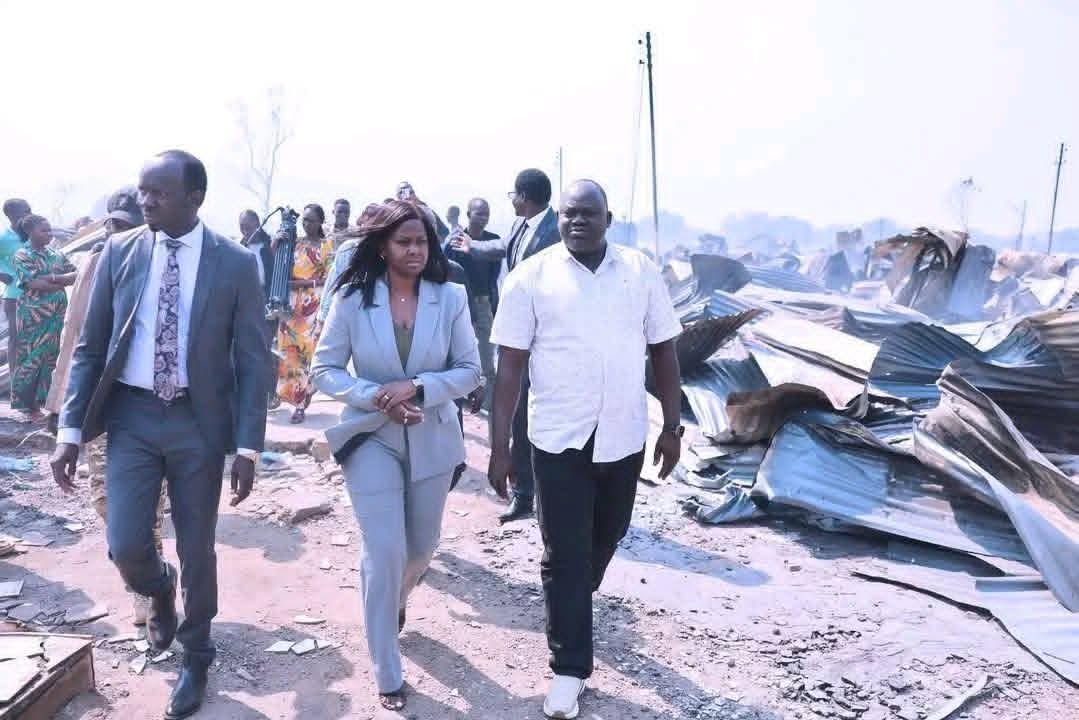
Amid the rubble, a voice of solace emerged from the highest echelons of government. Salva Adut Kiir, serving as Senior Presidential Envoy—a role that positions her as a key advisor to President Salva Kiir on matters of national reconciliation and development—stepped forward with a response that transcended bureaucracy. Her office’s statement, released mere hours after the blaze was contained, painted a vivid picture of leadership grounded in humanity.
“Deeply moved,” she said, having “witnessed firsthand the aftermath.” This wasn’t armchair sympathy; Adut Kiir’s team arrived at the scene under the cover of dawn, navigating twisted metal and soot-blackened earth where heat still pulsed like a dying heartbeat. 0 Accompanied by aides and local officials, she consoled grieving traders, her presence a rare fusion of presidential gravitas and maternal warmth. In South Sudan, where political figures often navigate a minefield of ethnic tensions and resource scarcity, such gestures are potent symbols. Adut Kiir, a Dinka like the president but known for her cross-community outreach, embodies the “unity government” ethos forged in the 2018 peace accord.
Her office pledged immediate action: assessments for emergency relief, coordination with the Ministry of Trade and Industry for compensation claims, and advocacy for fire safety upgrades. The ministry itself had already extended sympathies, vowing support for affected traders. 2 “We stand with our brothers and sisters whose livelihoods have been shattered,” the statement read, a nod to the communal spirit that defines South Sudanese society. On X (formerly Twitter), reactions poured in—prayers from @91komakechkenyi for “God to console those affected,” and calls for accountability from local voices like @TRCSouthSudan, which reported “traders suffer big losses.” 12 16
Adut Kiir’s intervention also spotlights women’s roles in South Sudan’s leadership. As one of the few female envoys in a male-dominated political landscape, her focus on market fires resonates deeply; women comprise over 60% of informal traders in Juba, per UN Women data. Her firsthand account—describing the “scale of destruction” and lingering heat—humanizes the crisis, urging a national reckoning on urban safety.
The Human Mosaic: Stories from the Ashes
Behind the statistics lie indelible human narratives. Take Achan, the fabric vendor, whose stall was her ticket out of a refugee camp in Uganda. “Everything—bolts of ankara, beads for my daughter’s wedding—was gone in a blink,” she shared, sifting through cinders for salvageable remnants. 0 Or young Peter Lual, a 22-year-old electronics hawker who arrived in Juba two years ago, fleeing floods in Jonglei State. His smartphone repair kit, his only inheritance from a late father, melted into unrecognizable slag. “This fire didn’t just burn shops; it burned futures,” he told Radio Tamazuj reporters, his eyes scanning the horizon for hope. 1
The child’s death adds a layer of profound sorrow. Neighbors whispered of a little girl, perhaps named Nyandeng after the first lady, caught in the stampede as parents shielded her from the flames. Her loss ripples through the community, where child mortality remains high—over 90 per 1,000 births, according to UNICEF—and such tragedies amplify calls for better child protection in public spaces.
Social media amplified these voices. Posts on X captured the raw grief: images of twisted rebar and forlorn vendors, hashtags like #JubaFire and #NyakuronStrong trending locally. 12 International echoes arrived too, with African Union observers expressing solidarity, linking the incident to broader continental pushes for resilient urban planning.
Broader Implications: Flames as a Catalyst for Change
The Nyakuron fire isn’t just a local calamity; it’s a clarion call for systemic overhaul. Economically, the losses—preliminarily pegged at tens of millions of SSP—exacerbate South Sudan’s woes. Oil revenues, the nation’s backbone, fluctuate with global prices, while floods and conflicts displace farmers, driving food prices skyward. Markets like Nyakuron absorb this shock, providing affordable goods; their disruption means higher costs for staples, hitting the poorest hardest.
Politically, the timing is fraught. With elections looming in 2026, President Kiir’s administration faces scrutiny over governance. Adut Kiir’s swift response burnishes the government’s image, but critics demand more: modern fire stations, subsidized insurance for traders, and zoning laws that accommodate growth without courting disaster. 3 The Juba City Council’s vendor ban, intended to streamline traffic, now draws backlash as a potential trigger. 10 “Vendors are economic growth,” Kurdit reiterated, sparking debates on inclusive urban policy.
On the humanitarian front, aid groups like the International Red Cross are mobilizing. Temporary shelters dot the market’s edges, stocked with tarps and non-perishables. Yet, as Adut Kiir noted, the “heat still radiating” symbolizes unresolved tensions—literal and figurative—that demand urgent attention.
Pathways to Resilience: Rebuilding Stronger
Reconstruction has begun, albeit haltingly. Traders like Achan pool resources through savings groups (yebeka), a traditional South Sudanese practice of mutual aid. Government pledges include low-interest loans via the National Ministry of Trade, but delivery remains key. 2 Long-term, experts advocate for fire-resistant materials, solar-powered lighting to reduce electrical risks, and community drills—lessons from Kenya’s Nairobi markets, which halved fire incidents post-2020 reforms.
Adut Kiir’s office envisions a “resilient Nyakuron,” integrating market upgrades into national development plans. Her firsthand witness, captured in 📸 photos shared by the office—showing her amid the ruins, hand on a trader’s shoulder—serves as both solace and spur. 0
A Nation’s Resolve: From Ashes to Aspiration
As the sun sets over Juba on December 2, 2025, the Nyakuron West Custom Market stands scarred but unbowed. Salva Adut Kiir’s words—”deeply moved”—resonate as a pledge: South Sudan, forged in fire, will rise again. For the vendors, the child lost, and the dreams deferred, this tragedy must ignite not just flames of grief, but fires of reform. In a land where hope is as enduring as the Nile, the path forward lies in unity, empathy, and action. The market will reopen, voices will haggle once more, and from the heat of destruction, a stronger Juba will emerge.
This article draws on on-the-ground reporting, official statements, and community voices to honor the affected. For support, contact local aid organizations or the Office of the Senior Presidential Envoy.