

BREAKING NEWS: Tensions Spike in West Africa as Putin Deploys 400 Russian Soldiers to Burkina Faso, Issues Stark Warning to Nigeria
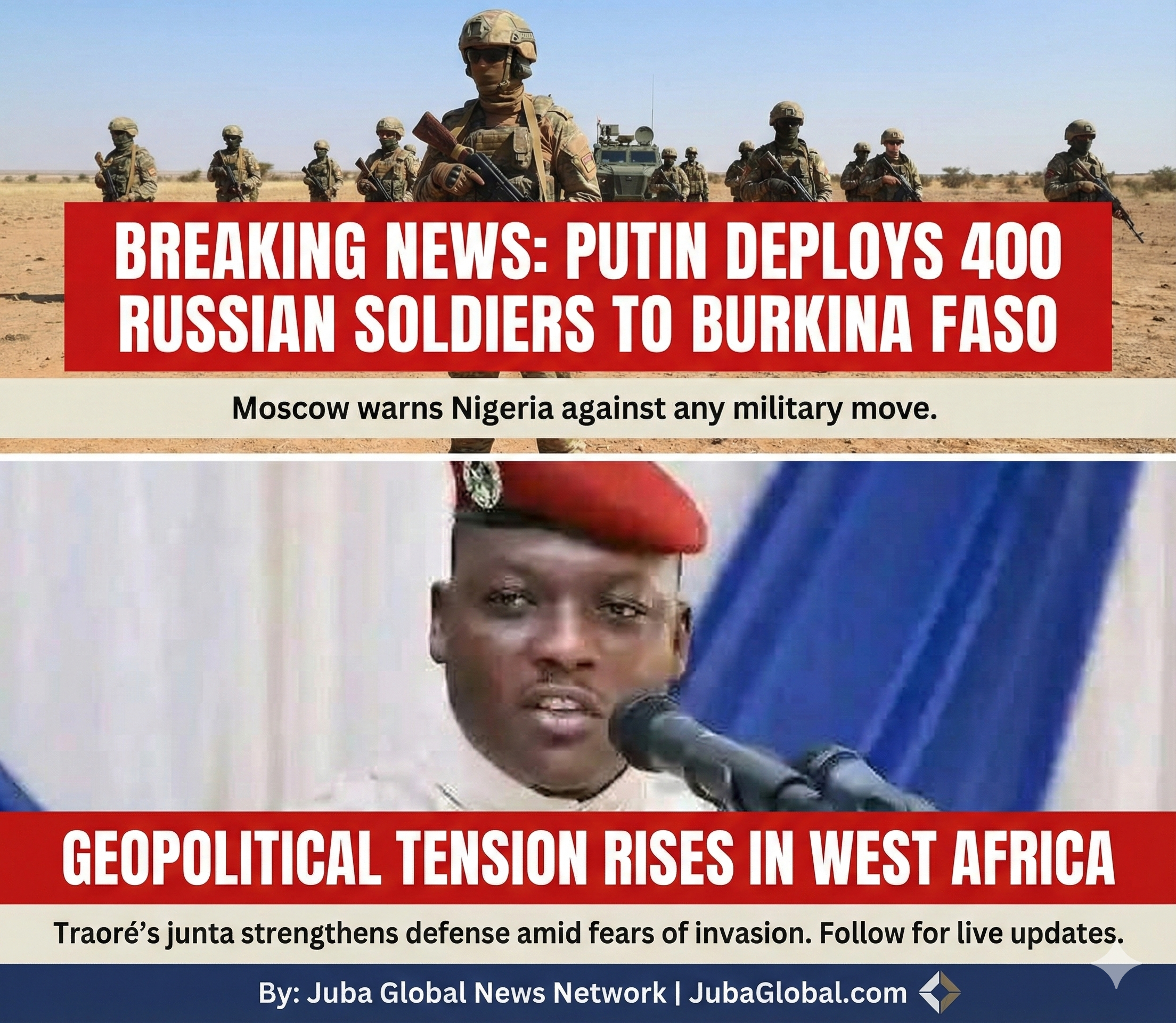
OUAGADOUGOU / MOSCOW – In a dramatic escalation of geopolitical tensions in the Sahel, reports from Ouagadougou and Moscow confirm that Russian President Vladimir Putin has deployed a specialized contingent of 400 elite Russian soldiers to Burkina Faso. This deployment comes with a severe and direct warning to the Nigerian government against any military incursion into the territory of the Alliance of Sahel States (AES).
The move marks a significant deepening of the Russian Federation’s involvement in West Africa and signals a potential flashpoint between the Russian-backed military juntas of the Sahel and the Western-aligned Economic Community of West African States (ECOWAS), led by regional heavyweight Nigeria.
The Deployment: A “Shield” for the Sahel
According to defense sources, the 400 troops—comprising elements of Russia’s specialized expeditionary corps and military advisors—arrived in Ouagadougou under the cover of night earlier this week. They have been tasked with fortifying Burkina Faso’s northern and eastern defenses and providing high-level strategic support to Captain Ibrahim Traoré’s government.
The deployment is officially described as part of a “bilateral defense cooperation agreement” aimed at counter-terrorism. However, the timing and the nature of the troops suggest a different primary objective: deterrence against external state actors.
The Kremlin’s involvement follows months of growing friction between Burkina Faso and its neighbors. With the recent detention of Nigerian military personnel by Burkinabè authorities on December 8, 2025, after a Nigerian aircraft was forced to land in Bobo-Dioulasso, the diplomatic standoff has rapidly militarized.
Putin’s Ultimatum to Abuja
In a statement that has sent shockwaves through diplomatic channels in Abuja and Washington, President Putin reportedly drew a “red line” regarding the sovereignty of Burkina Faso.
“Any attack on Burkina Faso will be considered an attack on the Russian Federation,” the Russian President was quoted as saying during a security briefing in Moscow. “We will respond decisively to protect our allies and ensure the stability of the region against foreign-sponsored aggression.”
This declaration effectively extends Russia’s nuclear umbrella and military guarantee to the Sahelian junta, complicating any potential plans by ECOWAS or Nigeria to intervene militarily to restore “constitutional order” or respond to border provocations.
Context: The Nigeria Factor and US Threats
The situation is further inflamed by the complex geopolitical game playing out in Nigeria. The Nigerian government, led by President Bola Tinubu, finds itself in a precarious position.
On one side, Nigeria faces pressure from the United States. Recent reports indicate that the Trump administration has threatened direct military intervention in Nigeria to “protect Christian communities” and combat Islamist insurgents, labeling Nigeria a “Country of Particular Concern.”
On the other side, Nigeria is the leading force of ECOWAS, which has been at loggerheads with the breakaway AES bloc (Mali, Burkina Faso, and Niger). The AES nations have severed ties with former colonial power France and pivoted sharply toward Russia.
Analysts warn that Nigeria is being squeezed. “Abuja is in a vice,” says regional security analyst Dr. Hassan Kouyaté. “If they move against Burkina Faso to assert regional dominance or satisfy Western partners, they risk a direct clash with Russian forces. If they do nothing, they look weak in the face of ongoing provocations like the detained aircraft.”
The Alliance of Sahel States (AES) Emboldened
The arrival of Russian boots on the ground has emboldened the military leadership in Ouagadougou, Bamako, and Niamey. The AES has already withdrawn from ECOWAS, citing the bloc’s failure to help fight terrorism and its subservience to foreign powers.
With 400 Russian troops now acting as a tripwire, Burkina Faso’s Captain Traoré has strengthened his rhetoric. In a broadcast following the deployment, state media hailed the arrival of “strategic partners” as the dawn of a new era of “true sovereignty” for the Burkinabè people.
International Reaction: Fears of a Proxy War
The international community has reacted with alarm.
- ECOWAS: An emergency meeting has been called in Abuja to discuss the “foreign militarization” of the region.
- The United States: The State Department has condemned the deployment, with officials warning that the introduction of Russian regular forces into the Sahel will only “exacerbate violence and destabilize the region further.”
- France: Having been forced to withdraw its own troops from the region, Paris is watching from the sidelines as its former sphere of influence becomes a contest between Moscow and Washington.
What Comes Next?
The immediate question is how Nigeria will respond to the detention of its personnel and the Russian warning. A military rescue operation or a retaliatory strike, once a possible option on the table for Nigeria’s defense chiefs, now carries the risk of igniting a much larger conflict involving a nuclear superpower.
For now, the 400 Russian soldiers stand as a physical manifestation of the new Cold War in Africa—a barrier that turns a regional dispute into a global standoff.
Stay tuned for updates on this developing story.
Would you like me to create a breakdown of the military capabilities of the AES nations (Mali, Burkina Faso, Niger) versus the ECOWAS bloc to see how they compare?