At least 40 dead in high-speed train collision in southern Spain: Spanish PM vows full investigation and declares three days of national mourning
By: Juba Global News Network | JubaGlobal.com January 20, 2026 – A catastrophic collision between two high-speed trains in the southern Spanish province of
By: Juba Global News Network | JubaGlobal.com
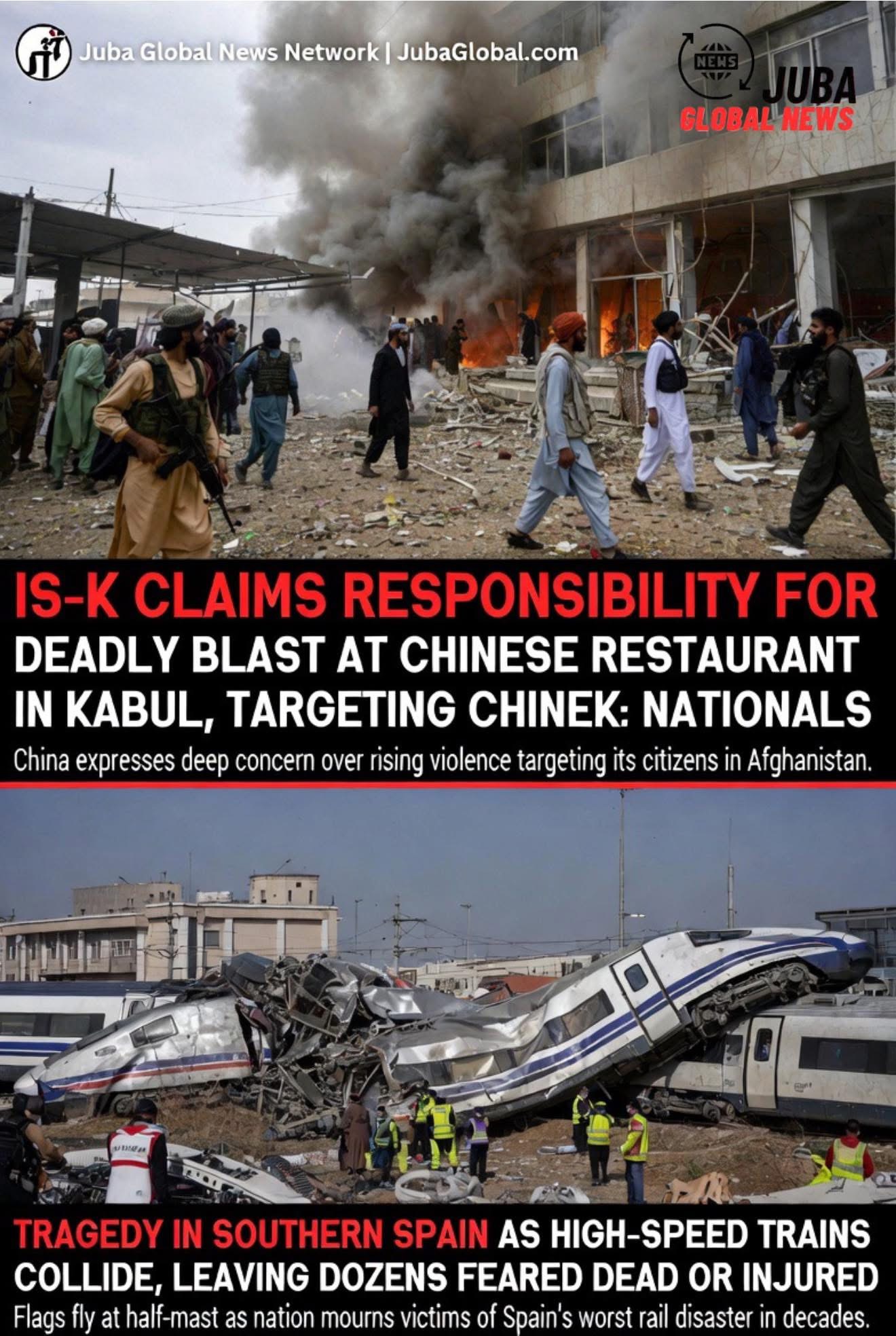
January 20, 2026 – A catastrophic collision between two high-speed trains in the southern Spanish province of Córdoba has claimed at least 40 lives and left more than 120 people injured, marking one of the deadliest rail accidents in Europe in over a decade. The crash occurred shortly before 1:00 p.m. local time on Monday near the small town of Adamuz, approximately 40 km northeast of Córdoba city, when a Madrid-bound AVE (Alta Velocidad Española) service collided head-on with a regional Alvia train traveling in the opposite direction on a single-track section of the Madrid–Seville high-speed line.
The Collision: What We Know So Far
According to initial reports from Renfe (Spain’s national railway operator) and the Guardia Civil, the Madrid-bound AVE (train number 03214) derailed after striking the oncoming Alvia service (train number 13007) at an estimated combined speed exceeding 300 km/h. The impact was so violent that the lead carriages of both trains were completely destroyed, with several cars derailing and others overturning. Rescue teams described scenes of twisted metal, scattered debris across the tracks, and passengers trapped in mangled compartments.
Emergency services—including firefighters, Red Cross volunteers, the Spanish Army’s UME (Military Emergency Unit), and multiple medical helicopters—were mobilized within minutes. Over 200 injured passengers were transported to hospitals in Córdoba, Seville, and Jaén, with at least 25 reported in critical condition suffering from severe trauma, burns, and crush injuries.
Official Response and National Mourning
Spanish Prime Minister Pedro Sánchez, who cut short a trip to Brussels, arrived at the crash site late Monday afternoon. Visibly shaken, he addressed the nation from a makeshift command post:
“This is a tragedy that has struck at the heart of our country. We mourn with the families who have lost loved ones. A full, independent, and transparent investigation will be carried out immediately. Nothing will be hidden. We have declared three days of official national mourning beginning tonight.”
King Felipe VI and Queen Letizia issued a joint statement expressing “profound sorrow” and announcing they would visit injured survivors in hospital on Tuesday. All Spanish flags on public buildings were lowered to half-mast.
The Ministry of Transport and Sustainable Mobility has launched a joint investigation with the Commission of Railway Accidents and Incidents (CIAF), ADIF (the rail infrastructure manager), and international experts from the European Union Agency for Railways (ERA). Preliminary theories include:
- Possible failure of the European Rail Traffic Management System (ERTMS), which should have prevented a head-on collision on a high-speed line.
- Human error (miscommunication or incorrect signaling).
- Track or signaling malfunction on the single-track stretch between Adamuz and Montoro.
Both trains were equipped with the latest safety systems, and the line had undergone routine maintenance checks less than two weeks earlier.
Passenger Demographics and Community Impact
The Madrid-bound AVE was carrying mostly business travelers and families returning from the weekend, while the Alvia service had a high proportion of local residents commuting between Andalusia and Madrid. Among the confirmed dead are several children, prompting an outpouring of grief across Spain.
In Adamuz (population ~4,300), residents opened their homes to survivors and donated food, blankets, and clothing. Local football club Córdoba CF announced it would dedicate its next match to the victims, while flamenco artists in Seville held impromptu vigils.
Broader Implications for Spanish Rail Safety
Spain’s high-speed rail network—among the longest and safest in the world—has suffered only a handful of fatal accidents since the first AVE line opened in 1992. The last major incident was the 2013 derailment near Santiago de Compostela, which killed 81 people and led to major safety upgrades.
Transport Minister Óscar Puente promised “no stone will be left unturned,” while opposition leaders called for an immediate parliamentary inquiry. The tragedy has reignited debate over single-track sections on high-speed lines, aging signaling infrastructure in certain corridors, and the pressure to maintain punctuality on one of Europe’s busiest networks.
Renfe has suspended all high-speed services between Madrid and Andalusia until further notice, with replacement bus and conventional rail services in place. Eurostar and other cross-border operators are monitoring the situation closely.
Looking Ahead
As search-and-rescue operations transition to recovery efforts and forensic identification, Spain braces for a long week of mourning and unanswered questions. The death toll—already at 40—may rise as some critically injured passengers remain in intensive care.
For now, a nation that has prided itself on one of the world’s most advanced rail systems is united in grief—and determined to ensure such a disaster never happens again.
Juba Global News Network will provide updates as the investigation progresses and more details emerge.
By: Juba Global News Network | JubaGlobal.com