

Argentina and US Ink Major Trade Deal: Tariffs Slashed, Alliance Strengthened
By: Juba Global News Network | JubaGlobal.com February 6, 2026 In a significant step toward deepening economic ties and reinforcing ideological alignment,
By: Juba Global News Network | JubaGlobal.com
February 6, 2026
In a significant step toward deepening economic ties and reinforcing ideological alignment, the United States and Argentina formally signed the United States–Argentina Agreement on Reciprocal Trade and Investment (ARTI) on February 5, 2026, in Washington, D.C. The landmark deal slashes or eliminates hundreds of reciprocal tariffs on goods flowing between the two nations, marking a major victory for Argentine President Javier Milei’s aggressive push to dismantle protectionist barriers and for President Donald Trump’s strategy to secure preferential market access for American exporters while addressing domestic concerns like food prices.
The agreement was signed by U.S. Trade Representative Jamieson Greer and Argentina’s Minister of Foreign Affairs, International Trade, and Worship Pablo Quirno. It builds directly on a framework announced in November 2025, transforming preliminary commitments into a binding pact that lowers long-standing trade barriers, facilitates investment in strategic sectors, and enhances cooperation on economic security, digital trade, and regulatory alignment.
Key Provisions of the Deal
At its core, the ARTI focuses on reciprocal tariff reductions:
• Argentina has committed to cutting or eliminating tariffs on more than 220 categories of U.S. goods, including medicines, medical devices, chemicals, machinery, motor vehicles, information technology products, and a broad range of agricultural items such as cattle, dairy, and other farm products. This opens Argentina’s historically closed market—long shielded by high tariffs and non-tariff barriers—to greater U.S. penetration.
• In return, the United States will eliminate reciprocal tariffs on over 1,600 Argentine products, with estimates suggesting this could boost Argentine export revenues by more than $1 billion annually. The U.S. side also agrees to review or adjust certain existing measures, such as Section 232 tariffs on steel and aluminum that have impacted Argentine exports.
Additional commitments include:
• Argentina accepting U.S. safety and regulatory standards for imported goods (e.g., autos and medical devices) and U.S. Department of Agriculture food safety certifications for meat and poultry, streamlining market entry.
• Prohibitions on barriers to digital trade, including no customs duties on cross-border data transmissions and no digital services taxes targeting U.S. tech firms.
• Modernization of customs procedures, promotion of investment in energy, critical minerals, infrastructure, and technology, and enhanced bilateral cooperation on supply chain resilience and national security issues.
• Expanded market access for Argentine beef—a politically sensitive item—with new tariff-rate quotas allowing duty-free entry of up to 80,000 metric tons in the first year (2026), addressing long-standing U.S. restrictions that have limited Argentine beef imports.
These measures aim to create a more balanced, rules-based trading environment while aligning with both leaders’ visions of free enterprise and reduced government interference.
Political and Economic Context
The deal underscores the close personal and ideological bond between Presidents Trump and Milei. Since taking office, Milei—a self-described anarcho-capitalist—has pursued radical economic reforms, including slashing subsidies, deregulating markets, and pivoting Argentina’s foreign policy toward alignment with the United States. His administration views the ARTI as a breakthrough in ending decades of isolationist protectionism that contributed to chronic economic distress, hyperinflation, and currency crises.
For the Trump administration, the agreement advances goals of reducing trade deficits, lowering consumer prices (particularly on food and inputs), and countering unfair practices globally. It also serves as a model for similar pacts with other Western Hemisphere partners, emphasizing reciprocity and shared democratic values amid broader tariff strategies targeting countries like China.
Economically, Argentina stands to gain immediate export relief—particularly in agriculture and natural resources—while U.S. manufacturers and farmers benefit from reduced competition in protected sectors. Critics in Argentina, including labor unions and domestic industries, have raised concerns about job losses from increased U.S. imports, but Milei’s government frames the deal as essential for long-term growth and attracting foreign investment.
Implementation and Outlook
The agreement takes effect upon ratification and domestic implementation processes in both countries, with many tariff cuts staged immediately or phased over short periods. USTR has released detailed tariff schedules outlining specific staging categories, from immediate duty-free entry (EIF) to gradual reductions.
Analysts see this as a pragmatic win-win: Argentina gains breathing room for its reform agenda, while the U.S. secures market openings without the complexities of a full free trade agreement requiring congressional approval. It also signals potential for further hemispheric integration under the current U.S. administration.
As global trade tensions persist—particularly with ongoing tariff negotiations elsewhere—this bilateral pact demonstrates how ideological alignment can translate into concrete economic benefits. Both governments have hailed it as a step toward stronger prosperity and security across the Americas.
Juba Global News Network will continue tracking implementation, economic impacts, and any follow-on negotiations related to the U.S.-Argentina ARTI.
For visual context, relevant images include:
• Official signing ceremony with U.S. Trade Representative Jamieson Greer and Argentine Foreign Minister Pablo Quirno
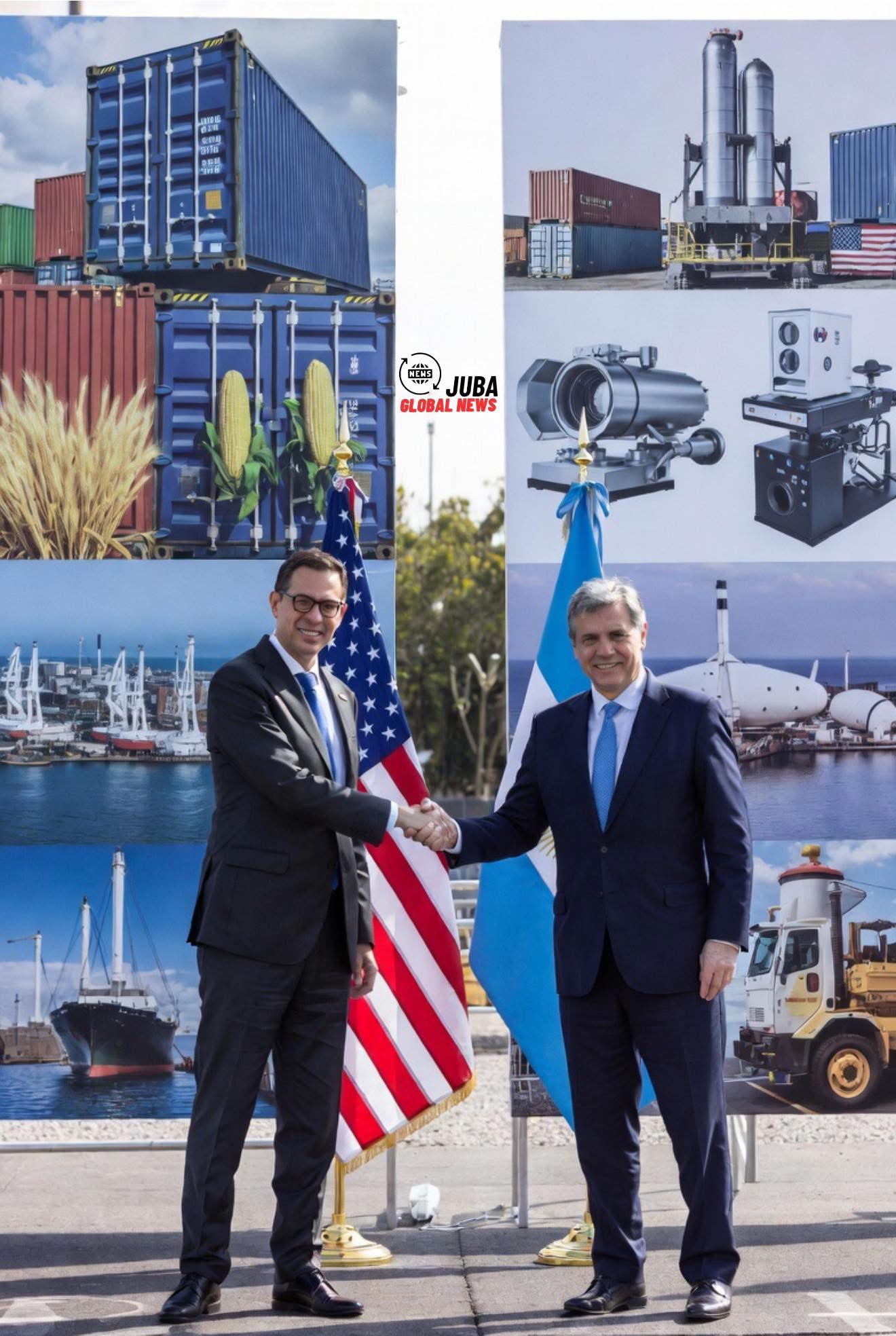
• Handshake between representatives against backdrops of the U.S. and Argentine flags
• Trade symbols such as shipping containers, agricultural products (beef, grains), machinery, and medical equipment
• Port scenes in Buenos Aires or U.S. export hubs illustrating increased bilateral trade flow