

A Pardon Across the Caribbean Sea: Trump’s Intervention in the Fate of Honduras’ Ex-President
By Juba Global News Network – Special Report December 9, 2025 – Tegucigalpa / Washington In a move that caught all of Latin America off guard and rekindled
By Juba Global News Network – Special Report
December 9, 2025 – Tegucigalpa / Washington
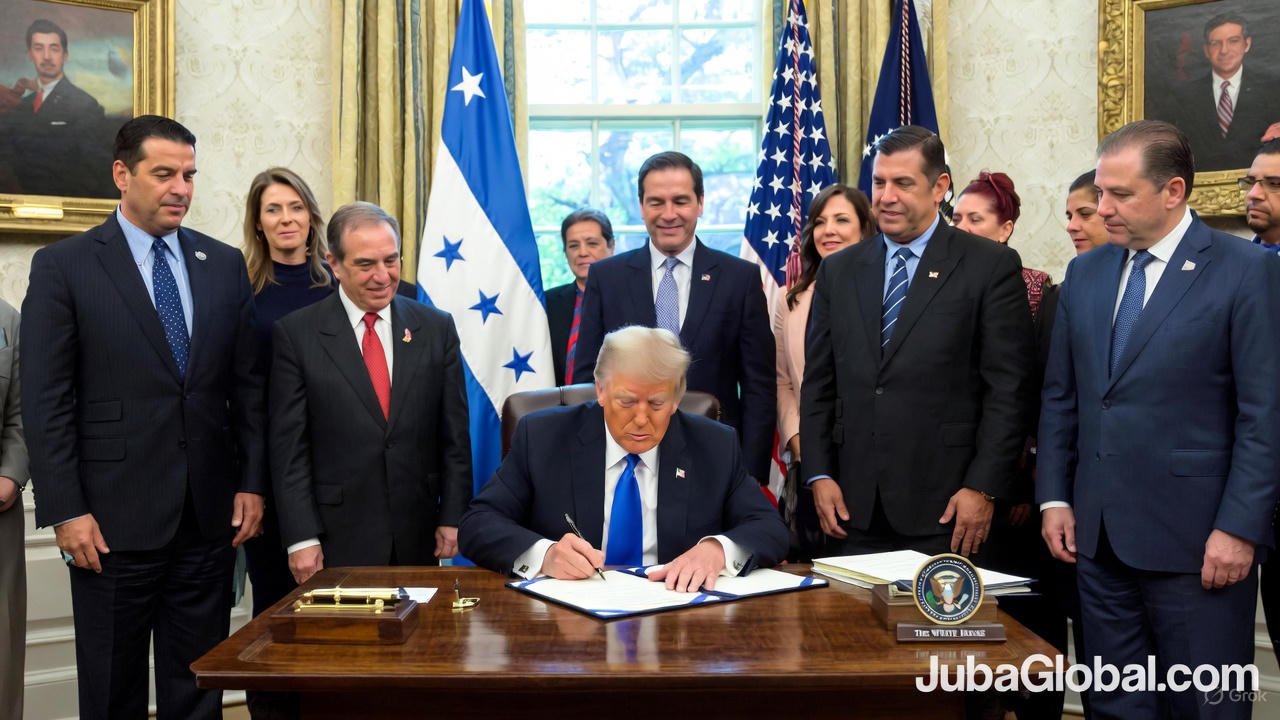
In a move that caught all of Latin America off guard and rekindled an old, heated debate about U.S. influence, President Donald J. Trump signed an absolute, unconditional pardon for former Honduran President Juan Orlando Hernández on December 8, 2025. The decision came just hours before Hernández was due to board a DEA flight to New York, where he faced the prospect of spending the rest of his life in prison for drug-trafficking and weapons charges. U.S. Ambassador to Honduras Laura Dogu hand-delivered the pardon to Hernández inside the infamous “El Pozo” maximum-security prison, immediately canceling the extradition order the U.S. itself had pushed through back in 2022. Only six hours after the news broke, Hernández was whisked away in a Honduran Air Force helicopter to his home in the upscale Palmas district of Tegucigalpa, where cheering supporters waved flags and set off fireworks late into the night.
The decision has thrown Honduras straight into political chaos, infuriated Biden-era officials still left at the Department of Justice, and driven President Xiomara Castro to declare a nationwide state of emergency. She’s now calling for Hernández’s “immediate re-arrest and extradition” to the United States—an urgent and bold demand.
From Presidential Palace to Federal Cell—Then Back Again
Hernández’s journey from the presidential palace to the center of an international legal and political firestorm is a wild one. He ruled Honduras from 2014 to 2022, a stretch that was riddled with accusations of massive corruption, alleged election rigging, and, according to U.S. prosecutors, turning the country into a “narco-state.” His younger brother Tony Hernández, remember, was convicted in 2019 by a New York court and handed a life sentence plus 30 years for smuggling over 185 tons of cocaine into the United States.
Just 38 days after Juan Orlando Hernández left office, in March 2022, he was arrested at home in a dramatic, televised operation involving DEA agents and Honduran special forces. A federal grand jury in New York had indicted him on three counts: conspiring to traffic cocaine, possessing machine guns to help that conspiracy, and making false statements about firearms. Prosecutors said Hernández took millions in bribes from drug cartels—including a $1 million payoff from Joaquín “El Chapo” Guzmán himself—in exchange for government protection.
After losing every last appeal in Honduran courts, Hernández was due for extradition on December 10, 2025, with his trial set for February 2026 in the same Manhattan court where his brother went down.
The Pardon: Timing, Motives, and Justifications
President Trump’s executive order claims “extraordinary contributions to regional stability and counter-narcotics cooperation during Hernández’s presidency,” zeroing in on the sharp drop in northbound migrant caravans after Honduras signed a 2019 “safe third country” deal with the U.S. There’s also a mention of Hernández’s loud support for Trump’s recognition of Jerusalem as Israel’s capital and the relocation of Honduras’ embassy that followed.
A senior White House official, speaking on background, told Juba Global News Network: “President Trump believes this prosecution was political revenge by the previous administration against a steadfast ally. He also sees Hernández as a possible stabilizing force in Central America at a time when Chinese and Russian influence is growing fast down there.”
Reactions: Outrage, Jubilation, and Diplomatic Mayhem
Back in Honduras, the country split right along the old lines.
- Tens of thousands of Hernández loyalists flooded the streets in Tegucigalpa and San Pedro Sula, honking car horns and chanting “JOH libre!”
- On the other side, anti-corruption protesters—led by the Libre party and various civil-society groups—set tires on fire and tried to march on the U.S. embassy, only to get pushed back by tear gas.
President Xiomara Castro, who won her post in 2021 by defeating Hernández’s chosen successor, called an emergency cabinet session and fired off a blistering statement: “This pardon is an insult to the Honduran people and a direct attack on our sovereignty. We’ll use every legal and diplomatic means to show that justice can’t be bought or sold by foreign powers.”
By Tuesday morning, the Honduran Supreme Court had issued a brand-new arrest warrant, saying the U.S. pardon was “non-binding on Honduran soil.” Police surrounded Hernández’s house but haven’t gone in yet—apparently wary of an armed clash with private security teams rumored to be working for the ex-president.
Regional and Global Fallout
The ripple effects go way beyond Honduras:
- El Salvador’s President Nayib Bukele congratulated Hernández on X, posting: “Welcome back to the fight, my friend.”
- Nicaragua and Venezuela quickly blasted the U.S., calling it “imperial hypocrisy.”
- The Organization of American States (OAS) has scheduled an emergency meeting for December 12.
- European Union diplomats are, in private, openly worried the pardon totally undercuts years of anti-impunity work funded by Brussels and Washington.
Inside the United States, Democratic lawmakers and several Republicans known for anti-corruption efforts slammed the move. Senator Tim Kaine (D-VA) called it “a betrayal of every DEA agent who risked life and limb to bring this narco-president to justice.”
A Country Divided and Facing the Unknown
As of Tuesday night, Juan Orlando Hernández is still holed up in his heavily guarded house, reportedly talking with military commanders and political friends about maybe returning to public life. Some sources close to him say he’s eyeing the launch of a new political movement ahead of the 2029 elections.
For many Hondurans, seeing a man once marched off in handcuffs now popping champagne pretty much sums up a tough reality: In a place where impunity usually wins, even a U.S. federal indictment and a life sentence may not end a political career built on suspected narco-deals.
Does this pardon signal the return of a divisive strongman, or is it the fuse that finally lights a real anti-corruption fire? Hard to say just yet. But one thing’s for sure: On December 8, 2025, the United States exercised one of its most powerful constitutional weapons to directly meddle in the affairs of a sovereign neighbor—and the aftershocks are going to be felt all over the Americas for a long time.
Juba Global News Network will keep following this fast-breaking story.
JubaGlobal.com – Reporting without fear or favor.