

A Milestone in African Health Sovereignty: South Africa’s Biovac Institute Advances Trials for the Continent’s First Fully Locally Produced Oral Cholera Vaccine
By: Juba Global News Network December 11, 2025 Amid a surge in cholera outbreaks that have gripped Africa in 2025—described by experts as the worst in 25 y
By: Juba Global News Network
December 11, 2025
Amid a surge in cholera outbreaks that have gripped Africa in 2025—described by experts as the worst in 25 years—a groundbreaking development offers renewed hope for the continent’s public health future. In October 2025, the Cape Town-based Biovac Institute initiated Phase 1 clinical trials for Africa’s first end-to-end locally manufactured oral cholera vaccine (OCV). This achievement, approved by the South African Health Products Regulatory Authority (SAHPRA), positions South Africa as a pioneer in vaccine self-reliance and aligns directly with the African Union’s ambitious goal of producing 60% of the continent’s vaccine needs locally by 2040. 0 “Exterior of the Biovac Institute facility in Cape Town, South Africa, a hub for vaccine manufacturing innovation.” “LARGE”
Health Minister Dr. Aaron Motsoaledi hailed the trials as a “historic milestone” during the launch event at Chris Hani Baragwanath Academic Hospital in Johannesburg on November 11, 2025. “This is not just for South Africa, but for the entire continent,” he emphasized, underscoring how local production could swiftly address outbreaks without reliance on strained global supplies. 17 “South African Health Minister Dr. Aaron Motsoaledi speaking at an event related to public health initiatives.” “LARGE”
The Escalating Cholera Crisis in Africa
Cholera, a waterborne disease caused by Vibrio cholerae bacteria, thrives in areas with poor sanitation, contaminated water, and overcrowding—conditions exacerbated by climate change, conflict, and poverty. In 2025, Africa has borne the brunt of a global resurgence. According to the Africa Centres for Disease Control and Prevention (Africa CDC), approximately 300,000 confirmed and suspected cases and over 7,000 deaths have been recorded across the continent this year alone, marking a more than 30% increase over 2024 figures. 13 “Affected communities during a cholera outbreak in Africa, highlighting the urgent need for prevention and treatment.” “LARGE”
Countries like Angola, Burundi, the Democratic Republic of Congo (DRC), Ethiopia, Nigeria, South Sudan, Sudan, Zambia, and Zimbabwe have been hardest hit. The World Health Organization (WHO) reports active transmission in up to 23 African nations, with cumulative cases since early 2024 exceeding 400,000 in some regional tallies. Factors such as extreme weather events—floods destroying infrastructure and droughts depleting clean water sources—have fueled this crisis, alongside ongoing conflicts displacing populations and overwhelming health systems. 15 “Patients receiving treatment at a cholera center in an affected African region.” “LARGE”
Global vaccine shortages have compounded the problem. Currently, the only WHO-prequalified oral cholera vaccines are produced outside Africa, primarily by South Korea’s EuBiologics (Euvichol-Plus). Demand has outstripped supply, forcing rationing and leaving vulnerable communities unprotected.
Biovac’s Journey: From Distribution to Full-Scale Manufacturing
Founded in 2003 as a public-private partnership to revitalize South Africa’s vaccine capabilities, Biovac has evolved dramatically. Initially focused on distribution and fill-finish operations, it has expanded into bulk manufacturing and now end-to-end production—the process from raw bacterial strains to final dosing. 2 “State-of-the-art laboratory at Biovac Institute in Cape Town, symbolizing advanced vaccine development capabilities.” “LARGE”
The OCV project stems from a 2022 technology transfer agreement with the International Vaccine Institute (IVI) in South Korea. This partnership provided the foundational strain and simplified formulation expertise, enabling Biovac to adapt and scale production locally. “We are proud to be manufacturing this vaccine entirely in South Africa—the first time in over 50 years,” said Biovac CEO Dr. Morena Makhoana. 3 “Interior view of Biovac’s new product development facility in Cape Town.” “LARGE”
Supported by philanthropies including the Bill & Melinda Gates Foundation, Open Philanthropy, Wellcome Trust, and ELMA Vaccines & Immunization Foundation, the initiative also creates jobs and builds technical expertise.
The Clinical Trials: A Rigorous Path Forward
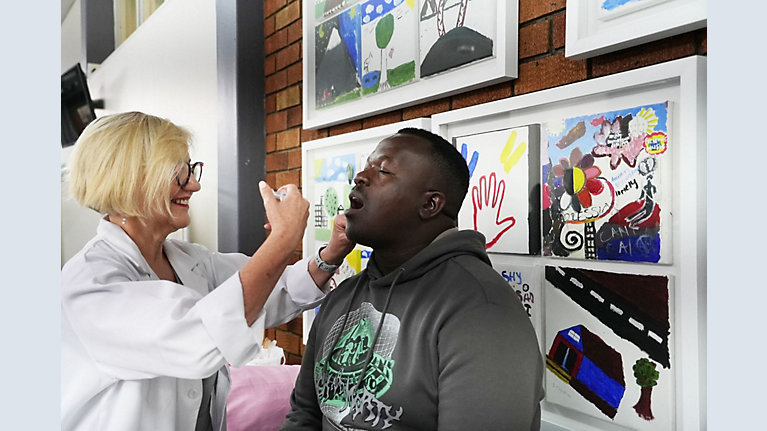
Phase 1 trials, coordinated by the South African Medical Research Council (SAMRC) and led by Professor Glenda Gray, began in October 2025 at the University of the Witwatersrand’s Perinatal HIV Research Unit (Wits PHRU). This initial stage involves a small group of healthy adults (approximately 60 participants) to assess safety and tolerability. 9 “Administration of the oral cholera vaccine during Phase 1 clinical trials in South Africa.” “LARGE”
If successful, the program advances to Phase 3—a larger comparative study enrolling up to 3,000 participants across multiple sites in Gauteng, Eastern Cape, and KwaZulu-Natal provinces, areas with historical cholera exposure. Here, Biovac’s OCV will be benchmarked against Euvichol-Plus for immunogenicity (antibody response) and efficacy. 5 “Vial of oral cholera vaccine, representative of the product under trial by Biovac.” “LARGE”
The entire process is projected to span 18 months, with potential approval for African use by 2028 and global rollout by 2028-2029. Gavi, the Vaccine Alliance, has introduced incentives for African-produced vaccines, enhancing market prospects.
Broader Implications: Aligning with Continental Goals
This vaccine is a flagship project under the African Union’s Partnerships for African Vaccine Manufacturing (PAVM) Framework for Action, launched in 2021 to shift from less than 1% local production to 60% by 2040. Recent expansions broaden PAVM’s mandate to include therapeutics and diagnostics, with pooled procurement mechanisms in development. 6 “Package and vial of an oral cholera vaccine, illustrating the life-saving technology Biovac is developing.” “LARGE”
The COVID-19 pandemic exposed Africa’s vulnerabilities to import dependencies, accelerating these efforts. Biovac’s success could inspire similar initiatives, fostering a robust ecosystem of manufacturers, researchers, and regulators.
Challenges and the Road Ahead
Despite optimism, hurdles remain: securing sustained funding, navigating regulatory harmonization across African nations, and ensuring equitable distribution. Global shortages persist, and climate-driven outbreaks show no signs of abating.
Yet, as Professor Gray noted during the launch, “This is a vital step in strengthening our ability to respond to infectious diseases.” If approved, Biovac’s OCV could save thousands of lives annually, reduce economic burdens from outbreaks, and affirm Africa’s capacity for scientific leadership.
In a year marked by health crises, this development stands as a testament to resilience and innovation. As trials progress, the continent watches with anticipation for a healthier, more self-reliant future.
Juba Global News Network commits to ongoing coverage of this pivotal story and Africa’s broader health advancements.
