

Oil Surges Above $100 as Iran Intensifies Attacks on Mideast Shipping
By Juba Global News Network | JubaGlobal.com March 12, 2026 LONDON / NEW YORK — Global oil prices blasted past the $100-per-barrel mark this week for the f
By Juba Global News Network | JubaGlobal.com
March 12, 2026
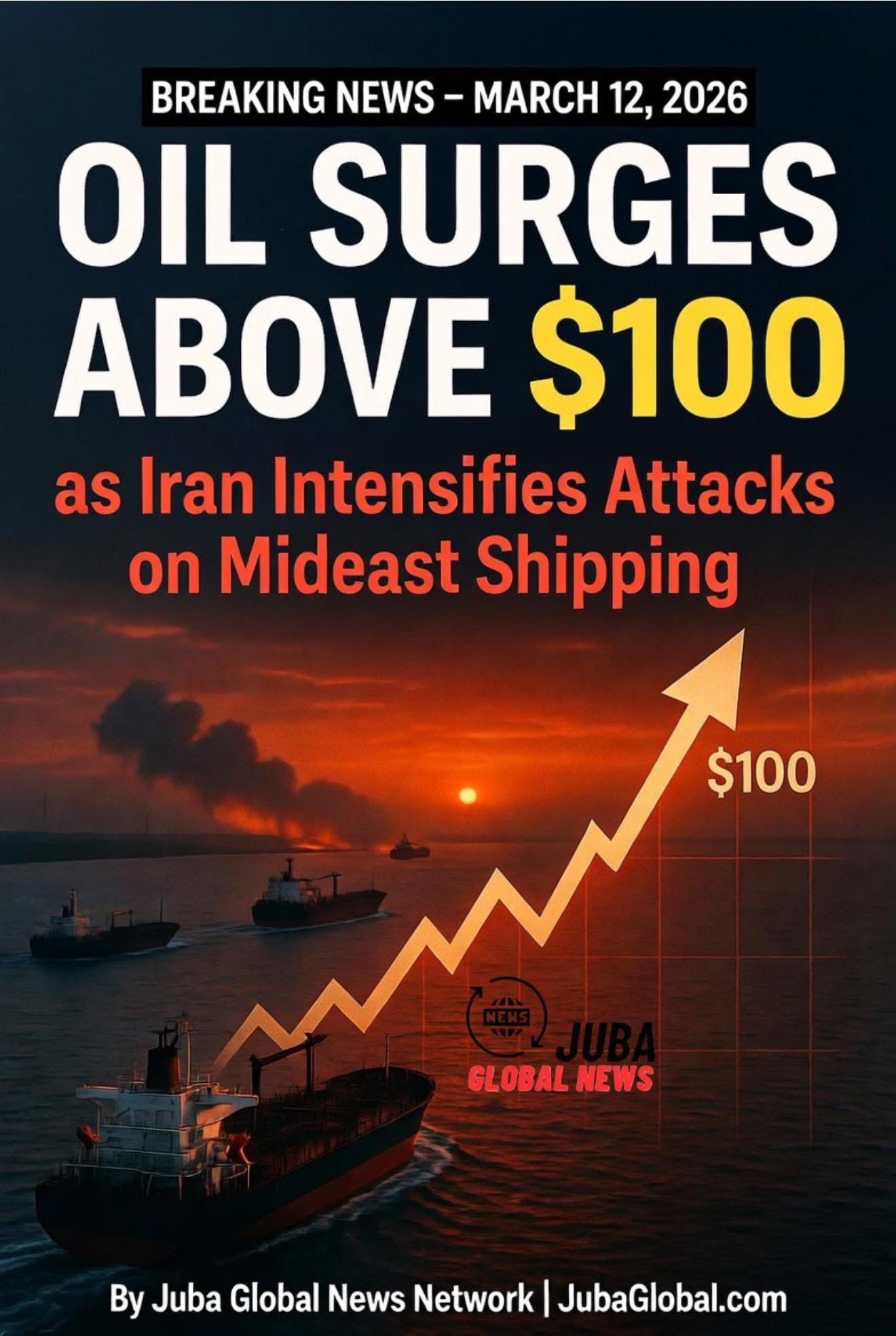
LONDON / NEW YORK — Global oil prices blasted past the $100-per-barrel mark this week for the first time since 2022, driven by Iran’s aggressive campaign to disrupt shipping in the Strait of Hormuz amid the escalating U.S.-Israel war on Iran. Brent crude futures spiked as high as $119.48 on Monday before volatile swings pulled them back to around $87–$91 by Wednesday, yet the psychological barrier of triple digits has rattled markets, governments, and consumers worldwide.
The trigger is unmistakable: Iranian forces have intensified attacks on commercial vessels and energy infrastructure in the Persian Gulf, effectively choking the narrow waterway that carries roughly 20% of the planet’s daily oil and liquefied natural gas supply. In the past 48 hours alone, at least three merchant ships were struck near or inside the Strait, including one tanker that caught fire, forcing its crew to abandon ship and leaving three mariners missing. British maritime monitoring groups and U.S. Central Command (CENTCOM) confirmed the incidents, with Iran appearing to claim responsibility for at least one strike on the tanker Mayuree Naree.
U.S. forces responded swiftly. On Tuesday, CENTCOM released dramatic video footage showing American strikes that destroyed 16 Iranian mine-laying vessels operating near the Hormuz chokepoint. “We will not allow Iran to turn this vital artery into a minefield,” a Pentagon spokesperson stated. Iranian Revolutionary Guard Corps commanders, however, doubled down, declaring they would permit “not one litre of oil” to leave the region while U.S.-Israeli attacks continue.
The Hormuz Crisis: From Threat to Reality
The Strait of Hormuz has long been Iran’s ace card in any conflict. For decades, Tehran has trained naval units and Revolutionary Guard speedboat squadrons specifically for “asymmetric warfare” in these confined waters. Now that plan is in motion.
Timelapse satellite imagery released by the BBC shows a dramatic collapse in shipping traffic since the U.S.-Israeli offensive began on February 28. What was once a steady stream of supertankers has slowed to a trickle. Insurance premiums for vessels transiting the Gulf have skyrocketed — some reports indicate rates up 400% in a single week. Major shipping lines including Maersk and COSCO have rerouted or suspended Gulf-bound voyages entirely.
Iranian state media broadcast footage of drone strikes on tankers and claimed successful hits on “enemy-linked” vessels. Independent verification from maritime security firms such as Dryad Global and EOS Risk confirms at least seven seafarer fatalities and multiple wounded since the campaign intensified. “This is no longer a theoretical threat,” said former NATO Supreme Allied Commander Adm. James Stavridis in a CNN interview. “The Iranians have 5,000 mines ready and decades of planning. They can turn the strait into a hellscape in days.”
Price Volatility Hits Record Territory
The market reaction was immediate and brutal. On Monday, West Texas Intermediate (WTI) futures jumped to $119.48 — their highest level in over three years — before profit-taking and mixed signals from Washington sent prices tumbling. Brent settled at $90.96 early Wednesday, still up more than 17% from pre-war levels around $73.
Analysts at Kpler and Goldman Sachs describe the swings as “the biggest supply shock since the 1973 oil embargo.” Even with the U.S. and its allies tapping strategic petroleum reserves — more than 30 countries coordinated releases this week — the physical disruption cannot be instantly replaced. Saudi Arabia and the UAE have promised to increase output, but analysts note their spare capacity is limited after years of OPEC+ cuts.
In the United States, the pain is already reaching the pump. The national average for regular gasoline climbed to $3.58 per gallon Wednesday, up from $2.98 before the conflict erupted. In California and the Northeast, prices have breached $4.20 in some markets. Trucking firms, airlines, and petrochemical manufacturers have issued profit warnings, while farmers face higher diesel costs ahead of spring planting.
Global Ripple Effects: Inflation, Recession Fears
The energy shock is rippling far beyond fuel costs. European leaders are openly discussing accelerated nuclear restarts and LNG imports from the United States and Qatar to offset the loss of Gulf supplies. China, the world’s largest oil importer, has activated emergency stockpiles while quietly increasing purchases from Russia and Brazil.
Top economists warn of a potential “butterfly effect.” KPMG chief economist Diane Swonk told Fortune that a prolonged conflict (three to six months) with sustained damage to Iranian and Gulf infrastructure could push oil above $130 and keep it elevated into 2027. That scenario, she said, would drive U.S. core inflation to 4.1% by year-end — levels not seen since 2023 — and trigger higher interest rates just as the Federal Reserve was hoping to ease.
Stock markets reflected the anxiety. Wall Street’s major indices fell sharply Monday before partial recovery, while European bourses and Asian markets posted their worst sessions in months. Gold and Bitcoin both surged as investors sought safe havens.
Washington’s Mixed Messages
President Donald Trump has alternated between reassurance and resolve. On Monday he posted on Truth Social that the war would end “very soon” and predicted oil prices would “drop rapidly” once victory is achieved. Hours later, Defense Secretary Pete Hegseth told reporters the campaign would continue “until the enemy is totally and decisively defeated” on America’s timeline.
The White House insists the disruption is temporary and points to record U.S. domestic production (now exceeding 13.5 million barrels per day) as a buffer. Texas oil executives, meanwhile, are quietly celebrating. “This is very good news for the oil industry,” one Houston-based analyst told the Texas Tribune. Shares in ExxonMobil, Chevron, and smaller shale producers jumped 8–12% on Monday.
Humanitarian and Strategic Fallout
Beyond economics, the human cost is mounting. Iranian officials report dozens of civilian deaths in port cities from collateral damage, while merchant mariners from India, the Philippines, and Ukraine find themselves caught in the crossfire. The United Nations has called an emergency Security Council session for Thursday to debate safe passage corridors.
Military analysts say Iran’s strategy is clear: inflict maximum economic pain to force Washington and Jerusalem into negotiations or to fracture the U.S.-led coalition. “They don’t need to sink every tanker,” one retired U.S. admiral noted. “They just need to make insurance impossible and scare every captain out of the water.”
Outlook: Short-Term Pain, Long-Term Uncertainty
For now, the world is watching every tanker movement and every Iranian drone launch. Energy ministers from the G7 met virtually Tuesday night to coordinate further reserve releases and contingency plans. OPEC+ is scheduled to convene an extraordinary session next week.
Consumers are being urged to conserve fuel where possible, while governments in Europe and Asia are dusting off 1970s-era rationing contingency documents. Airlines have begun surcharges; grocery chains warn of higher food prices as transport costs rise.
Juba Global News Network will continue to monitor developments in real time. As one senior oil trader in Singapore put it: “We’ve crossed $100. The question now is whether we ever come back down — or whether $100 is the new floor.”
This is a rapidly evolving story. Check JubaGlobal.com for live updates, price trackers, and expert analysis as the U.S.-Israel-Iran conflict reshapes the global energy landscape.
