

U.S.-Indonesia Trade Deal Finalized: 19% Tariffs Locked In, Opening Massive Market Access for American Goods
By: Juba Global News Network | JubaGlobal.com February 20, 2026 In a significant step forward for U.S. trade policy under President Donald Trump, the Unite
By: Juba Global News Network | JubaGlobal.com
February 20, 2026
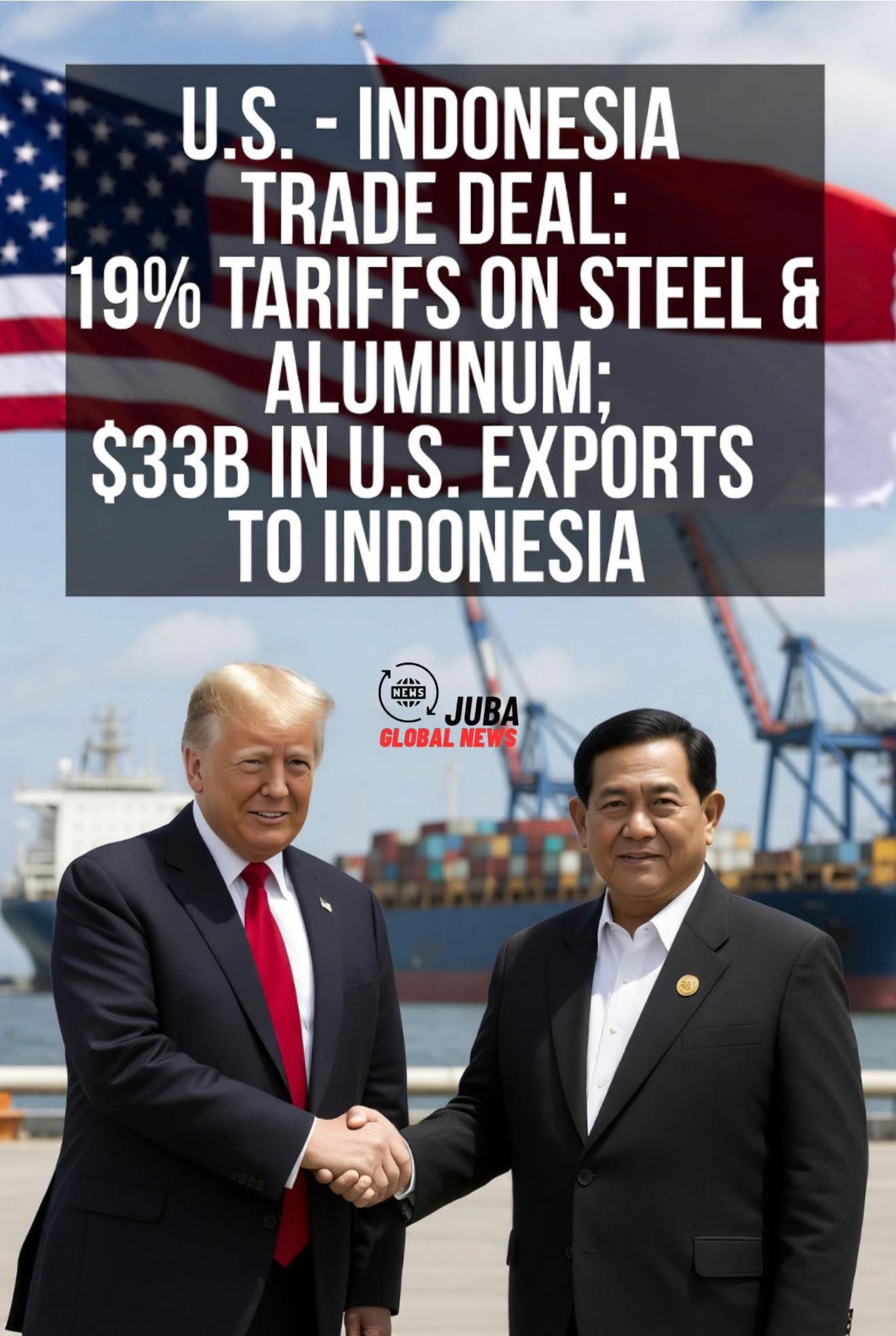
In a significant step forward for U.S. trade policy under President Donald Trump, the United States and Indonesia formally signed the Agreement on Reciprocal Trade on February 19, 2026. The deal locks in a 19% U.S. tariff rate on most Indonesian imports—down from a previously threatened 32%—while granting American exporters virtually tariff-free access to Indonesia’s massive market of over 280 million consumers.
The agreement, finalized during Indonesian President Prabowo Subianto’s visit to Washington for the inaugural meeting of Trump’s Board of Peace, marks Indonesia as the third Southeast Asian nation (after Malaysia and Cambodia) to secure such a reciprocal trade pact with the U.S. in recent months. It builds on a framework deal reached in July 2025 and reflects the Trump administration’s emphasis on “reciprocal” and “fair” trade to rebalance relationships and boost American manufacturing, agriculture, and exports.
Key Terms of the Agreement
According to the White House fact sheet and statements from the Office of the U.S. Trade Representative (USTR):
- Indonesia eliminates tariffs on over 99% of U.S. products exported to the country, covering sectors such as agriculture, health products, seafood, information and communications technology, automotive goods, and chemicals.
- The U.S. maintains a 19% reciprocal tariff on most Indonesian imports, with certain products (including key commodities like palm oil, coffee, cocoa, natural rubber, and spices) receiving exemptions or 0% rates.
- Indonesia agrees to dismantle numerous non-tariff barriers, including exemptions from local content requirements for U.S. companies, acceptance of U.S. federal safety and emission standards for vehicles, FDA standards for medical devices and pharmaceuticals, removal of burdensome certification and labeling rules, and elimination of pre-shipment inspection requirements.
- Commitments to resolve long-standing intellectual property issues, enhance transparency on geographical indications (e.g., for meats and cheeses), and prevent barriers to U.S. agricultural sales.
- Indonesia will support a permanent moratorium on customs duties for electronic transmissions at the WTO, ensure fair competition for U.S. digital payment services, and join the Global Forum on Steel Excess Capacity to address global overproduction.
- Both nations pledge cooperation on supply chain resilience, duty evasion prevention, export controls, investment security, and critical minerals. Indonesia will lift restrictions on exports of industrial commodities (including critical minerals) to the U.S.
- Indonesia commits to adopt and implement a forced labor import ban and reform labor laws to better protect workers’ rights to freedom of association and collective bargaining.
The deal is projected to facilitate major commercial activity, with Indonesian companies committing to purchase approximately $33 billion in U.S. goods and services. This includes:
- $15 billion in U.S. energy commodities.
- $13.5 billion in commercial aircraft and aviation-related products (notably from Boeing).
- Over $4.5 billion in U.S. agricultural products, with specific commitments like 1 million tons of soybeans, 1.6 million tons of corn, 93,000 tons of cotton, and 50,000 metric tons of beef annually.
Broader Strategic Context
The pact aligns with President Trump’s broader strategy of using tariff threats as leverage to secure better terms for American workers and industries. Last year, Trump had warned Indonesia of 32% tariffs if no agreement was reached, prompting swift negotiations. The 19% rate matches deals with Malaysia and Cambodia, creating a consistent framework across key Southeast Asian partners while pressuring others (like Vietnam, at 20%) to follow suit.
U.S. Trade Representative Jamieson Greer hailed the agreement as a “landmark” that advances economic and national security interests, unlocking opportunities for American farmers, manufacturers, and tech firms in one of the world’s fastest-growing economies.
Indonesian officials, including Economic Coordinating Minister Airlangga Hartarto, emphasized the deal’s benefits for bilateral ties and economic stability. President Prabowo described it as part of a “new golden age” in U.S.-Indonesian relations, helping narrow Indonesia’s trade surplus with the U.S. through increased American imports.
Economic Implications and Reactions
Economists view the deal as a win for U.S. exporters, particularly in agriculture and aerospace, where market access has long been restricted. American red meat producers, for instance, anticipate “tremendous gains” from guaranteed beef imports and reduced barriers.
For Indonesia, avoiding higher tariffs preserves export competitiveness in the U.S. market—its second-largest destination—while securing exemptions for flagship commodities like palm oil protects key industries.
Reactions have been largely positive from business groups on both sides, though some critics question the long-term reciprocity given the asymmetric tariff structure (near-zero for U.S. goods vs. 19% for most Indonesian ones). Supporters argue it strengthens alliances in the Indo-Pacific amid competition with China and enhances supply chain security for critical materials.
As implementation begins, both governments have instructed teams to move quickly on next steps. The agreement could serve as a model for future deals, reinforcing Trump’s “America First” trade agenda while fostering deeper economic ties in Southeast Asia.
Juba Global News Network will continue to track implementation progress, commercial deals, and any related developments in U.S.-Indonesia relations.
(Images: President Donald Trump and Indonesian President Prabowo Subianto shaking hands at the signing ceremony; U.S. and Indonesian flags with cargo ships and containers in the background; Graph showing projected $33 billion in U.S. exports to Indonesia; Boeing aircraft on tarmac symbolizing aviation deals)
