

U.S. THE END OF AID US Rescinds Protected Status for Ethiopians: A Shift in Policy, Humanitarian Hilarity and the Future of Thousands
By Juba Global News Network WASHINGTON D.C. – The United States Department of Homeland Security (DHS) has issued a notice that it will terminate the Tempor
By Juba Global News Network
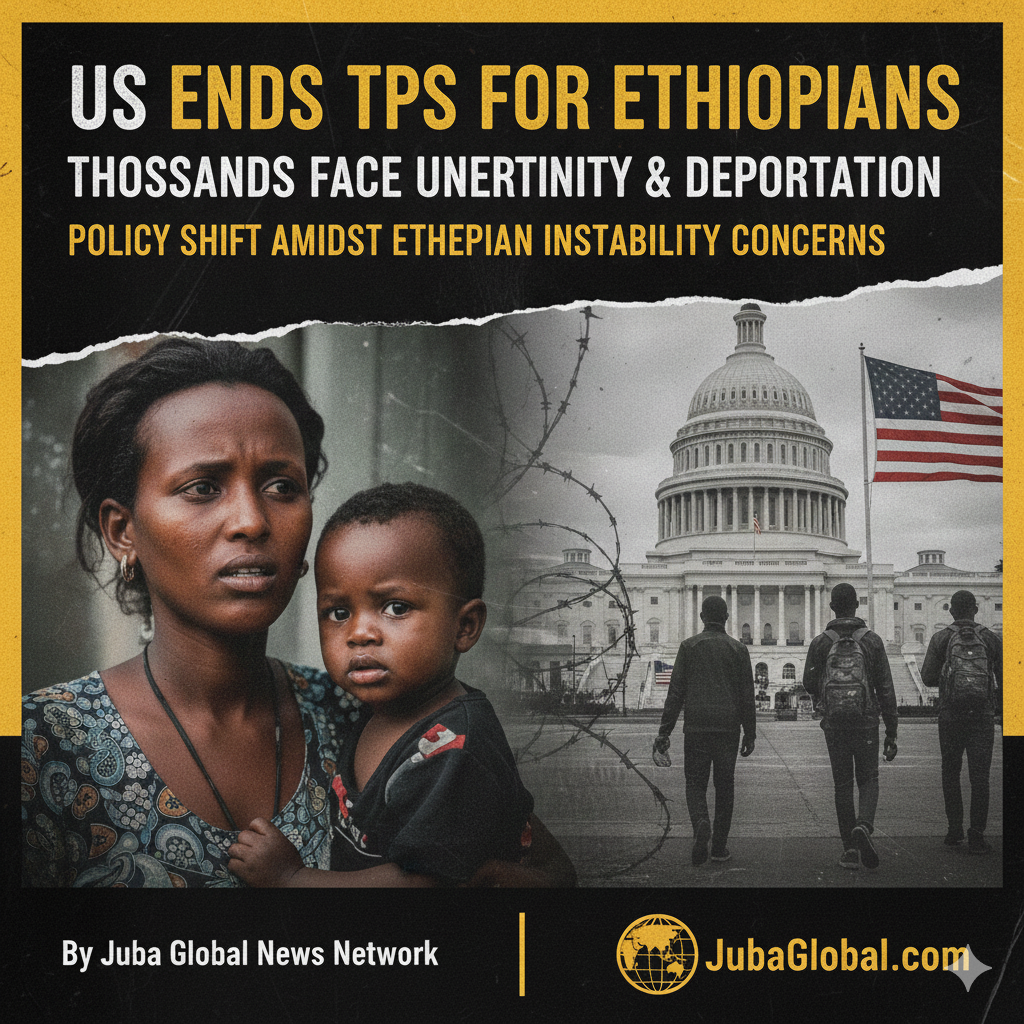
WASHINGTON D.C. – The United States Department of Homeland Security (DHS) has issued a notice that it will terminate the Temporary Protected Status (TPS) designation for Ethiopian nationals, effectively turning thousands of migrants who have legally lived and worked in the U.S. for decades into undocumented immigrants overnight. Effective Feb. 2026, following a 60-day wind-down period, this move is part of a larger trend in U.S. immigration policy on humanitarian designations and raises serious concerns about the current country conditions in Ethiopia.
The cancelation, formally declared by the Homeland Security secretary, stems from an assessment of conditions in Ethiopia. The secretary decided that the East African country “no longer meets the conditions for designation for Temporary Protected Status,” partly because there’s been a lessening in the severity of the armed conflict which was responsible for entitling them to protection.
Origin of the TPS for Ethiopia
Temporary Protected Status is a humanitarian program created by the U.S. Congress in 1990. It allows qualified people from certain countries to come and legally live and work in the United States for a renewable amount of time. A country can be granted TPS if temporary conditions in that country, such as war or a natural disaster, make it unsafe for its people to return home, based on — among other things:
- Continuing warfare (including civil war).
- An ecological crisis (from an earthquake or hurricane).
- Other exceptional and temporary measures.
Ethiopia was initially named for TPS in December of 2022, during a civil crisis that has included a devastating war in the Tigray region and large-scale humanitarian crises such as an historic drought. The designation was terminated and issued in early 2024, providing deportation protection as well as work permit eligibility for Ethiopian nationals who met the continuous residency and physical presence requirements.
The Impact: Thousands Given a Deadline
The end of Ethiopia’s TPS designation removes recipients’ temporary legal status. Official estimates differ, but according to the decision, between 4,500 and more than 30,000 Ethiopian nationals in this country depend on TPS for their livelihood.
After that termination date of Feb 13, 2026, it’s a sorry story for these people: - Departure: They would have to leave the United States on their own, usually back to a home country where they may already have few connections or resources. The DHS has provided a 60 day voluntary departure period.
- Adjustment of standing: All must first transfer to another lawful immigration status, which may include applications for asylum, family-based visas or employment based green cards. This procedure is usually complicated, costly and waiting periods are significant.
Deportation Risk: Those who do not receive an alternative lawful immigration status will become undocumented and subject to U.S. Immigration and Customs Enforcement (ICE) arrest and deportation Proceeding by the Department of Homeland Security (DHS). Additionally, people deported through the enforcement process may become subject to future legal re-entry bars in the U.S.
For the people who first arrived this year and have built lives in the U.S. — owning businesses, raising families, sending children to school or working jobs deemed essential in industries like health care, logistics and manufacturing — the news has brought immediate panic and uncertainty. Advocacy groups note that two months is not enough time for individuals to upend established lives and seek alternative ways of immigrating.
Disputed Conditions and Humanitarian Concerns
The central justification for ending it is the government’s claim that circumstances in Ethiopia are such now that they do not present a “serious threat to the personal safety of returning Ethiopian nationals.”
But this analysis is vigorously disputed by humanitarian groups and immigrant advocates: - Continuing Instability: Though a peace offering officially brought an end to the devastating war in Tigray, there is heavy violence and instability that still exists in other major regions particularly Amhara and Oromia. Intermittent but fierce fighting between federal and regional militias generates more displacement.
- Humanitarian Crisis: The nation continues to struggle with the ripple effects of war and one of the worst droughts in living memory. Vital assistance has been reduced or halted in certain locations, with millions of internally displaced persons (IDPs) not having enough to eat or cure their symptoms.
- The Fear of Return: Advocates say sending people with T.P.S. back to ongoing violence, famine or political persecution is a violation of humanitarian obligation. The circumstances not that long ago necessitating protection — mass instability, widespread violence and infrastructure collapse — remain only partially addressed.
A Tradition in US Immigration Policy
The end of Ethiopia’s TPS designation is not a standalone action but rather part of an apparent, and controversial, pattern towards the winding down of humanitarian programs in U.S. immigration policy. In recent months, the administration has announced or approved the ending of protective status for citizens of several other nations, including Haiti and Myanmar (also known as Burma), South Sudan and Syria; Venezuela was added to that list this year, and Somalia last year.
Critics say the administration is “weaponizing” humanitarian designations to push migrants to go home, noting that TPS — though temporary by definition — is being canceled based on an overly optimistic view of country conditions. Supporters, however, argue that the program was never intended to be anything but a temporary one and stretching it out indefinitely defies the law and undermines an immigration system that should be based on honesty.
The legal war over these terminations is expected to escalate as advocates challenge DHS’s finding of improved conditions in court. The results of these challenges will establish critical monuments to the future of humanitarian protection in the U.S.
The Road Ahead
For the Ethiopian nationals affected, the next few months will be an excruciating race against time. They are also being urged to seek immigration lawyers asap in order to consider all possible avenus for legal recourse, including applying for asylum or alternative employment visas, and family-based options.
The decision to end TPS for Ethiopia underscores the fine line between a country’s sovereign prerogative to determine control its borders and its humanitarian duty to shield people from war and disaster. The lives of thousands are now hanging in the balance as we reach the February 2026 deadline and with it, the world’s focus is once again fixed on the implications of a far-reaching policy framework.
Juba Global News Network will monitor the legal and humanitarian aspects of ending TPS for Ethiopians.
What else should we learn about U.S. immigration policy or the situation in Ethiopia?
