ECOWAS Declares Regional State of Emergency: West Africa’s Fragile Democracies Get a Wake-Up Call
By: Juba Global News Network
December 10, 2025
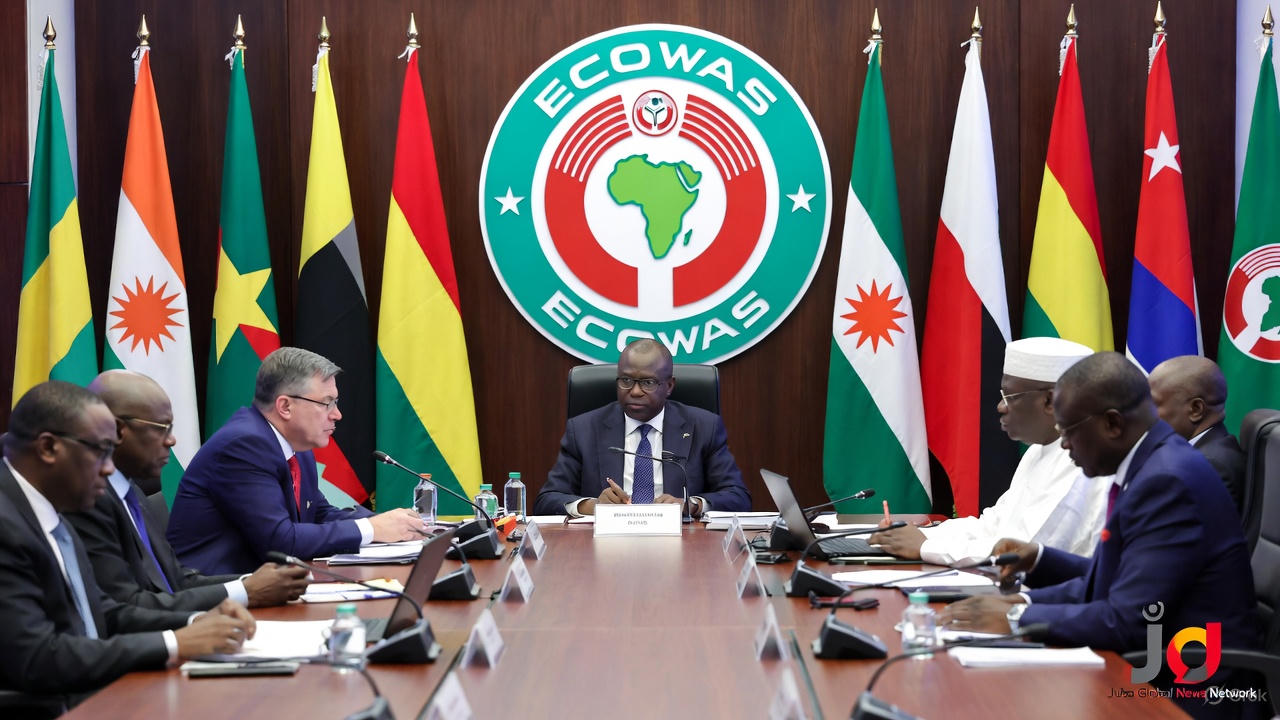
In a striking turn of events aiming to halt the surge of political upheaval gripping both the Sahel and the West African coastline, the Economic Community of West African States (ECOWAS) has stepped up to declare a regional state of emergency. The announcement landed on December 9, 2025, during the 55th Ordinary Session of the Mediation and Security Council held in Abuja, Nigeria. With this unprecedented decision, the bloc appears pushed to the edge—facing an onslaught of military takeovers, thwarted mutinies, and the relentless spread of jihadist violence.
Omar Alieu Touray, President of the ECOWAS Commission, minced no words: “Faced with this situation, Excellencies, it is safe to declare that our community is in a state of emergency.” His statement rings out as both a blunt diagnosis and what almost sounds like a desperate call for unified action. The timing is critical for the now 50-year-old regional institution, which for decades has styled itself as a firewall against unconstitutional power grabs. But as juntas dig in their heels across crucial member states and outside pressures keep mounting, the very relevance and effectiveness—perhaps even the survival—of ECOWAS comes under scrutiny.
So, what exactly does this emergency mean? Why now, of all times? And is there a real shot at reversing the democratic unraveling that’s left millions homeless and economies wrecked? Well, let’s look at the roots, consequences, and what’s next for this union that just can’t seem to catch a break.
The Gathering Storm: Tracing the Timeline of Upheaval
West Africa didn’t tumble into chaos overnight—and really, no one paying attention would say any of this came out of nowhere. Going back to 2020, the region’s been rocked by at least eight coups (or attempts), shattering that brief post-Cold War period when democracy seemed to be taking hold. The Sahel stands out as ground zero: insurgencies linked to al-Qaeda and ISIS have exploited weak governance to snatch up swathes of land, uprooting entire communities and pushing resources past the breaking point.
Recent events only drive home the urgency. Just on December 7, 2025, a cluster of Beninese military officers launched a bold, if ultimately failed, attempt to topple President Patrice Talon. Loyalist troops, with a little help from French surveillance and logistics, shut it down. Not long before, Guinea-Bissau went through the real thing: army factions scrapped presidential election results, tossed out the constitution, and threw their support behind a junta led by Colonel Umaro Sissoco Embaló’s allies. Go back a bit further this year and you’ll find Guinea and Sierra Leone’s already-precarious transitions tottering amid election violence and fraud allegations.
All of this is just the tip of the iceberg. Mali’s 2021 coup, the double military shakeups in Burkina Faso (2022), and Niger’s 2023 putsch together gave rise to the Alliance of Sahel States (AES)—a rebel group of military regimes that ditched ECOWAS at the start of 2025. They blamed the bloc’s “imperialist” sanctions and its failure to tackle terrorism, for what it’s worth. With the AES breaking off, regional security structures have pretty much splintered, opening the door to unchecked cross-border jihadist attacks.
Touray, speaking in Abuja, didn’t sugarcoat things: “Terrorism and banditry operate without respect for territorial boundaries.” It’s a humanitarian disaster—over 7.6 million people now forcibly displaced (including 6.5 million internally), according to UNHCR numbers from October 2025. The hardest-hit? Nigeria, Burkina Faso, Niger, and Mali. Meanwhile, places like Côte d’Ivoire and Togo are struggling to absorb the flood of asylum seekers.
Bad Governance: The Match That Lights the Coup Powder Keg
It’s “bad governance” that sits at the heart of ECOWAS’s current panic—a phrase Touray used to sum up the toxic brew of corruption, exclusion, and economic mismanagement that’s stripped away public trust and set the stage for military interventions. Timothy Kabba, Sierra Leone’s Foreign Minister and the Council’s current Chairman, hammered this point home in Abuja, calling the recent coups “sobering reminders of the fragility of our democratic gains.” He also recounted how he’d led a team to Guinea-Bissau on December 1, 2025, to try to open talks with the junta—just a glimpse into the diplomatic high-wire act ECOWAS now walks.
Observers, for their part, blame this instability on deep-rooted failures. Youth unemployment in the Sahel is stuck between 40% and 50%, at least according to World Bank figures. Climate disasters—floods, droughts—have slashed crop yields by half in Burkina Faso and Niger since 2020. Elite networks, accused of nepotism and siphoning off resources, have widened the gap between rich and poor; look at Mali, where gold profits (it’s Africa’s third-biggest producer) mostly land in the pockets of a connected minority, fueling bitterness. Elections, supposedly a pressure valve for democracy, have just become another flashpoint: Guinea-Bissau’s disputed votes and Benin’s fraught 2026 election prep echo the violence that unseated leaders in Niger and Gabon.
External actors aren’t exactly helping. Russia’s Wagner Group (now rebranded as Africa Corps) is ensconced in Mali and Burkina Faso, swapping security help for mining rights while sidelining both ECOWAS and Western backers. Meanwhile, with France losing ground and China dangling infrastructure loans, alliances are more fractured than ever. AES leaders, for their part, rail against ECOWAS as a “neo-colonial puppet.”
The Emergency Unveiled: What’s Actually Changing?
So, what does a “state of emergency” even mean when declared by ECOWAS for its 15 members? Unlike what you might see with a national emergency, this regional move kicks key bloc protocols into high gear—the 1999 Mechanism for Conflict Prevention and the 2001 Democracy and Good Governance Supplementary Protocol, to be exact. Touray sketched out some immediate must-dos: tightening up security cooperation, sharing resources to fight cross-border threats, and sitting down with AES in hopes of hammering out joint anti-terrorism deals.
The big steps? Here’s the rundown:
- Standby Forces Deployed: After Benin’s coup was foiled, ECOWAS green-lit its multinational Standby Force—troops from Nigeria, Ghana, and Senegal are now set to stabilize hotspots. Nigeria’s Senate signed off on sending more soldiers to Benin on December 9, a move the Nigerian Governors’ Forum said helped dodge a “key security threat.”
- Sanctions and Diplomatic Moves: Expect sharper penalties for junta holdouts—think asset freezes, travel bans—alongside some carrots for those willing to transition back to democracy. The Abuja council’s proposals will be reviewed at an upcoming summit of Heads of State, which could speed up changes to the bloc’s anti-coup playbook.
- Humanitarian and Economic Support: With more people displaced than ever, ECOWAS is promising to beef up funding for the Regional Food Security Reserve—ironically, a lifeline that AES states like Mali have relied on in the past. The group’s pushing for stronger economic ties, using the ECOWAS Common External Tariff, to shore up trade battered by sanctions.
Ramifications: A Region Teetering on the Edge
The stakes really couldn’t be higher. If left unchecked, military coups could normalize authoritarian rule, undercutting the African Union’s zero-tolerance policy and possibly emboldening similar moves in places like Côte d’Ivoire or Togo. Economically, fragmentation puts the $700 billion regional market at risk; AES’s exit has already pushed transport costs up by about 30% along Sahel trade routes. On the security front, jihadist strongholds in lawless zones could threaten coastal states—Nigeria’s northeast alone is now home to three million people uprooted by Boko Haram.
For ordinary people, the impact is immediate and harsh. Burkina Faso’s got more than two million internally displaced folks, many facing WFP-classified famine emergencies. Women and young people, as usual, suffer the most—bearing the brunt of gender violence and dashed prospects.
Looking outside the region, the crisis is a test for global cooperation. The U.S. and EU—major ECOWAS funders—could ramp up their support (they’ve already pledged $500 million post-Abuja) but will probably demand stronger accountability. Russia and China, busy wooing the AES, might only deepen divisions, risking West Africa’s slide into a new kind of proxy conflict.
Pathways Forward: Rebuilding in the Aftermath
This emergency declaration from ECOWAS—let’s be honest—serves as a loud and clear warning. But turning things around is going to take a lot more than tough talk. So, tackling “bad governance” really starts with giving more power to civil society. Stuff like transparent elections, dedicated anti-corruption courts, and maybe even quotas to bring more young people into politics—these could go a long way toward rebuilding lost trust. Then, there’s the issue of security: any sort of pact with the AES, possibly with the AU stepping in as a mediator, ought to emphasize sharing intelligence rather than just escalating confrontations. On the economic front, resilience matters—a lot. Adapting agriculture to the changing climate and boosting digital trade might just be what blunts the temptation for coups.
When Touray spoke about ECOWAS’s “commitment to its citizens,” and called for unity during these “geopolitical pressures,” it was clear that any true revival depends on some real self-reflection: it’s about undoing exclusion and holding people accountable, not just grandstanding. Right outside those polished conference halls in Abuja, you can almost feel that West Africa’s future is still up in the air. The state of emergency? It’s not a conclusion. It’s more of a starting gun—assuming leaders are ready to take its lessons seriously.
For the 400 million people from Bamako’s bustling markets to Lagos’s hectic ports, the decision really couldn’t be more urgent: either come together and face the storm, or risk letting democracy’s already fragile light go out for good. The whole world might be watching, but when you get down to it, the responsibility—and the real power—sits squarely with the region itself.