

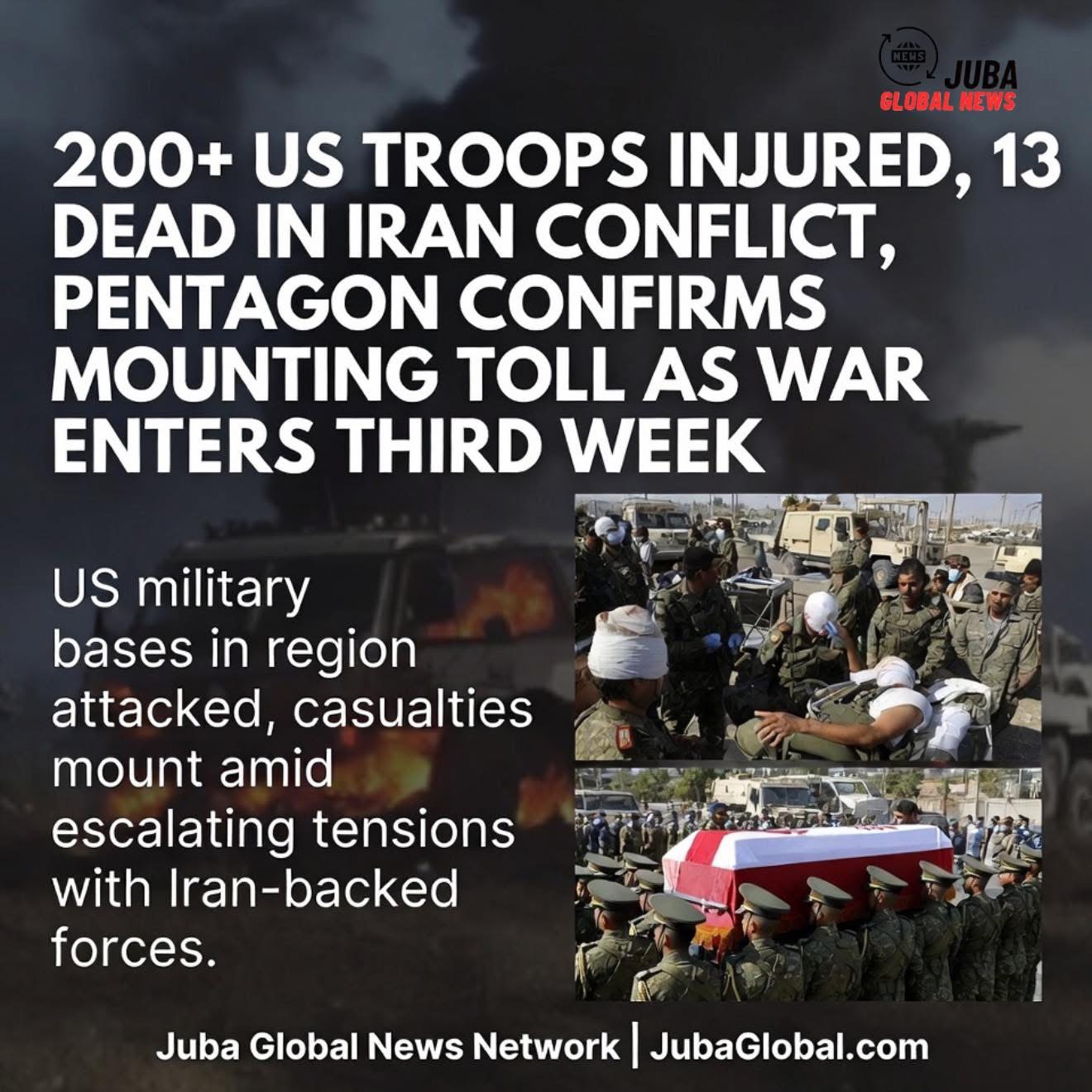
200+ US Troops Injured, 13 Dead in Iran Conflict — Pentagon Confirms Mounting Toll as War Enters Third Week
By Juba Global News Network | JubaGlobal.com March 17, 2026 WASHINGTON / DOHA / BAGHDAD — The Pentagon has officially confirmed that more than 200 American
By Juba Global News Network | JubaGlobal.com
March 17, 2026
WASHINGTON / DOHA / BAGHDAD — The Pentagon has officially confirmed that more than 200 American service members have been wounded since the United States and Israel launched coordinated military operations against Iran on February 28, with at least 13 fatalities now attributed directly or indirectly to the conflict.
In a briefing Monday afternoon, a senior Defense Department spokesperson stated that the casualty figures reflect injuries and deaths across multiple regional bases in six countries, primarily from Iranian ballistic missile barrages, drone swarms, and proxy militia attacks. The toll represents the highest number of US casualties in the Middle East in a single campaign since the peak years of the Iraq War (2003–2011).
“These numbers are tragic but reflect the intense, asymmetric nature of the threats our forces continue to face,” the spokesperson said. “Our service members are performing with extraordinary courage under fire, and we are providing the best possible medical care to the wounded.”
Breakdown of Casualties
According to CENTCOM and Pentagon updates compiled from March 1–17:
• Killed in action or conflict-related incidents: 13 confirmed deaths.
• Seven from direct enemy fire, including missile strikes on forward operating bases in Iraq, Saudi Arabia, and Kuwait.
• Six crew members of a KC-135 Stratotanker refueling aircraft that crashed in western Iraq on March 12–13 after reportedly sustaining damage from ground fire or a near-miss drone strike. All aboard were lost, with no survivors.
• Wounded: Approximately 200–210 service members.
• Around 30 remain not yet cleared to return to duty, with some in serious or critical condition at Landstuhl Regional Medical Center in Germany or US military hospitals in the region.
• The majority of injuries stem from shrapnel, blast trauma, and concussive effects from Iranian missile and drone attacks on bases hosting US personnel.
Notable incidents contributing to the toll include:
• March 1–2: Iranian ballistic missiles targeted Al Udeid Air Base in Qatar and Prince Sultan Air Base in Saudi Arabia, injuring dozens and killing at least one service member who later succumbed to wounds.
• March 3: A drone strike on a US facility in Kuwait killed four personnel initially, with additional deaths reported from follow-on attacks.
• Ongoing: Rocket and drone attacks by Iranian-backed militias in Iraq have caused scattered casualties at bases near Baghdad and Erbil.
Human Stories Behind the Numbers
While the Pentagon has released limited details to protect operational security and next-of-kin notifications, some profiles have emerged through family statements and media reports:
• Sgt. First Class Michael Reyes, 34, from Texas — Killed in the KC-135 crash. A married father of two, Reyes was a boom operator with over 1,200 flight hours. His wife told local news outlets he had volunteered for the deployment “because someone has to keep our guys safe in the air.”
• Spc. Aisha Thompson, 25, from Georgia — Severely wounded by shrapnel during a March 8 missile barrage on a logistics hub in Iraq. Currently recovering at Walter Reed, Thompson’s family described her as “fighting every day like the warrior she is.”
• Multiple unnamed airmen and soldiers from the crash in Iraq, including pilots and maintainers, whose families have shared tributes on social media calling for prayers and swift resolution.
The Department of Defense continues to notify families before public identification in most cases, leading to a lag between confirmed deaths and named releases.
Broader Context and Strategic Implications
The casualty figures arrive as the US-Israeli campaign—officially termed Operation Epic Fury—enters its 18th day with no immediate signs of de-escalation. US strikes have focused on degrading Iran’s missile production, air defenses, and IRGC command infrastructure, while Iran has responded with waves of drones, missiles, and proxy operations designed to inflict steady attrition on coalition forces.
President Donald Trump addressed the casualties briefly during a White House remarks session, saying: “These are brave Americans, the best we have. Iran will pay a very heavy price for every single one of them. We don’t start wars, but we finish them—and we finish them decisively.”
Military analysts note that while the numbers remain relatively low compared to past prolonged conflicts (e.g., thousands killed in Iraq/Afghanistan over years), the pace—13 dead and 200+ wounded in under three weeks—underscores the risk of escalation if Iran sustains its retaliatory campaign or if US forces expand ground operations.
Pentagon officials emphasize robust medical evacuation chains (the “golden hour” doctrine) and advanced body armor/trauma care have limited fatalities relative to injuries. Still, the wounded figures highlight the persistent threat from precision-guided Iranian munitions and low-cost drone swarms.
Global and Domestic Reactions
• At home: Bipartisan calls in Congress for clearer end-state objectives and regular classified briefings. Gold Star families and veterans’ groups have begun organizing vigils outside the White House and Pentagon.
• Allies: NATO partners expressed condolences but reiterated reluctance to commit combat forces, focusing instead on defensive support and intelligence sharing.
• Iran: State media downplayed US losses while amplifying claims of “hundreds” of coalition casualties and portraying Iranian strikes as precise and proportionate.
As the conflict grinds on, the human cost to American forces serves as a stark reminder of the stakes. Juba Global News Network will continue tracking official updates, family statements, and battlefield developments.
