US Confirms 3 Troops Killed, 5 Wounded in Iran Operation; Trump Warns of More Casualties
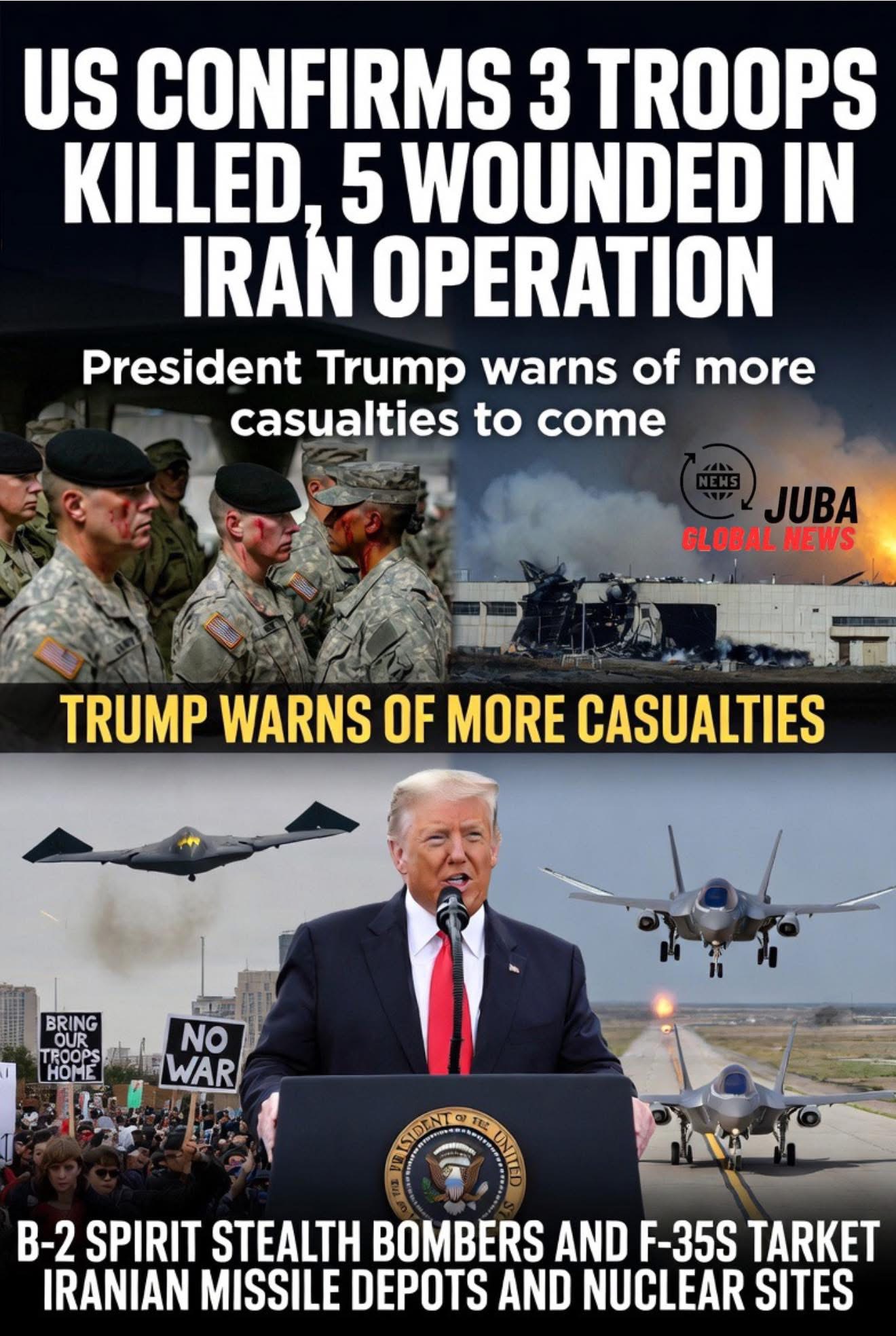
As the joint U.S.-Israeli military campaign against Iran—now officially in its third day on March 2, 2026—enters a more dangerous phase, the Pentagon has confirmed the first American combat losses since the operation began. Three U.S. service members were killed and five others wounded in attacks attributed to Iranian retaliatory missile and drone strikes targeting coalition positions in the Gulf region. President Donald Trump, speaking from the White House Situation Room late on March 1, acknowledged the casualties directly, warning that “more losses are likely” as the mission continues to degrade Iran’s ballistic missile capabilities, nuclear infrastructure, and remaining command structure following the assassination of Supreme Leader Ayatollah Ali Khamenei.
The First Confirmed U.S. Casualties
The deaths and injuries occurred during a series of Iranian ballistic missile barrages launched in the early hours of March 1 (Day 2 of the conflict). U.S. Central Command (CENTCOM) identified the incidents at multiple forward operating locations:
- Camp Arifjan, Kuwait — A base housing thousands of U.S. troops and coalition forces — took direct hits from at least two Iranian Fateh-110 class short-range ballistic missiles. Initial reports indicate that shrapnel and secondary explosions from nearby fuel storage caused the fatalities and wounds.
- Al Udeid Air Base, Qatar — Home to the forward headquarters of U.S. Air Forces Central — sustained damage from a drone swarm, though Patriot and THAAD interceptors downed the majority of incoming threats. Several service members were injured by blast effects and flying debris.
- Naval Support Activity Bahrain — The headquarters of U.S. Naval Forces Central Command (NAVCENT) and the Fifth Fleet — reported minor structural damage and personnel injuries from a cruise missile that was partially intercepted.
The three killed were identified (pending family notification) as members of different branches: one Army soldier, one Air Force airman, and one Navy sailor. The wounded, ranging from moderate to serious injuries, were evacuated to Landstuhl Regional Medical Center in Germany or treated on-site at expeditionary medical facilities.
Pentagon Press Secretary Maj. Gen. Pat Ryder stated in a briefing: “These brave Americans were supporting defensive operations to protect our partners and deter further Iranian aggression. Their sacrifice will not be in vain.”
Trump’s Statement: “We Will Finish What We Started”
In a nationally televised address delivered from the Oval Office, President Trump addressed the nation for the first time since the initial strikes on February 28:
“We took out 48 of their top leaders—including the so-called Supreme Leader—in one night. That was surgical, precise, and necessary. Now Iran is lashing out like a wounded animal. We’ve lost three great patriots tonight. Five more are wounded and fighting for their lives. I want every American to know: these losses hurt. They hurt deeply. But we knew going in that this would not be bloodless. More casualties are likely. I won’t sugarcoat it. But we will not stop until Iran’s ballistic missile program is crippled, their nuclear ambitions are ended for good, and they can never threaten us or our allies again.”
Trump emphasized that the operation—referred to in Israeli media as “Roar of the Lion” and by U.S. officials simply as “ongoing defensive and preemptive actions”—was expected to last “four weeks or less,” though he left open the possibility of extension if objectives were not met.
He also directly addressed Iran’s interim leadership: “You can end this today. Stop the missiles, come to the table, and we can talk. Or keep fighting—and we will finish what we started.”
Operational Context: Air Dominance vs. Asymmetric Threats
Despite the casualties, U.S. and Israeli officials maintain that coalition air forces retain overwhelming superiority. B-2 Spirit stealth bombers, F-35s, F-22s, and Israeli F-15Is have conducted hundreds of sorties, targeting IRGC missile depots, command bunkers in Tehran, suspected nuclear enrichment sites near Natanz and Fordow, and coastal anti-ship missile batteries.
However, Iran’s response has relied heavily on its large arsenal of mobile short- and medium-range ballistic missiles (estimated 3,000+ before the conflict), cruise missiles, and low-cost drones—many launched from hardened underground facilities that have proven difficult to neutralize completely in the opening days.
The use of saturation attacks—firing dozens to hundreds of projectiles simultaneously—has occasionally overwhelmed localized defenses, particularly at Gulf bases where Patriot batteries are spread thin protecting multiple sites.
Broader Implications and Domestic Reaction
The confirmation of U.S. deaths has already intensified domestic debate:
- Congressional leaders from both parties expressed support for the troops while calling for clearer end-state objectives.
- Anti-war protests began forming outside the White House and in several major cities, with organizers citing fears of another prolonged Middle East conflict.
- Oil prices, already up 13% due to Strait of Hormuz threats, climbed further on news of U.S. casualties, reflecting investor concerns about escalation.
Allied reactions were mixed: Gulf states quietly bolstered defenses and allowed continued use of their bases, while European capitals urged de-escalation and humanitarian corridors.
Looking Ahead: Sustained Operations and Rising Risks
With no signs of Iranian capitulation—and Hezbollah now actively engaged on Israel’s northern border—the Pentagon is preparing for a prolonged air campaign. Additional carrier strike groups are moving into the region, and prepositioned munitions stocks in Diego Garcia and other locations are being drawn down.
For the families of the fallen and wounded, the pain is immediate and personal. For the broader American public and the world watching, the question is how high the cost will climb before either side seeks—or is forced into—a path back from the brink.
As Day 3 continues, every missile launch, every intercept, and every casualty count brings the conflict closer to a point of no easy return.
By Juba Global News Network | JubaGlobal.com
March 2, 2026
Stay tuned for live updates as this fast-moving story develops.