Russia Losing Thousands of Troops Per Mile Gained in Ukraine: NATO Commander Assessment Highlights Brutal Attrition in Grinding War
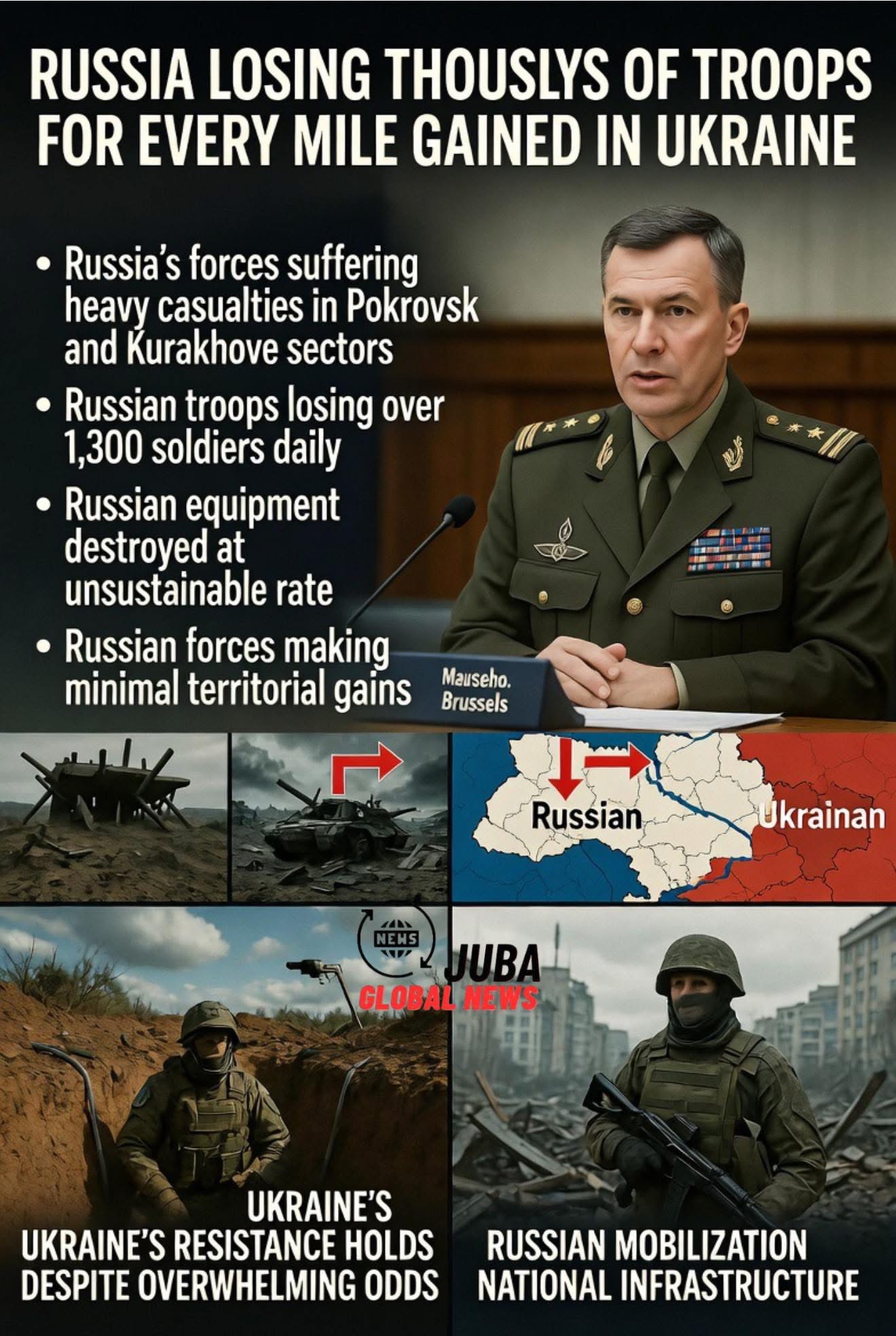
A senior NATO commander delivered a sobering assessment on February 26, 2026, stating that Russian forces are suffering extraordinarily high casualties—often thousands of troops killed or wounded—for every mile of territory gained in eastern Ukraine. The blunt evaluation, delivered during a closed-door briefing to alliance defense ministers in Brussels and later partially declassified for public release, underscores the attritional nature of the conflict now entering its fifth year and raises fresh questions about Moscow’s ability to sustain its offensive momentum.
General Christopher G. Cavoli, Supreme Allied Commander Europe (SACEUR), told the NATO Military Committee that Russian advances in key sectors—particularly around Pokrovsk, Kurakhove, and Vuhledar in Donetsk oblast—were coming at an “unsustainable cost.” According to intelligence estimates shared with allies and corroborated by Ukrainian General Staff figures, Russia has lost between 1,200 and 2,000 soldiers (killed and severely wounded) for every kilometer (roughly 0.62 miles) of ground seized since the beginning of the intensified autumn–winter campaign in late 2025.
“Russia is buying meters with blood,” Cavoli reportedly said. “The casualty-to-terrain ratio is among the worst we have seen in modern conventional warfare since World War II.” He cited satellite imagery, signals intelligence, and open-source geolocation of Russian military cemeteries and casualty reporting channels showing that entire battalion tactical groups—once the backbone of Russian maneuver warfare—were being chewed up in weeks-long assaults on fortified Ukrainian positions.
The Numbers Behind the Attrition
Ukrainian military intelligence (HUR) and Western estimates place total Russian casualties (killed and wounded) since February 2022 at between 650,000 and 800,000, with the most intense losses occurring since the failed summer 2023 counteroffensive and the subsequent Russian grinding campaign. In the past six months alone (September 2025–February 2026), Russia is believed to have suffered over 180,000 casualties while capturing approximately 1,200–1,500 square kilometers—mostly in Donetsk and small salients in Kharkiv and Luhansk oblasts.
Breaking it down geographically:
- Pokrovsk direction: Russian forces advanced roughly 12–15 km in six months at an estimated cost of 60,000–80,000 casualties.
- Kurakhove–Velyka Novosilka axis: Gains of 8–10 km came with losses approaching 50,000.
- Overall eastern front: Average exchange rate of 1,500–2,000 casualties per kilometer gained, with some heavily contested villages (e.g., Kurakhove, Novohrodivka) costing several thousand lives for control of a few hundred meters.
These figures do not include the destruction of Russian equipment—estimated at over 14,000 tanks, armored vehicles, and artillery systems lost since 2022—nor do they account for the steady drain on Russia’s professional contract soldiers, forcing greater reliance on poorly trained mobilized reservists, convicts recruited from prisons, and foreign fighters.
Why the High Cost?
NATO and Ukrainian commanders attribute Russia’s staggering losses to several factors:
- Ukrainian defensive depth and fortifications: Multi-layered trench systems, minefields, drone swarms, and precision artillery (especially HIMARS and Excalibur rounds) have turned frontal assaults into meat-grinder operations.
- Poor Russian tactics: Repeated use of small infantry assaults (“meat waves”) without adequate combined-arms support, limited use of maneuver, and failure to achieve air superiority.
- Logistical strain: Extended supply lines, Ukrainian deep strikes on ammunition depots and rail hubs, and winter conditions have compounded casualties.
- Manpower quality: The replacement of experienced units with hastily trained recruits has reduced combat effectiveness and increased vulnerability.
Cavoli emphasized that while Russia retains numerical advantages in manpower and artillery shells, the quality gap is widening: “They can replace bodies faster than Ukraine, but not at zero cost. The math is brutal.”
Implications for 2026
The assessment comes as both sides face critical junctures:
- Russia: High casualties strain domestic morale, recruitment, and the economy. Putin has avoided full mobilization since 2022, but pressure is growing to either scale up conscription or seek a political off-ramp.
- Ukraine: Despite inflicting massive losses, Kyiv struggles with ammunition shortages, delayed Western aid, and manpower constraints. The high Russian casualty rate buys time—but time alone does not win wars without sustained resupply.
- NATO: The alliance is accelerating production of artillery shells (targeting 2 million rounds annually by 2027) and pushing for long-range strike capabilities to be delivered to Ukraine.
Cavoli concluded the briefing with a warning: “Russia is bleeding profusely, but it has not yet bled out. Ukraine must be given the means to turn tactical attrition into strategic defeat.”
As the war grinds into its fifth year, the stark reality laid out by NATO’s top commander is clear: every mile Russia gains comes at a price that may ultimately prove unaffordable—even for a country willing to pay in blood.
(Compiled from NATO briefings, Ukrainian General Staff daily reports, British Ministry of Defence intelligence updates, Institute for the Study of War assessments, Reuters, BBC, Financial Times, and The Economist as of February 27, 2026. Casualty estimates remain contested and are based on intelligence assessments; official Russian figures are significantly lower and considered unreliable by Western governments.)