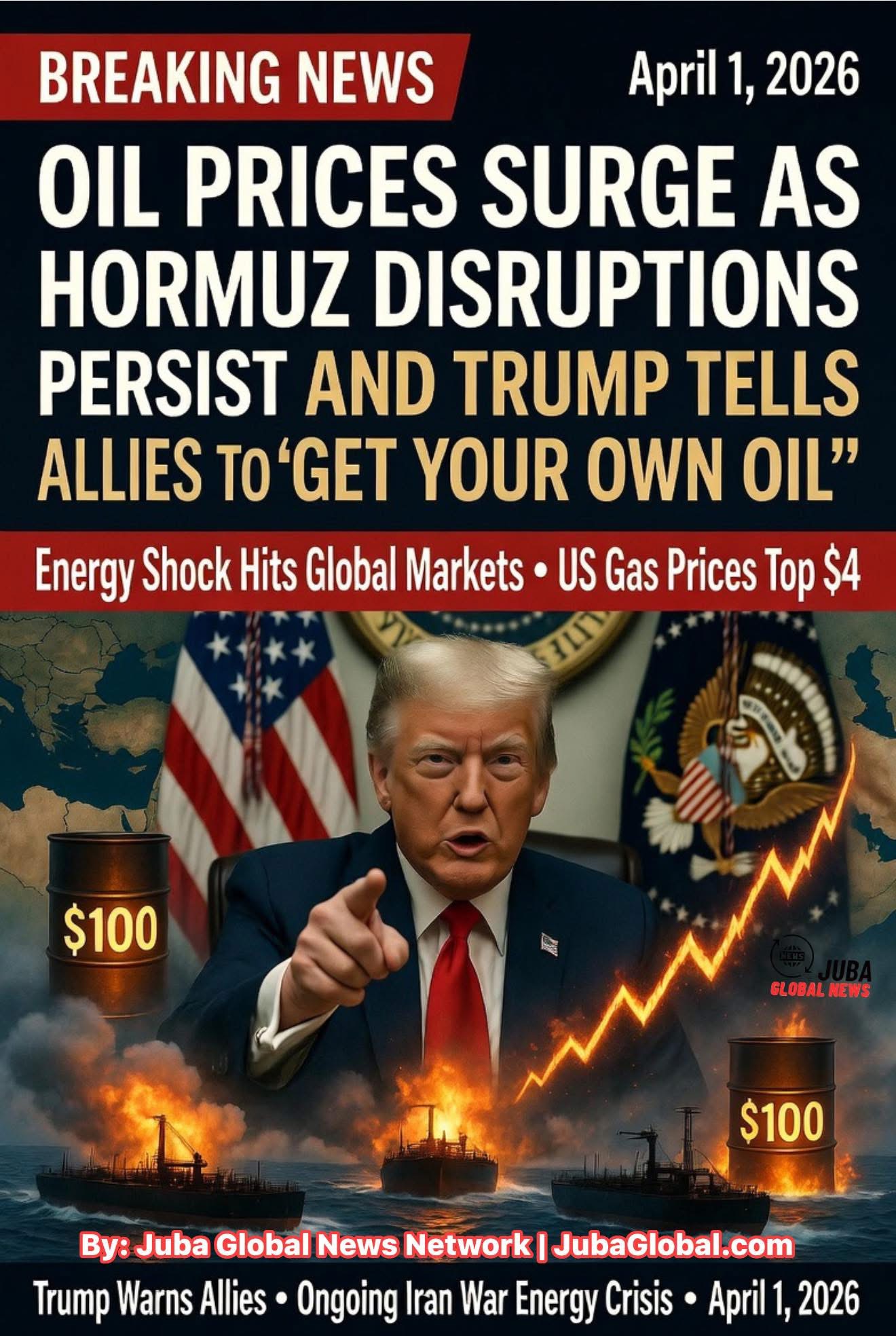
Oil Prices Surge as Middle East Conflict Threatens Global Supply
By Juba Global News Network | JubaGlobal.com
February 28, 2026

Crude oil prices exploded higher in early trading on Saturday as the joint U.S.-Israeli preemptive strikes on Iran and the Islamic Republic’s immediate missile retaliation sent shockwaves through global energy markets. Benchmark Brent crude jumped more than 12% in the first hours of electronic trading, briefly touching $118 per barrel before settling around $114–$116—a level not seen since the height of the 2022 Russia-Ukraine energy crisis. West Texas Intermediate (WTI) followed a similar trajectory, surging past $110 before paring gains to trade near $108.
The sharp move reflects immediate fears that the escalating conflict could disrupt crude flows through the Strait of Hormuz, the narrow chokepoint through which roughly 20–21% of the world’s seaborne oil passes daily (approximately 21 million barrels). Iran has repeatedly threatened to close or severely restrict the strait in response to military action against its territory, a move that would instantly remove millions of barrels from the market and send shipping insurance premiums skyrocketing.
Analysts point to several direct and indirect supply risks triggered by Saturday’s events:
- Iranian production and exports
Iran produces roughly 3.2–3.4 million barrels per day (bpd) and exports around 1.5–1.8 million bpd, mostly to China under sanctions-evasion arrangements. Early reports indicate Israeli and U.S. strikes targeted missile production facilities, air-defense sites, and command centers—but also hit infrastructure linked to the oil and gas sector, including storage tanks and export terminals near Kharg Island. While no official confirmation exists yet of major damage to production or loading facilities, even temporary outages or export interruptions would tighten already strained physical markets. - Strait of Hormuz vulnerability
Beyond Iran’s own exports, the strait handles roughly 5 million bpd from Saudi Arabia, the UAE, Kuwait, Iraq, and Qatar. Any mining, missile attacks on tankers, or naval harassment in the waterway would cause immediate supply panic. Shipping groups have already begun rerouting vessels away from the Persian Gulf, and war-risk premiums for tankers transiting the strait reportedly tripled overnight. - Gulf Arab retaliation risk
Iran’s retaliatory missile strikes hit U.S. military facilities in Bahrain, Qatar, Kuwait, and Saudi Arabia. While oil infrastructure itself was not directly targeted in the opening salvos, any escalation involving Saudi Aramco facilities (as occurred in the 2019 Abqaiq attack) or UAE export terminals could remove another 2–4 million bpd from global supply almost instantly. - Secondary effects on OPEC+ discipline
With Brent already trading well above most members’ fiscal breakeven prices, several producers may see little incentive to rush additional barrels to market. Russia, a key OPEC+ member and vocal critic of the U.S.-Israel operation, has signaled it will not compensate for potential Iranian shortfalls. Saudi Arabia and the UAE have remained silent on production policy so far, but private discussions suggest reluctance to flood the market while the conflict remains active.
Energy traders and analysts warn that the current price spike could prove short-lived if the conflict is contained to a few days of exchanges—or become far more severe if either side targets energy infrastructure directly. Goldman Sachs raised its 12-month Brent forecast to $125/bbl in a flash note, while JPMorgan warned of a possible “$150–$200 scenario” in the event of a prolonged Strait closure. On the bearish side, some hedge funds noted that global spare capacity (estimated at 5–6 million bpd, mostly in Saudi Arabia and the UAE) could eventually cap runaway gains if producers respond aggressively.
Downstream impacts are already visible: European and Asian refiners are scrambling to secure alternative cargoes, U.S. gasoline futures are up sharply, and airlines have begun surcharging tickets for Middle East routes. Consumer fuel prices in the United States are expected to rise 20–40 cents per gallon at the pump within the next week, assuming the conflict does not abate quickly.
The International Energy Agency (IEA) and OPEC have both issued cautious statements calling for calm and emphasizing the importance of keeping oil markets supplied. Yet with diplomacy appearing stalled and military action ongoing, energy markets remain in a state of extreme volatility.
As sirens continue to sound in Israel, smoke rises over Tehran, and tankers hesitate at the entrance to the Strait of Hormuz, one thing is clear: the price of oil is no longer driven solely by fundamentals—it is now a direct barometer of geopolitical risk in the world’s most critical energy corridor.
Juba Global News Network will track oil market movements and any developments affecting energy infrastructure in real time. Live charts and analysis available at JubaGlobal.com.
By: Juba Global News Network | JubaGlobal.com