

Oil Prices Surge as Hormuz Disruptions Persist and Trump Tells Allies to ‘Get Your Own Oil’ Amid Iran War Energy Shock
By Juba Global News Network | April 1, 2026
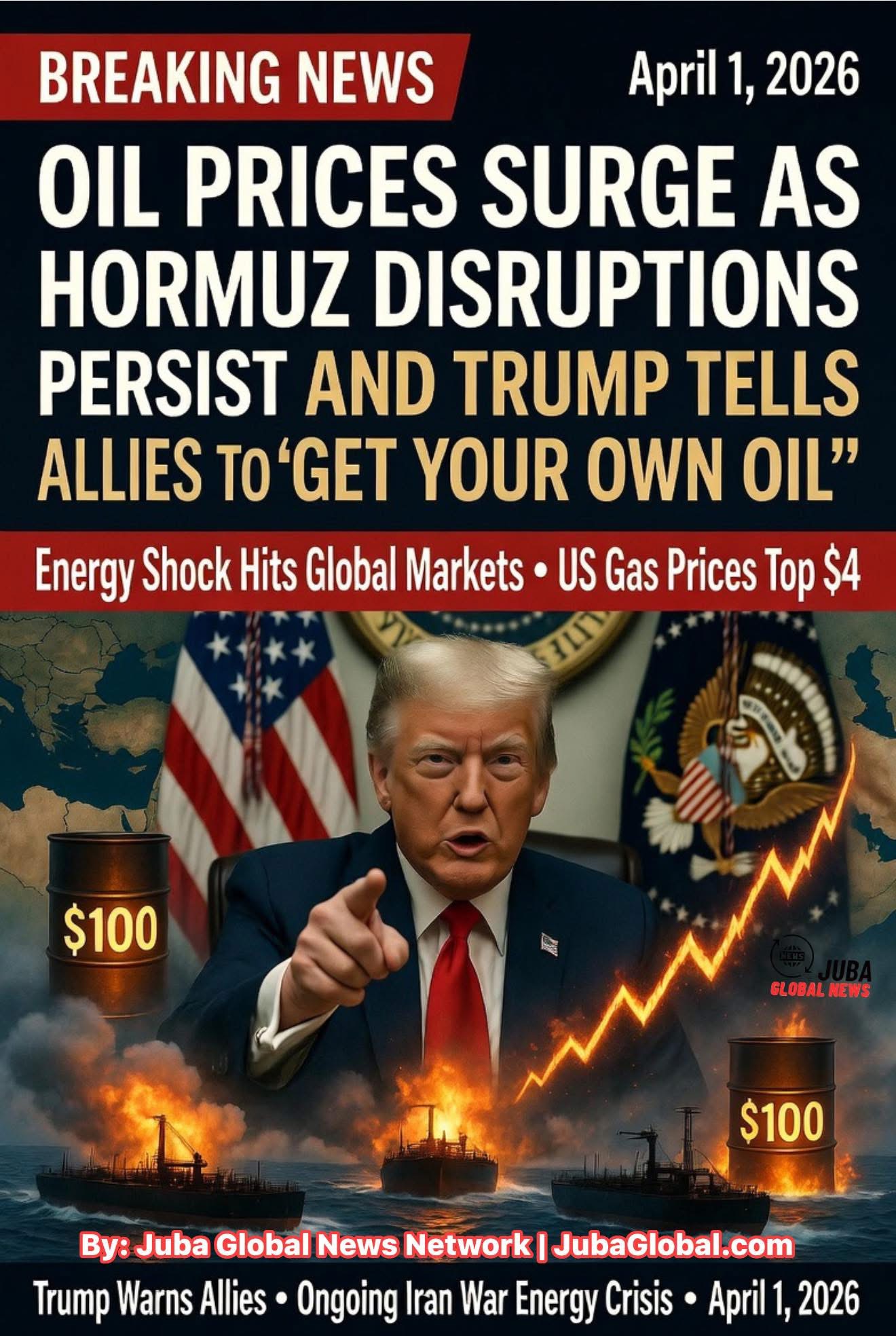
Global oil markets remain under severe pressure as disruptions in the Strait of Hormuz continue into the second month of the 2026 Iran war, driving significant price increases and forcing major consuming nations to scramble for alternative supplies. President Donald Trump has responded bluntly to allies facing shortages, telling them they must “get your own oil” and warning that the United States will no longer serve as the default guarantor of energy security in the region.
Brent crude and West Texas Intermediate (WTI) benchmarks have posted record monthly gains for March 2026, with prices fluctuating near or above the $100-per-barrel mark at times. In the United States, national average gasoline prices have climbed above $4 per gallon for the first time since 2022, delivering a direct hit to American households and businesses already grappling with broader economic uncertainty from the conflict.
The Hormuz Chokepoint Crisis
The Strait of Hormuz, through which roughly 20-21% of global oil trade normally flows, has become one of the most critical flashpoints of the war. Iranian forces have repeatedly threatened and partially disrupted tanker traffic through mining, drone attacks, and naval harassment, while US and allied naval operations have focused on protecting key shipping lanes and responding to Iranian provocations.
Even with sustained US strikes aimed at degrading Iranian naval and missile capabilities, complete restoration of safe passage has proven elusive. Insurance rates for tankers transiting the area have skyrocketed, and several major shipping companies have rerouted vessels around the longer African route, adding weeks to delivery times and further tightening supply.
The result has been a classic supply shock: reduced exports from Iran itself (already under heavy sanctions), combined with hesitation by other Gulf producers and heightened risk premiums, have pushed prices sharply higher. Analysts estimate that daily oil flows through Hormuz have dropped by as much as 30-40% at peak disruption periods.
Trump’s Direct Message to Allies
In characteristically forthright remarks this week, President Trump made clear that Washington expects its partners to take greater responsibility for their own energy needs.
“You’ll have to start learning how to fight for yourself,” Trump stated. “The U.S.A. won’t be there to help you anymore, just like you weren’t there for us. Iran has been, essentially, decimated. The hard part is done. Go get your own oil!”
The comments were directed particularly at European nations and some Asian allies that have relied heavily on US naval presence in the Gulf for decades. Trump’s administration has signaled that any post-conflict security arrangements for the Strait will not automatically default to American leadership, especially if US military involvement winds down within the two-to-three-week timeline the president has indicated.
This stance has caused unease among Gulf Cooperation Council (GCC) countries, several of which have privately urged the US to maintain pressure on Iran longer than currently planned. Saudi Arabia, the UAE, Kuwait, and Bahrain — all heavily invested in stable energy markets — fear that a rapid US drawdown could leave a power vacuum that Iran or its proxies might exploit.
Domestic Impact on American Consumers
For US drivers, the energy shock is no longer abstract. Pump prices exceeding $4 per gallon in many states are squeezing family budgets and raising costs for transportation-dependent industries such as trucking, agriculture, and manufacturing. Airlines and shipping companies have begun passing on higher fuel surcharges, while petrochemical producers warn of rising input costs that could eventually feed into consumer goods prices.
The White House has so far resisted calls for direct intervention such as releasing large volumes from the Strategic Petroleum Reserve (SPR), with officials arguing that domestic production remains strong and that the focus should stay on degrading the source of the disruption — Iran’s military capabilities.
Broader Economic and Geopolitical Ripple Effects
The oil price surge is rippling far beyond the United States:
• Europe and Asia: Countries with limited domestic production face the toughest challenges. Some European nations have accelerated LNG imports from the US and Qatar, but oil remains essential for transport and heating in many areas.
• Developing Nations: Import-dependent economies in Africa and South Asia are particularly vulnerable, with higher fuel costs threatening inflation, subsidy burdens, and political stability.
• Stock Markets: Energy company shares have rallied, but broader indices have shown volatility as investors weigh the balance between higher corporate profits in the oil sector and the drag from elevated energy costs elsewhere.
• Alternative Routes and Suppliers: Increased interest in pipelines bypassing Hormuz (such as Saudi and UAE east-west lines) and renewed focus on non-OPEC+ sources, including US shale and Brazilian deepwater production.
Analysts caution that while prices may ease if Hormuz disruptions diminish or if Trump’s announced US exit reduces uncertainty, a prolonged period of elevated volatility is likely. Long-term contracts and strategic stockpiling by major importers could keep a floor under prices even after immediate military tensions subside.
Strategic Calculations Behind Trump’s Position
President Trump’s “get your own oil” message aligns with his long-standing view that allies have under-contributed to collective security. By tying energy security explicitly to burden-sharing, the administration aims to reshape expectations for the post-conflict period.
At the same time, ongoing US military operations — including recent bunker-buster strikes on Isfahan and continued naval patrols — demonstrate that America is not abandoning the theater overnight. The two-to-three-week exit horizon appears tied to achieving core objectives: severely degrading Iran’s nuclear and long-range missile programs.
Whether this approach succeeds in forcing greater self-reliance among allies or instead creates dangerous gaps that adversaries could exploit remains a subject of intense debate in Washington and foreign capitals.
Reactions and Outlook
• Gulf Allies: Mixed signals — public support for US actions combined with private concerns about premature withdrawal and long-term Hormuz security.
• European Leaders: Quiet frustration over both the price surge and the suggestion that they must now handle regional security more independently.
• Oil Producers: OPEC+ members outside the immediate conflict zone have so far refrained from major production increases, citing market balance concerns.
• Iran: State media has highlighted the oil price spike as evidence that the conflict is hurting the West more than Tehran, while continuing to threaten further disruptions.
As President Trump prepares for his national address tonight, markets and policymakers will be watching closely for any additional signals on energy policy, SPR releases, or expectations for allies.
The coming weeks will test whether the combination of military pressure on Iran and a firmer stance on allied burden-sharing can restore stability to global energy flows — or whether the 2026 Iran war will leave a lasting legacy of higher prices and reshaped security arrangements in the Middle East.
Juba Global News Network will provide live coverage of the presidential address and ongoing market reactions.


