

FBI Warns of Potential Iranian Drone Attacks on US West Coast
By Juba Global News Network | JubaGlobal.com March 12, 2026 WASHINGTON / SACRAMENTO — The Federal Bureau of Investigation issued an urgent nationwide alert
By Juba Global News Network | JubaGlobal.com
March 12, 2026
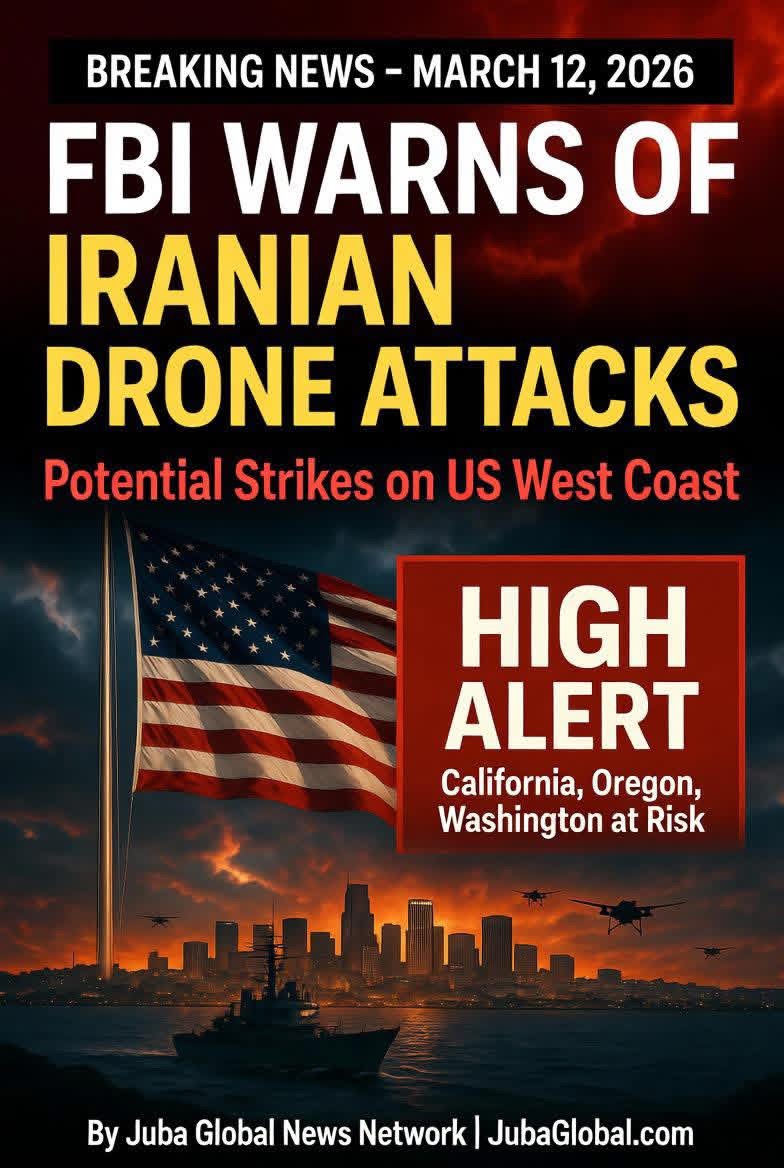
WASHINGTON / SACRAMENTO — The Federal Bureau of Investigation issued an urgent nationwide alert to state and local law enforcement agencies Wednesday morning, warning of credible but unconfirmed intelligence indicating that Iran may be planning retaliatory drone strikes on targets along the U.S. West Coast in response to ongoing American military operations inside Iran.
The internal FBI bulletin, obtained by Juba Global News Network and confirmed by two senior law enforcement officials who spoke on condition of anonymity, describes “specific, time-sensitive reporting” suggesting Iranian Revolutionary Guard Corps (IRGC) elements or their proxies could attempt to launch small unmanned aerial vehicles (UAVs) from commercial vessels positioned off the California, Oregon, or Washington coastlines.
While the alert stops short of predicting an imminent attack, it urges heightened vigilance at ports, energy infrastructure, military installations, and large public gatherings along the Pacific seaboard.
Details of the Warning
According to the bulletin:
- The most likely delivery method would be small, commercially available or modified drones launched from cargo ships or fishing vessels operating in international waters 50–150 nautical miles offshore.
- Potential targets include critical infrastructure (LNG terminals, refineries, electrical substations), military bases (Naval Base San Diego, Naval Air Station North Island, Joint Base Lewis-McChord), and symbolic civilian sites in major cities.
- Drones could carry small explosive payloads, chemical agents, or be used for surveillance to cue follow-on attacks.
- IRGC naval units have reportedly been training on “maritime drone swarm” tactics since at least 2023, with exercises simulating strikes against moving maritime and coastal targets.
The FBI’s Weapons of Mass Destruction Directorate and the Joint Terrorism Task Forces in Los Angeles, San Francisco, Seattle, and Portland have been placed on 24/7 operational status. The bulletin instructs agencies to increase random vessel inspections within the U.S. Exclusive Economic Zone, enhance drone-detection radar sweeps at key facilities, and review emergency evacuation plans for coastal population centers.
California Governor Gavin Newsom convened an emergency video conference with the state’s fusion center, National Guard leadership, and port authorities shortly after the alert was disseminated. “We are treating this seriously but calmly,” Newsom said in a brief public statement. “There is no active public-safety emergency at this time, but we are taking every precaution.”
Context: Retaliation in the Shadow of Escalation
The warning comes amid the most intense phase yet of the U.S.-Israel military campaign against Iran, now in its third week. Iranian state media and IRGC commanders have repeatedly vowed “painful revenge” on American soil for strikes that have killed hundreds of Iranian civilians and damaged critical energy and nuclear infrastructure.
In recent days Iranian officials have pointedly referenced America’s “long and vulnerable coastline” and boasted of possessing “thousands of martyrdom drones” capable of reaching U.S. territory. Last week, Iran displayed what it claimed was a new long-range kamikaze drone—the Shahed-238—with a stated range exceeding 2,500 km, though independent analysts question whether it has been operationally deployed at that distance.
U.S. intelligence officials stress that while Iran possesses the technical capability to attempt such an attack, successfully launching and guiding drones across the Pacific without detection remains extraordinarily difficult. The vast distance, U.S. naval dominance in the eastern Pacific, and layered air-defense systems around major West Coast cities present formidable obstacles.
Still, the 2019 drone attack on Saudi Aramco facilities — widely attributed to Iranian proxies — and the 2021 attack on the Israeli-owned tanker Mercer Street demonstrated Tehran’s willingness to use drones for asymmetric retaliation far from its shores.
Heightened Measures Already Underway
Several visible security steps have been taken in recent days:
- The U.S. Coast Guard has increased boardings of inbound commercial vessels in the approaches to Los Angeles–Long Beach, the nation’s busiest container port complex.
- NORAD and Northern Command have repositioned additional airborne early-warning aircraft and fighter patrols over the western United States.
- Private-sector partners, including major utilities and tech companies with campuses in Silicon Valley and Seattle, have been quietly briefed on drone-detection enhancements.
- The Transportation Security Administration has expanded random screening at West Coast airports, focusing on passengers arriving from certain transit hubs.
Pentagon spokesperson Maj. Gen. Pat Ryder told reporters Wednesday afternoon: “We are not aware of any specific, credible threat to the homeland at this moment, but we take every indication seriously. Our force posture in the Pacific remains robust.”
Public Reaction and Political Fallout
News of the FBI alert leaked quickly, sparking a wave of concern—and some criticism—on social media and cable news. In Los Angeles and San Francisco, local stations reported increased calls to non-emergency lines from residents asking about shelter-in-place guidance.
Former CIA director Mike Pompeo, now a prominent Trump administration critic, posted on X: “This is exactly what happens when you bomb a country without a clear exit strategy. Iran is lashing out because they’ve been cornered.”
The White House pushed back sharply. Press Secretary Karoline Leavitt called the comments “irresponsible” and insisted the administration’s actions were “preventive and necessary to stop Iran from acquiring nuclear weapons that could threaten the entire world—including our West Coast.”
California’s congressional delegation issued a bipartisan statement calling for a classified briefing and urging calm while security agencies do their work.
Expert Perspectives
Retired Adm. James Stavridis, former NATO Supreme Allied Commander, told CNN: “Iran has every motive to try something dramatic, but the capability gap is still enormous. Launching from a freighter in the middle of the Pacific is a high-risk, low-probability operation. That said, even a failed attempt would be a propaganda win for Tehran.”
Counterterrorism analyst Katherine Zimmerman of the American Enterprise Institute added: “The real danger isn’t a Hollywood-style swarm attack. It’s a single drone slipping through to hit a symbolic target—say, an oil refinery or a tech campus—and the psychological impact that would have.”
Outlook
For now, the FBI alert remains at the “guarded but elevated” level—no shelters-in-place, no school closures, no mass evacuations. Officials emphasize that sharing the warning publicly is part of a deliberate strategy to disrupt any potential plot by increasing scrutiny.
As one senior Homeland Security official put it off the record: “We’d rather look overly cautious today than explain tomorrow why we didn’t act on credible reporting.”
Juba Global News Network will continue to monitor developments. The situation along the West Coast remains fluid, with law enforcement and military assets on high alert as the broader U.S.-Iran conflict enters what many fear could be its most dangerous phase yet.
This is a rapidly evolving story. Live updates, official statements, and expert analysis available now at JubaGlobal.com.
