

US Forces Destroy 16 Iranian Mine-Laying Vessels in Preemptive Strike Near Strait of Hormuz as US-Israel-Iran War Enters Critical Phase
By Juba Global News Network | JubaGlobal.comMarch 11, 2026 In a dramatic escalation of the ongoing US-Israel-Iran conflict, the United States military has
By Juba Global News Network | JubaGlobal.comMarch 11, 2026
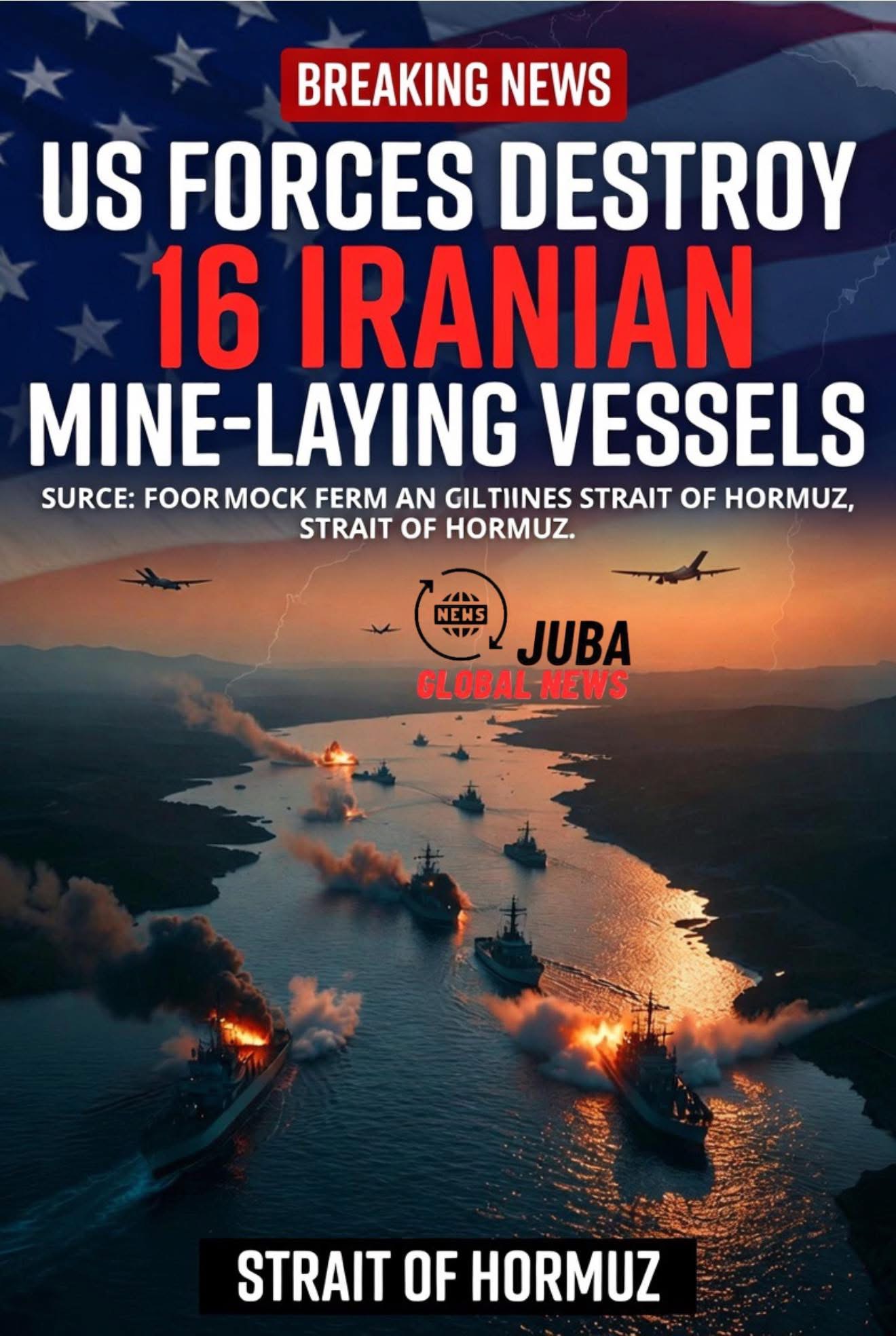
In a dramatic escalation of the ongoing US-Israel-Iran conflict, the United States military has destroyed 16 Iranian mine-laying vessels near the strategically vital Strait of Hormuz, according to official statements from U.S. Central Command (CENTCOM) and President Donald Trump. The operation, carried out on March 10, 2026, comes amid intelligence reports that Iran has begun deploying explosive mines in the narrow waterway — a move that could choke off one-fifth of the world’s oil supply and trigger a global energy crisis.
The strike marks one of the most significant naval actions in the 12-day-old war, which began on February 28 when joint U.S. and Israeli forces launched surprise airstrikes on Iranian targets, including the assassination of Supreme Leader Ali Khamenei. Iran responded with missile barrages, drone attacks on U.S. bases across the Gulf, and a partial closure of the Strait of Hormuz, halting commercial shipping and sending oil prices soaring to nearly $120 per barrel before volatile swings in recent days.
Trump’s Stark Warning and Immediate U.S. Action
President Trump took to Truth Social earlier on March 10 to issue a direct ultimatum to Tehran. “If Iran has put out any mines in the Hormuz Strait, and we have no reports of them doing so, we want them removed, IMMEDIATELY!” he posted. He followed up with a second message announcing initial successes: “I am pleased to report that within the last few hours, we have hit, and completely destroyed, 10 inactive mine laying boats and/or ships, with more to follow!”
Hours later, CENTCOM confirmed the full scope of the operation in a post on X (formerly Twitter), stating: “U.S. forces eliminated multiple Iranian naval vessels, March 10, including 16 minelayers near the Strait of Hormuz.” The command released unclassified aerial footage showing precision strikes on moored vessels, with munitions visibly impacting at least nine ships in a rapid sequence of explosions. Most of the targets were described as “inactive” and moored at the time of the attack.
Defense Secretary Pete Hegseth reinforced the administration’s hardline stance, warning that any attempt by Iran to disrupt oil flows through the strait would result in strikes “20 times harder” than those already delivered. Joint Chiefs of Staff Chairman Gen. Dan Caine added that U.S. forces are actively hunting mine-laying vessels and storage facilities as part of broader objectives under “Operation Epic Fury.”
Iran’s Mine-Laying Efforts and Retaliatory Threats
U.S. intelligence sources report that Iran has already laid a small number of mines — perhaps a few dozen — in recent days, though not yet on a scale that has fully blocked the waterway. Tehran’s Islamic Revolutionary Guard Corps (IRGC) has openly threatened to prevent “even a single litre of oil” from leaving the region if U.S.-Israeli attacks continue. IRGC spokesperson Ali Mohammad Naini warned that any U.S. or allied naval movements in the area would be met with missiles and drones.
The Strait of Hormuz, just 21 miles (34 km) wide at its narrowest point with shipping lanes only 2 miles (3.2 km) across in each direction, is the world’s most critical energy chokepoint. Roughly 20-21% of global oil consumption transits through it daily. Iran has a long history of using mines in the waterway, most notably during the 1980s “Tanker War” with Iraq. Experts estimate Tehran possesses between 2,000 and 6,000 naval mines, many based on Chinese and Russian designs.
Oil Markets in Turmoil
The threat alone has already wreaked havoc on energy markets. Oil prices spiked dramatically after Iran’s initial closure of the strait in late February, then plunged as much as 19% in a single session following a now-deleted social media post by U.S. Energy Secretary Chris Wright claiming the Navy had escorted a tanker through the waterway — a claim quickly walked back by the administration as “incorrectly captioned.”
As of March 11, Brent crude has settled below $90 per barrel amid Trump’s statements that the war could “end very soon,” but analysts warn of renewed volatility if mining escalates. The International Energy Agency is reportedly preparing its largest-ever release of strategic oil reserves — potentially exceeding the 182 million barrels released after Russia’s 2022 invasion of Ukraine — with a decision expected soon. Saudi Aramco has warned of a potential “catastrophe” unless the strait reopens and is already maximizing its east-west pipeline capacity to bypass the route.
Broader Context: Day 12 of the US-Israel-Iran War
The naval action in the Hormuz comes on the 12th day of intense fighting. U.S. and Israeli airstrikes have targeted Iranian military sites, nuclear facilities, and leadership, while Iran has launched hundreds of missiles and drones at Israel and U.S. bases in the Gulf. Casualties include approximately 150 U.S. service members wounded and at least 9 killed, according to Pentagon figures, alongside thousands of Iranian deaths reported by both sides and human rights monitors.
Iran’s new leadership under Mojtaba Khamenei has vowed a prolonged fight, while Trump and Israeli Prime Minister Benjamin Netanyahu have signaled determination to achieve decisive objectives, including dismantling Iran’s nuclear program and missile capabilities.
Global Implications and Risks Ahead
A full mining of the Strait of Hormuz could take months to clear and would devastate global supply chains, driving up fuel, food, and shipping costs worldwide. European nations have already deployed warships to protect Cyprus from Iranian strikes, and shipping companies are rerouting vessels at enormous extra cost.
U.S. officials insist the preemptive strike on the mine-layers was necessary to protect freedom of navigation and global energy security. However, analysts caution that further naval clashes could draw in additional actors or push Iran toward asymmetric responses using its vast drone fleet or proxy militias.
Juba Global News Network will continue monitoring this fast-developing situation. As President Trump put it in one of his recent posts: “They will be dealt with quickly and violently” if Iran persists. The world watches anxiously as the war’s energy front threatens to reshape the global economy.
Search Keywords for this article: US destroys Iranian mine-laying vessels Strait of Hormuz, Iran war naval strikes March 2026, Trump warns Iran mines Hormuz, CENTCOM footage Iranian ships destroyed, Strait of Hormuz crisis oil prices 2026.
This comprehensive report is based on verified statements from CENTCOM, the White House, and multiple international news outlets. Stay tuned to JubaGlobal.com for live updates, analysis, and the latest developments in the US-Israel-Iran war.
