

China Warns Xi: Trump’s Iran War Proves Need for Greater Hard Power
By Juba Global News Network | JubaGlobal.com March 7, 2026 In closed-door meetings of the Politburo Standing Committee and expanded sessions of the Central
By Juba Global News Network | JubaGlobal.com
March 7, 2026

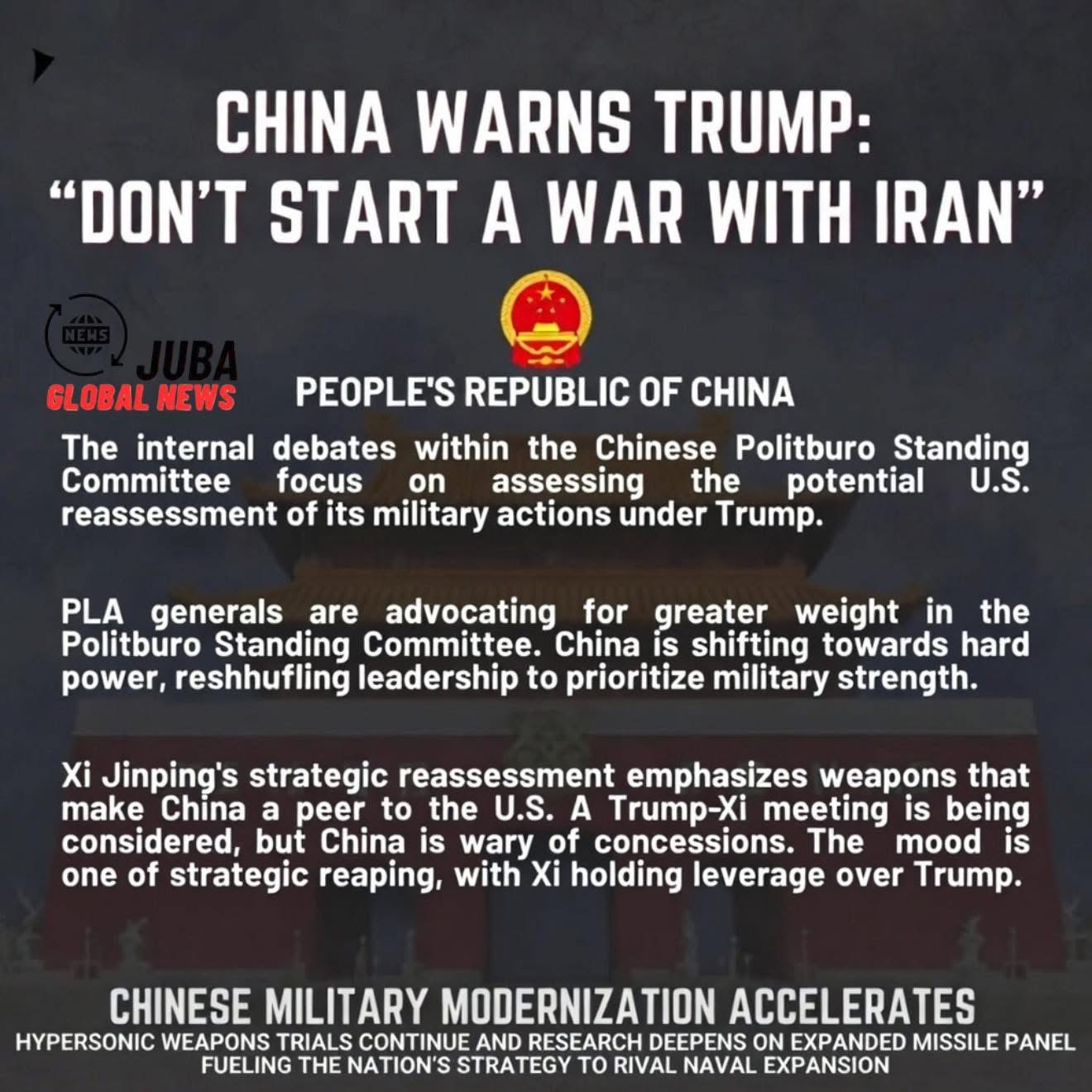
In closed-door meetings of the Politburo Standing Committee and expanded sessions of the Central Military Commission this week, Chinese President Xi Jinping has reportedly received stark assessments from senior PLA generals and foreign policy advisers: the rapid U.S.-Israeli military campaign against Iran demonstrates that Washington remains willing—and able—to use overwhelming hard power to achieve strategic objectives, even at the risk of global economic shockwaves and superpower confrontation.
Multiple sources with knowledge of the internal deliberations describe Xi as viewing the Iran war as a “vivid and dangerous validation” of long-standing arguments made by hawkish elements within the People’s Liberation Army (PLA) and national security establishment. The core message delivered to the paramount leader: China’s current military modernization pace, while impressive, remains insufficient to deter similar U.S. adventurism directed at Beijing’s core interests—particularly concerning Taiwan, the South China Sea, and the first island chain.
Internal Debate Intensifies
According to accounts relayed to foreign diplomats and select overseas Chinese media outlets, two competing schools of thought clashed during the emergency sessions called after the first week of intense bombing of Iranian targets:
- The “Caution Camp” — Led by figures associated with the Ministry of Foreign Affairs and parts of the State Council, this group argues that the Iran conflict proves the high costs and unpredictability of major kinetic operations. They point to surging global oil prices (Brent briefly touching $85+), disrupted LNG flows, stock market turbulence, and the risk of Russian entanglement as evidence that even a militarily superior power can quickly face severe blowback.
- The “Acceleration Camp” — Dominated by senior PLA Rocket Force and Navy commanders, together with influential voices from the Central Military Commission’s Equipment Development Department, this faction contends that Washington’s willingness to launch thousands of precision strikes, eliminate a head of state (Ayatollah Khamenei), degrade an entire air force and missile arsenal in days, and sustain high-tempo operations despite interceptor expenditure demonstrates exactly why China must accelerate acquisition of “system destruction warfare” capabilities. They argue that only credible hard-power parity—or better—can prevent the United States from attempting analogous operations against Chinese interests.
Xi is said to have listened intently to both sides before emphasizing that “peaceful development does not mean unpreparedness for war” and instructing accelerated implementation of already-approved 2026–2030 defense budget increases, with particular focus on:
- Hypersonic glide vehicles and anti-ship ballistic missiles (especially variants capable of targeting moving carrier groups)
- Next-generation stealth aircraft and unmanned combat aerial vehicles
- Quantum-secure communications and electronic warfare systems
- Expanded anti-access/area-denial (A2/AD) networks in the Western Pacific
- Rapid stockpiling of precision-guided munitions and long-range standoff weapons
Strategic Reassessment Ahead of Trump–Xi Meeting
The internal reassessment comes at a sensitive moment: President Trump has publicly floated the possibility of meeting Xi Jinping “soon” to discuss trade, fentanyl flows, and “other matters,” even as the Iran campaign continues. Chinese analysts interpret the outreach as an attempt to keep Beijing on the sidelines while Washington finishes degrading Iranian capabilities.
Several well-placed commentators in Beijing note that Xi sees three interlocking lessons from the Iran war:
- Speed and resolve matter — The U.S. and Israel moved from decision to execution in days, achieving strategic surprise and rapid degradation of Iranian command-and-control. This contrasts with China’s traditional emphasis on gradual buildup and political signaling.
- Economic interdependence is not absolute deterrence — Despite catastrophic potential effects on global energy markets and supply chains, Washington pressed ahead. This weakens arguments that deep economic ties with the U.S. would automatically prevent military conflict over Taiwan or other flashpoints.
- Alliances and basing still provide decisive advantage — Extensive U.S. access to bases in Israel, Jordan, Gulf states, Diego Garcia, and carriers in the region enabled sustained operations. China’s relative lack of reliable overseas basing remains a glaring vulnerability.
Public Posture vs. Private Urgency
Publicly, China’s Foreign Ministry has maintained a measured tone, calling for “maximum restraint,” an immediate ceasefire, and respect for sovereignty while avoiding direct condemnation of either side. State media has focused on the humanitarian toll, oil price shocks affecting developing nations, and risks of wider escalation—positioning Beijing as a responsible great power advocating de-escalation.
Behind closed doors, however, the mood is far more urgent. Defense spending is already projected to rise 7.2–8% in the official 2026 budget announcement later this month, but insiders expect supplemental allocations and accelerated procurement timelines for several high-priority programs. PLA Rocket Force exercises simulating strikes on moving maritime targets have reportedly intensified, and naval shipyards in Shanghai and Dalian are working extended shifts.
Global Implications
If Xi internalizes the “Iran lesson” as a call for faster hard-power accumulation, the strategic consequences could be profound:
- Faster erosion of the military balance across the Taiwan Strait
- Heightened risk-taking in gray-zone activities in the South China Sea
- Increased pressure on neighbors (Japan, Philippines, Australia, South Korea) to bolster defenses and U.S. alliances
- Greater Chinese willingness to provide material support to actors opposing U.S. interests (potentially including spare parts, components, or intelligence to Iran or Russia)
As the war in the Middle East enters its second week with no resolution in sight, one of its most consequential side effects may be unfolding half a world away—in Zhongnanhai, where Xi Jinping and his inner circle appear increasingly convinced that only greater hard power can guarantee China’s security in an era when the United States still chooses—and can—wage decisive military campaigns thousands of miles from home.
Juba Global News Network will continue monitoring internal Chinese debates and their impact on regional security. Visit JubaGlobal.com for ongoing coverage.
Sources: Compiled from diplomatic reporting, Hong Kong and overseas Chinese media analysis, statements by Chinese Foreign Ministry spokespersons, PLA Daily editorials, U.S. think-tank assessments, and anonymous sources briefed on Politburo discussions as of March 7, 2026.
