

Pakistan Accused of Attempted Strike on Afghan Air Base Amid Regional Instability
As the US-Israel war on Iran enters its third day and sends shockwaves across the Middle East, a new flashpoint has emerged on the other side of Asia. On M
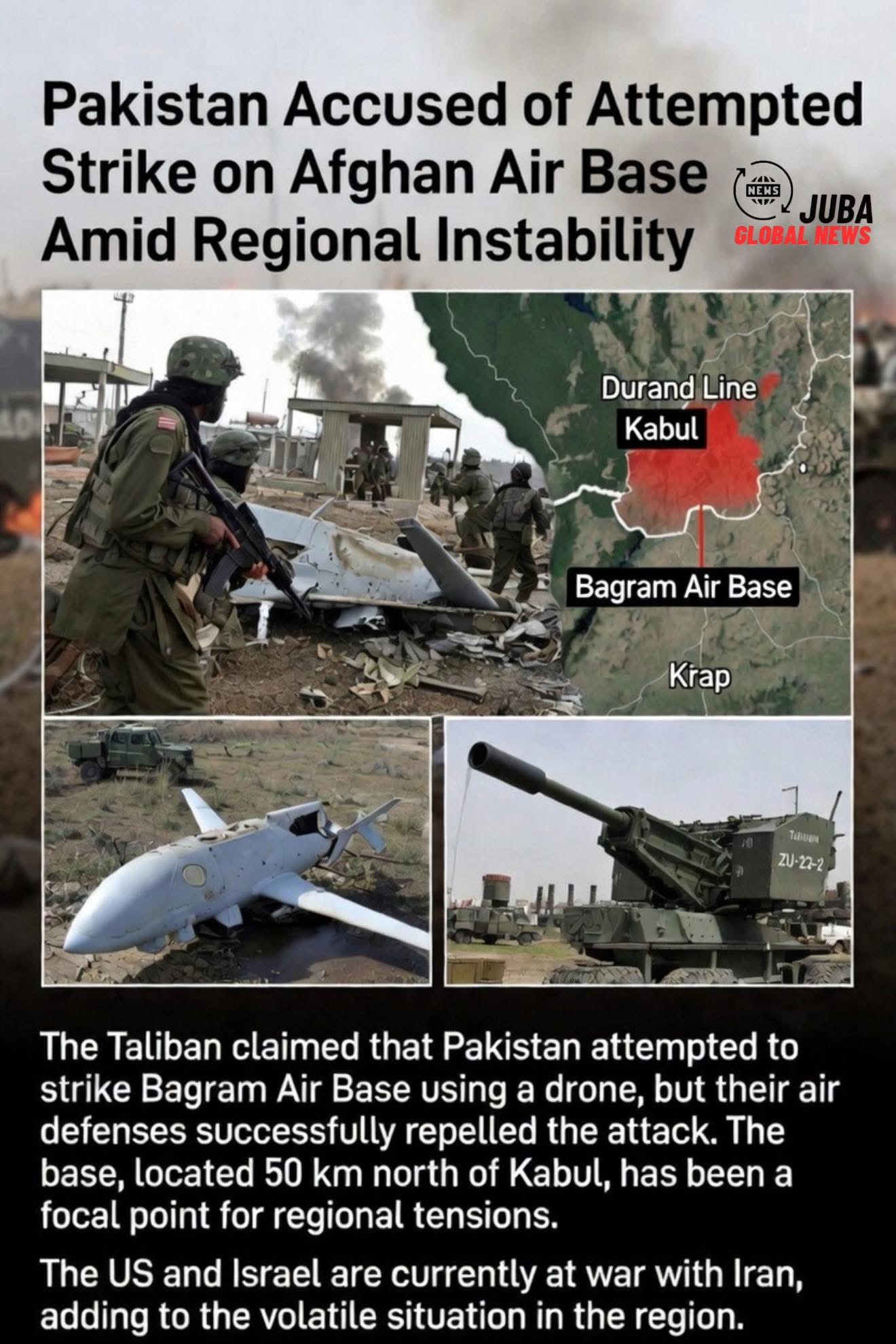
As the US-Israel war on Iran enters its third day and sends shockwaves across the Middle East, a new flashpoint has emerged on the other side of Asia. On March 1, 2026, the Afghan Taliban government accused Pakistan of launching an attempted drone or missile strike on the strategic Bagram Air Base—formerly the largest U.S. military installation in Afghanistan—claiming the attack was thwarted by Afghan air defenses. The allegation, if confirmed, marks one of the most serious direct military confrontations between the two nuclear-armed neighbors since the Taliban’s return to power in 2021 and raises fears of spillover violence fueled by the broader regional turmoil.
The Alleged Incident
According to a statement issued by Afghanistan’s Ministry of Defense on March 1 evening:
- At approximately 2:17 a.m. local time, Afghan radar detected an incoming unmanned aerial vehicle (UAV) approaching Bagram Air Base from the southeast—direction consistent with Pakistani airspace.
- The object was classified as hostile and engaged by Afghan surface-to-air systems (reportedly upgraded Chinese FM-90 or indigenous systems acquired post-2021).
- The UAV was downed roughly 8 km from the base perimeter; wreckage recovery teams later identified debris consistent with a Pakistani-origin Burraq or Shahpar-series armed drone.
- No casualties or significant damage were reported at Bagram, which remains under Taliban control and houses Taliban special forces units and limited foreign technical advisors.
Afghan spokesperson Zabihullah Mujahid accused Pakistan of “aggression aimed at destabilizing the Islamic Emirate” and warned of “severe consequences.” He linked the incident to long-standing grievances: Pakistan’s alleged support for anti-Taliban groups (particularly the Tehrik-i-Taliban Pakistan or TTP), border fencing disputes, and recent cross-border skirmishes in Kurram and North Waziristan.
Pakistan’s Inter-Services Public Relations (ISPR) issued a swift denial on March 2:
“Pakistan Armed Forces have not conducted any strike inside Afghan territory. Such baseless allegations appear designed to deflect from the Afghan side’s failure to control TTP sanctuaries on its soil, which continue to launch terrorist attacks inside Pakistan.”
Context: A Long-Simmering Border Crisis
Tensions between Pakistan and the Taliban-led Afghanistan have steadily worsened since 2021:
- Pakistan accuses the Taliban of providing safe havens to TTP militants who have carried out hundreds of attacks inside Pakistan, killing thousands of civilians and security personnel.
- The Taliban accuse Pakistan of supporting anti-Taliban resistance groups (notably the National Resistance Front in Panjshir) and conducting extrajudicial killings of Afghan refugees.
- Frequent artillery duels and airstrikes along the Durand Line have become almost routine since mid-2024.
- In January 2025, Pakistan carried out verified airstrikes inside Afghanistan targeting alleged TTP hideouts, killing dozens and prompting Afghan retaliation with mortar fire.
The alleged Bagram incident represents an escalation in both target (a high-profile former U.S. base now symbolically important to the Taliban) and method (attempted precision drone strike rather than indiscriminate shelling).
Connection to the Iran War
While no direct causal link has been proven, analysts point to several indirect connections:
- Regional Distraction — The intense focus on the Iran conflict may have created a perceived window of opportunity for Pakistan to act against perceived threats without immediate international backlash.
- Proxy Dynamics — Iran’s “Axis of Resistance” includes some Afghan Shia militias historically opposed to the Taliban. A weakened Iran could embolden anti-Taliban actors, prompting preemptive Pakistani moves.
- U.S. Withdrawal Vacuum — With U.S. attention fixed on the Gulf, Pakistan may feel less constrained in dealing with cross-border threats.
- Nuclear Shadow — Both nations are nuclear-armed; any miscalculation risks rapid escalation in a region already on edge.
International Reactions
- United Nations — Called for “maximum restraint” and urged both sides to use existing channels (including the Quadrilateral Coordination Group framework) to de-escalate.
- China — Beijing, Pakistan’s closest ally and major investor in Afghanistan, quietly urged both parties to avoid actions that could destabilize the China-Pakistan Economic Corridor (CPEC) and Belt and Road projects.
- United States — The Pentagon issued a brief statement: “We are monitoring reports closely. Bagram remains Afghan sovereign territory; any external military action there is concerning.”
- India — New Delhi has remained silent publicly but is widely believed to be watching closely given its own tense border dynamics with Pakistan.
What Comes Next?
As of March 2, no independent verification of the drone wreckage or launch origin has emerged. Satellite imagery analysts are examining commercial sources for launch signatures or debris fields.
If the allegation is substantiated, it would represent a serious breach of sovereignty and could trigger retaliatory Afghan actions—potentially airstrikes on Pakistani border posts or increased support for anti-Pakistan militants. If disproven, it risks further eroding already fragile trust between Islamabad and Kabul.
In a week already defined by missile barrages in the Gulf, friendly-fire losses in Kuwait, and nuclear safety fears at the IAEA, the alleged Bagram incident serves as a stark reminder: the ripple effects of the Iran war are spreading unpredictably, threatening to ignite multiple flashpoints across an already volatile arc from the Levant to the Hindu Kush.
By Juba Global News Network | JubaGlobal.com
March 2, 2026
Stay tuned for live updates as this fast-moving story develops.
