Green Party Scores Major Win in UK By-Election Amid Political Shifts: Historic Victory Signals Rising Environmental and Progressive Momentum
By Juba Global News Network | JubaGlobal.com
March 1, 2026
In a stunning upset that has sent shockwaves through British politics, the Green Party of England and Wales secured its first-ever Westminster by-election victory on February 26, 2026, in the Greater Manchester constituency of Gorton and Denton. The result not only overturned a massive Labour majority but pushed the governing Labour Party into a humiliating third place, behind both the Green winner and the right-wing populist Reform UK. The outcome underscores deepening fractures in the UK’s political landscape less than two years after Labour’s landslide general election win in 2024, and highlights the surging appeal of progressive, eco-focused politics amid widespread dissatisfaction.
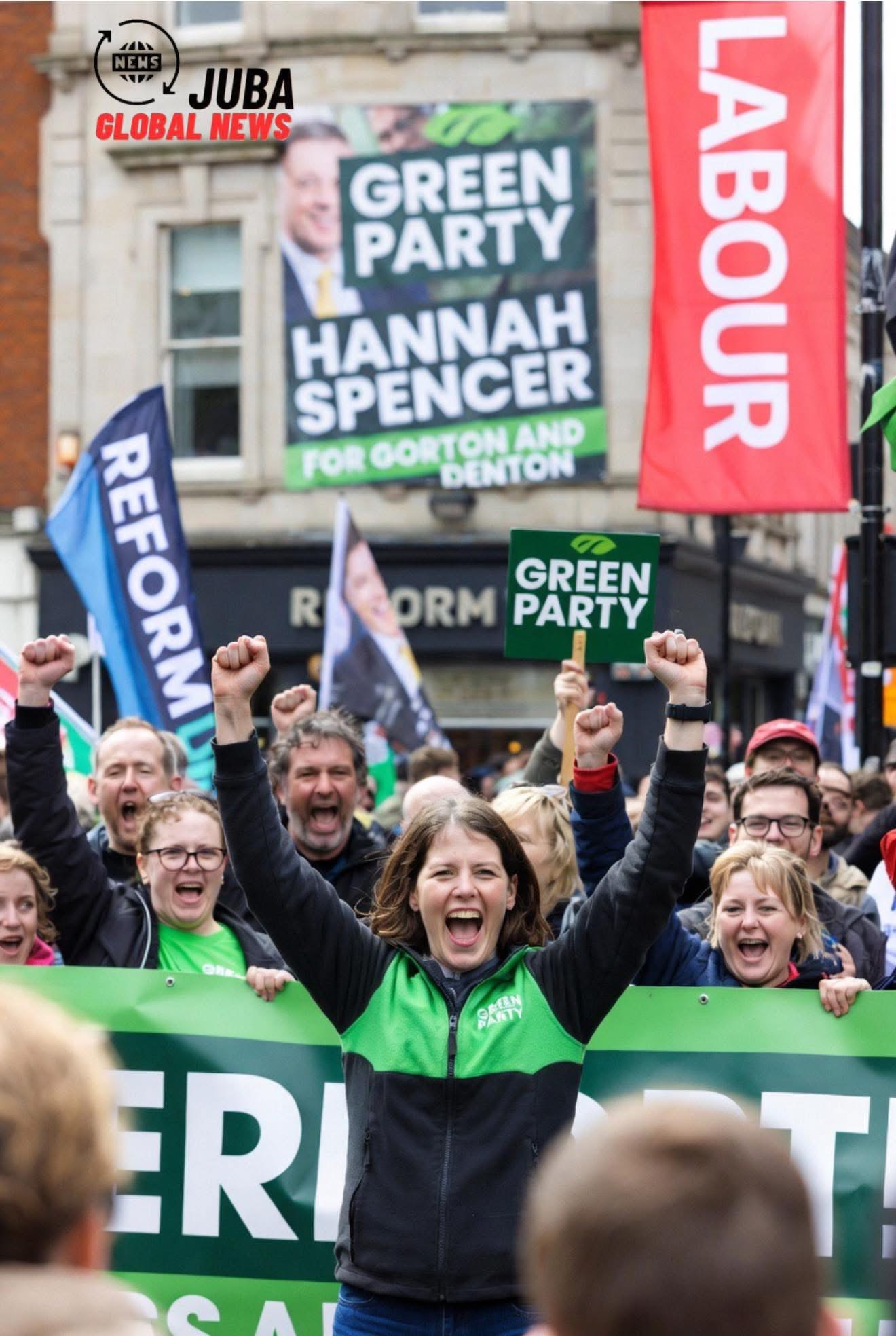
Hannah Spencer, a 34-year-old local councillor and plumber from the area, claimed the seat for the Greens with 14,980 votes—approximately 40.7% of the total—securing a majority of more than 4,000 over Reform UK’s Matt Goodwin, who took 28.7%. Labour’s candidate received just 25.4%, a dramatic collapse from the party’s 50%+ dominance in the same constituency during the 2024 general election. The Conservatives, once a minor presence here, lost their deposit entirely.
The by-election was triggered by the resignation of former Labour MP Andrew Gwynne. What was expected to be a routine hold for Keir Starmer’s government turned into a political earthquake. The Greens achieved a remarkable 26-percentage-point swing from their 2024 performance in the seat, leaping from a distant third to outright victory. This marks the first time the Green Party has won a parliamentary by-election at Westminster, increasing their Commons representation to five MPs and proving their ability to break through in urban, working-class areas long considered Labour heartlands.
A Surge Under New Leadership
The triumph is widely attributed to the energetic leadership of co-leader Zack Polanski, who has steered the party toward a bolder, more populist progressive platform. Since taking the helm, Polanski has broadened the Greens’ appeal beyond traditional environmentalism to encompass cost-of-living concerns, housing affordability, drug policy reform, and strong support for Palestinian rights—issues resonating with disillusioned left-leaning voters frustrated by Labour’s centrist shift under Starmer.
In the immediate aftermath, the Green Party announced a dramatic membership milestone: surpassing 200,000 members nationwide. This represents a near tripling from just 68,000 in September 2025, fueled by local election gains and the momentum from Gorton and Denton. Polanski hailed the surge as proof that “the future of progressive politics belongs to the Greens,” describing it as a “political turning point” against “managed decline, climate delay, or timid politics.”
Spencer, in her victory speech delivered at a local wedding venue turned press conference, struck an emotional and defiant tone. She pledged to fight for those who feel “left behind” by mainstream parties, vowing to champion working people, tackle inequality, and push aggressively on climate action. Her background as a tradeswoman and community councillor helped humanize the campaign, contrasting sharply with perceptions of an out-of-touch political class.
Labour’s Nightmare and Starmer’s Response
For Prime Minister Keir Starmer, the defeat is a major blow. Labour had held Gorton and Denton (or its predecessor seats) for nearly a century, making it one of the party’s safest strongholds. Coming third in such a constituency—behind both a left-wing insurgent and a right-wing populist—signals vulnerability on multiple fronts. Commentators describe it as Labour now fighting a two-sided insurgency: Reform UK siphoning votes on immigration and economic nationalism, while the Greens erode support among younger, urban, and progressive voters alienated by Starmer’s cautious approach to issues like Gaza, welfare, and green investment.
Starmer responded by vowing to “keep on fighting” and pledging to confront “extremes” on both the left and right. Yet his stony-faced public appearance and the government’s defensive posture have fueled speculation about internal pressure and questions over his long-term leadership.
The result also reflects broader trends: low turnout, voter disillusionment with the two main parties, and the rise of insurgent forces. Reform UK’s strong second place reinforces Nigel Farage’s party as a persistent threat, while the Greens’ breakthrough shows that climate and social justice concerns can mobilize voters in unexpected places.
What It Means for British Politics
Analysts see the Gorton and Denton result as evidence of a fragmenting political landscape. With the Greens now claiming they can “win anywhere” and predicting a “tidal wave” of seats at the next general election, Labour faces intensified pressure to shift leftward to reclaim progressive voters. Meanwhile, the victory boosts Green confidence ahead of upcoming local elections and strengthens their case as a credible alternative for those seeking bolder action on the environment and inequality.
As the dust settles, one thing is clear: the Green Party’s historic win in a former Labour bastion marks a pivotal moment. British politics is no longer a simple red-blue contest—green is emerging as a serious electoral force, and the implications could reshape the future of progressive politics in the UK and beyond.
Juba Global News Network will continue to track the fallout and evolving political dynamics in Westminster.