

Mass Shooting at Tumbler Ridge Secondary School: Canada’s Deadliest School Attack Claims 12 Lives, Sparks National Reckoning on Gun Violence and Rural Safety
By Juba Global News Network Staff JubaGlobal.com February 14, 2026 – Juba, South Sudan A quiet Friday morning in the remote coal-mining town of Tumbler Rid
By Juba Global News Network Staff
JubaGlobal.com
February 14, 2026 – Juba, South Sudan
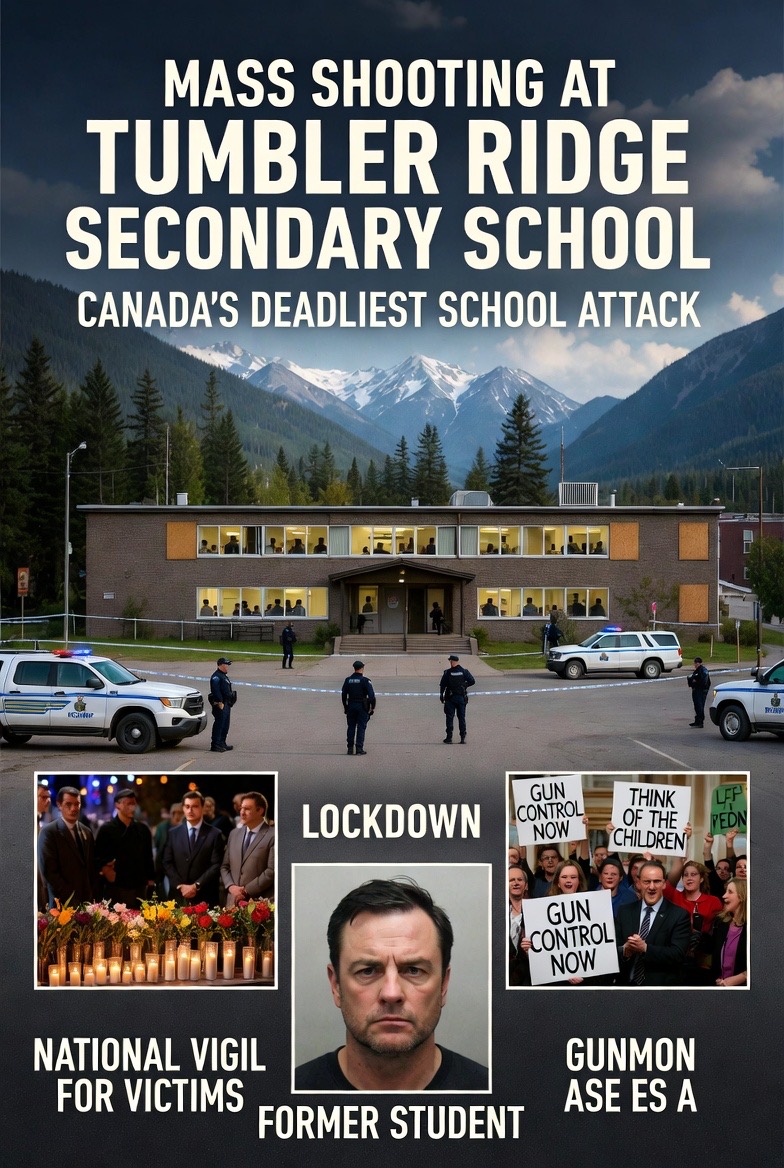
A quiet Friday morning in the remote coal-mining town of Tumbler Ridge, British Columbia, descended into horror on February 13, 2026, when a lone female shooter entered Tumbler Ridge Secondary School and opened fire, killing 11 people — including six students, three teachers, one administrator, and one parent volunteer — before taking her own life. The attack, which also left 31 people wounded (seven critically), has become the deadliest school shooting in Canadian history, surpassing the 1989 École Polytechnique massacre in Montreal (14 killed) and forcing the nation into a period of collective grief, soul-searching, and renewed debate over gun control, mental-health services, and safety in isolated rural communities.
The Attack: Timeline and Eyewitness Accounts
The first 911 calls came in at 1:17 p.m. local time (Mountain Standard Time). Students and staff described hearing what initially sounded like firecrackers in the main hallway near the cafeteria. Within minutes, the school’s public-address system crackled with a frantic announcement: “Lockdown, lockdown, this is not a drill.”
Surviving students later recounted chaotic scenes:
- Grade 10 student Ethan Moreau, 15, barricaded his classroom door with desks while classmates hid under tables and texted parents goodbye messages. “We heard screaming, then silence, then more shots. It felt like forever.”
- Teacher Sarah Landry, 38, shepherded 22 students into a storage closet and used her body to shield the door. She was shot twice but survived after colleagues applied tourniquets.
- A parent volunteer helping with a lunch program was killed while trying to protect children in the foyer.
RCMP officers from the Peace River detachment arrived within 11 minutes and engaged the shooter in the gymnasium wing. The suspect — a 19-year-old former student whose identity has been withheld pending family notification and out of respect for privacy laws — died from a self-inflicted gunshot wound before officers could reach her position.
The Community of Tumbler Ridge
Tumbler Ridge (population ≈2,200) sits in the foothills of the Rocky Mountains, 1,200 km northeast of Vancouver, near the Alberta border. Once a booming coal town in the 1980s, it has struggled economically since the decline of metallurgical coal exports. The secondary school (grades 7–12, enrollment ~320) serves as the educational and social heart of the community, drawing students from surrounding Indigenous reserves and remote homesteads.
Many families are connected through multi-generational ties to the coal mines or forestry. The town’s isolation — the nearest major hospital is in Dawson Creek, 120 km away — amplified the tragedy’s impact. Air ambulances flew critically injured victims to Kelowna and Edmonton; some families drove through snowstorms to be near their children.
British Columbia Premier David Eby, visibly emotional, described the town as “a family — and today that family has been shattered.” Prime Minister Mark Carney announced a national day of mourning for February 16 and pledged federal funding for long-term mental-health support and school-safety upgrades.
The Suspect and Early Investigation Findings
The RCMP has released limited details about the shooter, citing an active investigation and the need to protect the privacy of minors and families. What is known:
- The suspect was a former student who left the school in grade 11 (2024–2025 academic year) and had no known criminal record.
- Firearms recovered at the scene included a semi-automatic rifle (restricted class) and a handgun (prohibited class in Canada). Police believe both were legally purchased by a family member and improperly stored.
- No manifesto or social-media trail indicating ideological motive has been publicly confirmed. Investigators are examining possible mental-health history, bullying complaints, and online activity.
- The attack appears to have been planned; police recovered ammunition caches and tactical gear at the suspect’s residence.
The dual suicide–homicide nature of the attack has led experts to draw parallels with several U.S. cases involving school shooters who ended their own lives after carrying out mass violence.
National Reaction: Grief, Anger, and Policy Debate
Flags flew at half-mast across Canada on February 14. Vigils were held in Vancouver, Calgary, Edmonton, Toronto, Ottawa, and dozens of smaller communities. In Tumbler Ridge itself, hundreds gathered at the community centre despite sub-zero temperatures, lighting candles and placing flowers outside the school’s entrance.
Gun-control organizations — including PolySeSouvient (founded by survivors of the 1989 Polytechnique massacre) and the Coalition for Gun Control — renewed calls for:
- Mandatory secure storage requirements for all restricted and prohibited firearms
- A national buyback of assault-style rifles (delayed since 2020)
- Closing loopholes in background checks for family members living in the same household
- Increased funding for rural mental-health services and school-based threat-assessment teams
Conservative politicians and rural-community leaders cautioned against “knee-jerk” legislation, arguing that the problem lies in enforcement, mental-health support, and addressing rural isolation rather than further restricting law-abiding gun owners. Conservative Leader Pierre Poilievre stated: “We need to protect our kids, not punish responsible hunters and sport shooters.”
Broader Implications for Canada
The Tumbler Ridge shooting has laid bare several structural vulnerabilities:
- Rural policing gaps — The nearest RCMP detachment is understaffed for a region covering thousands of square kilometers.
- Mental-health deserts — Northern British Columbia has among the lowest per-capita access to psychiatrists and crisis-intervention services in the country.
- School safety in remote areas — Many small-town schools lack resource officers, panic buttons, or secure vestibules common in urban centres.
- Youth alienation — Former students and community elders describe a generational disconnect in resource towns hit hard by economic decline.
A national summit on school safety and youth mental health is now scheduled for March 2026 in Ottawa. Prime Minister Carney has promised to work with provinces and territories on a coordinated response package.
Conclusion: A Community — and a Country — in Mourning
Tumbler Ridge Secondary School will remain closed for the foreseeable future. Counselors, trauma specialists, and clergy have descended on the town. Funerals are being planned, scholarships established, and a permanent memorial fund created.
For the families who lost children, spouses, parents, and friends, February 13 will forever be the day the quiet mountain town changed forever. For Canada, it is a piercing reminder that even in a country with comparatively strict gun laws, no community is entirely immune to the scourge of mass violence.
Juba Global News Network extends its deepest condolences to the victims, survivors, and people of Tumbler Ridge. We will continue to cover the investigation, the national response, and the long road to healing with respect and care.
