

South Africa Intercepts 30 Undocumented Migrants at OR Tambo: A Snapshot of a Continent on the Move
By Juba Global News Network Staff Juba, South Sudan – 12 December 2025 JOHANNESBURG – In the pre-dawn chill of Tuesday, 10 December 2025, two routine fligh
By Juba Global News Network Staff
Juba, South Sudan – 12 December 2025
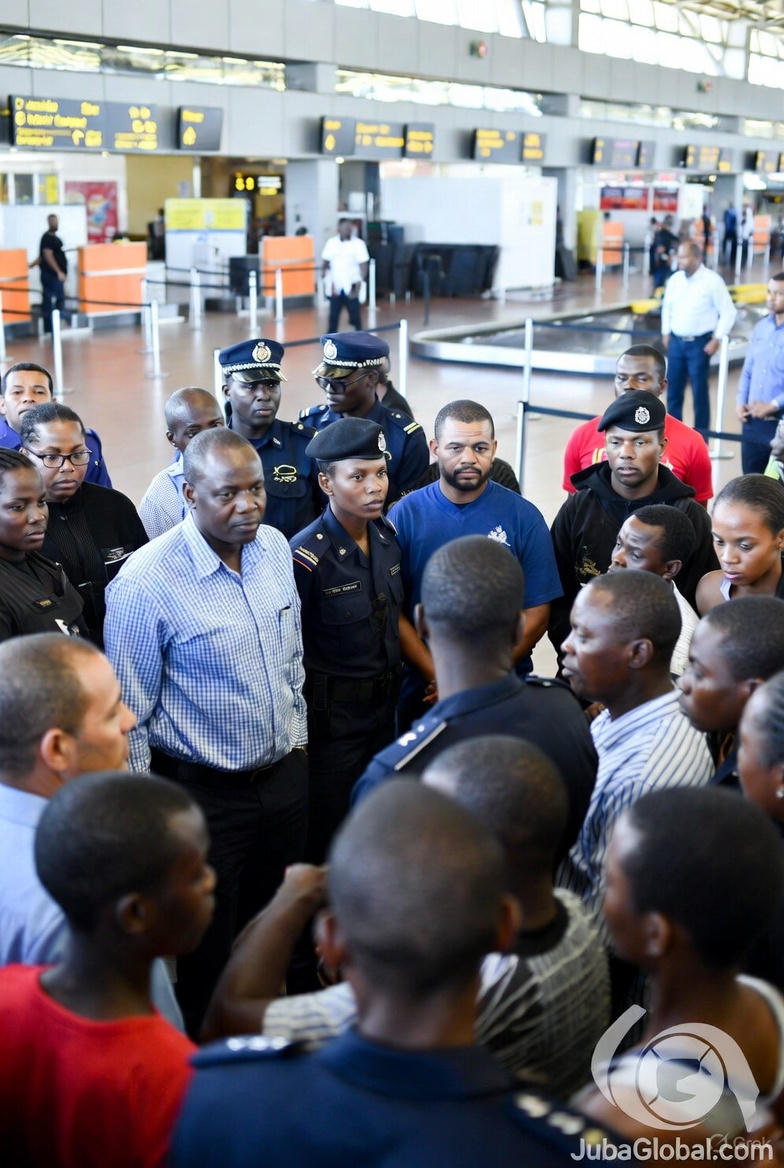
JOHANNESBURG – In the pre-dawn chill of Tuesday, 10 December 2025, two routine flights touched down at OR Tambo International Airport within hours of each other and quietly exposed the intricate, high-stakes chess game that now defines irregular migration across Africa. Flight EK761 from Dubai delivered 16 Bangladeshi nationals carrying expertly forged European visas, while Ethiopian Airlines’ ET809 from Addis Ababa carried 14 Ethiopian citizens travelling on no documents at all. By sunrise, all 30 were in holding cells, the airlines were staring at fines of up to R1.5 million each, and South African social media was once again ablaze with the familiar refrain: “Close the borders.”
Yet the incident, dramatic as it was, is merely the visible tip of a migration iceberg that has been growing for more than a decade. Between January and November 2025 alone, OR Tambo has intercepted 1,874 undocumented or improperly documented passengers – a 38 % increase from the same period in 2024. These are not isolated cases of desperation; they are the final, highly visible stage of sophisticated transnational networks that stretch from the slums of Dhaka to the highlands of Oromia, and from the call-centres of New Delhi to the backrooms of Nairobi and Lusaka.
The Two Flights: Parallel Journeys, Same Destination
The Bangladeshis – A Textbook “Visa-Run” Operation
The 16 men, aged between 22 and 38, presented Portuguese, Greek, and Italian Schengen visas that appeared flawless to the untrained eye. Only when Emirates’ Advanced Passenger Information System flagged inconsistencies – mismatched biometric data and suspicious booking patterns – did South African immigration officials subject the documents to ultraviolet and high-resolution scrutiny. The visas were masterpieces: holograms perfect, security threads intact, but the underlying data layers had been altered using software now widely available on dark-web forums for as little as $800 per passport.
South African investigators believe the group left Dhaka on low-cost carriers to Dubai, spent between three and seven days in transit hotels, then boarded the direct Emirates service to Johannesburg with the explicit intention of using South Africa as a springboard to Europe. Once inside the international transit zone of OR Tambo (technically South African soil but not yet “entered”), they planned to destroy their Bangladeshi passports and request asylum at the next European connection. It is a route that has exploded in popularity since Italy and Greece tightened direct arrivals from the Middle East in early 2025.
The Ethiopians – The Classic “Clean Skin” Tactic
The 14 Ethiopian passengers on ET809 presented an even simpler, and therefore more alarming, modus operandi: they boarded in Addis Ababa with no travel documents whatsoever. Known in the trade as “clean skins,” they carried only mobile phones containing WhatsApp conversations with agents promising “guaranteed entry” into South Africa for fees ranging from $4,000 to $6,000 per person. Upon landing, they intended to surrender to immigration officials and immediately lodge asylum claims – a process that, under South African law, triggers an automatic prohibition on removal until the claim is fully adjudicated, a procedure that can take between three and ten years given the current backlog of 178,000 pending cases.
The Business Model: How Africa Became the World’s Busiest Migration Corridor
What links these two groups is not poverty alone – Bangladesh’s per-capita GDP is now higher than Kenya’s – but a global industry that has professionalised human smuggling to an unprecedented degree.
- Recruitment
In rural Bangladesh and Ethiopia’s Amhara and Oromia regions, agents (often former migrants themselves) target young men with the promise of European salaries. Social media, especially Facebook and TikTok, is the primary advertising platform. One Dhaka-based smuggler openly advertises “Europe via Joburg – 100 % legal entry” for BDT 2.8 million (approximately $24,000). - Financing
Families mortgage land, sell livestock, or take high-interest loans from informal lenders. In Ethiopia, the hawala system moves millions of dollars weekly to agents in Dubai and Nairobi. - Documentation
Forged passports and visas are produced in printing hubs in Bangkok, Istanbul, and increasingly in Nairobi’s Eastleigh neighbourhood. A genuine Bangladeshi passport page with a professionally inserted Schengen visa now costs $3,500 on the black market. - Routing
The Addis–Johannesburg and Dubai–Johannesburg routes are favourites because Ethiopian Airlines and Emirates are seen as “low-scrutiny” carriers that do not systematically verify onward tickets. South Africa’s policy of allowing visa-free entry to certain transit passengers (even without onward tickets in some cases) is exploited ruthlessly. - Arrival and Dispersal
Once inside South Africa – either legally in transit or illegally via asylum claims – migrants are met by a second tier of smugglers who move them by road to Beitbridge (for those heading to Europe via Zimbabwe–Botswana–Namibia) or simply absorb them into Johannesburg’s informal economy.
The Numbers Behind the Headlines
The Department of Home Affairs’ latest statistics paint a sobering picture:
- 1,874 airline interceptions at OR Tambo Jan–Nov 2025 (up from 1,357 in 2024)
- Top nationalities: Bangladesh (412), Ethiopia (389), Pakistan (276), India (188), Democratic Republic of Congo (154)
- Estimated street value of the smuggling industry feeding South Africa: R18–22 billion per year
- Only 11 % of intercepted migrants are actually deported within 90 days; the rest vanish into the country’s townships or lodge asylum claims
Why South Africa? The Pull Factors No One Wants to Discuss
South Africa remains the continent’s most powerful migration magnet for reasons that go far beyond geography:
- A functioning (if overwhelmed) asylum system that acts as a de facto legalisation pathway
- A large informal economy that absorbs undocumented workers instantly
- Relatively sophisticated banking and mobile-money systems that allow remittances home
- A public discourse that, while often hostile, has not yet translated into the large-scale deportations seen in the Gulf or North Africa
- Direct flights from almost every major smuggling hub in Asia and the Horn of Africa
As one intercepted Ethiopian told officials through a translator: “In Dubai they beat you and deport you in days. Here they give you a paper and you disappear into Hillbrow. Everyone knows this.”
The Airline Dilemma: Carrier Sanctions vs. Humanitarian Obligations
Under Section 35 of South Africa’s Immigration Act, airlines face fines of up to R150,000 per improperly documented passenger – a potential R5.4 million bill for the 30 cases this week alone. Yet both Emirates and Ethiopian Airlines insist they complied with IATA’s Timatic system and that the ultimate responsibility lies with departure-point checks in Dubai and Addis Ababa.
Behind the scenes, a quiet diplomatic tug-of-war is playing out. South Africa has threatened to revoke landing rights for carriers with repeated violations, while Ethiopia – a crucial partner in regional stability and counter-terrorism – has warned that aggressive fines could trigger reciprocal measures against South African carriers in Addis.
The Bigger Picture: A Continent in Motion
The OR Tambo interceptions are only the most visible manifestation of a much larger trend. The African Union’s own 2025 migration report estimates that 28 million Africans now live outside their country of birth – more than double the figure from 2010. Most move legally or semi-legally within the continent, but the irregular corridors are growing fastest:
- West Africa → Morocco → Canary Islands
- Horn of Africa → Yemen → Gulf states
- East Africa → South Africa → Europe or permanent settlement
South Africa, with its unemployment rate above 34 % and deepening xenophobic sentiment, finds itself both destination and transit hub – a role it is increasingly unwilling, and perhaps unable, to play.
Looking Ahead: Policy, Politics, and the 2026 Local Elections
The timing could hardly be worse for the governing ANC–DA coalition. With municipal elections looming in 2026, the opposition Economic Freedom Fighters and Patriotic Alliance have made “border security” their rallying cry. Footage of the 30 intercepted migrants being escorted off aircraft has already been edited into campaign videos with the caption “While you struggle, they fly in.”
Home Affairs Minister Leon Schreiber has announced a R2.4 billion “border management modernisation” package that includes biometric gates at all international airports by 2028 and the reintroduction of transit visas for high-risk nationalities. Critics, however, point out that the department still lacks a functioning case-management system for the 1.8 million undocumented migrants already inside the country.
The Human Faces Behind the Statistics
In the holding facility beneath OR Tambo’s Terminal A, two stories stand out.
Mohammed, 29, from Sylhet in Bangladesh, borrowed $21,000 to pay his smuggler. He has a civil-engineering degree but saw no future in a country where garment workers earn $110 a month. “They told us South Africa is hard, but Europe is waiting on the other side,” he said.
Alemayehu, 26, left his village in Wollega after his brother was killed in ethnic violence. He sold the family’s only ox to raise the $5,500 fee. “If they send me back, the Oromo militia or the government soldiers – someone will kill me. Here at least I have a chance.”
Both men, like thousands before them, now enter a legal limbo that could last years.
A Continent at a Crossroads
Thirty migrants, two flights, one morning. The numbers seem small until you multiply them by the 1,874 interceptions this year, and then by the tens of thousands who make it through undetected. The story of Africa in 2025 is no longer just one of poverty driving migration; it is one of ambition, ingenuity, and global connectivity colliding with immigration systems built for a different era.
As the sun rose over Johannesburg on 10 December, another group of young men from distant corners of the continent and beyond began their long, uncertain journeys southward. For now, the runway lights of OR Tambo remain one of the brightest beacons on a very long road.
Juba Global News Network – Independent, Pan-African, Unfiltered.
www.JubaGlobal.com
