

Guinea-Bissau Approves Transitional Charter as Military Consolidates Power After Coup
By Juba Global News Network Staff Juba, South Sudan – 12 December 2025 BISSAU – On Wednesday, Guinea-Bissau’s military-dominated National People’s Assembly
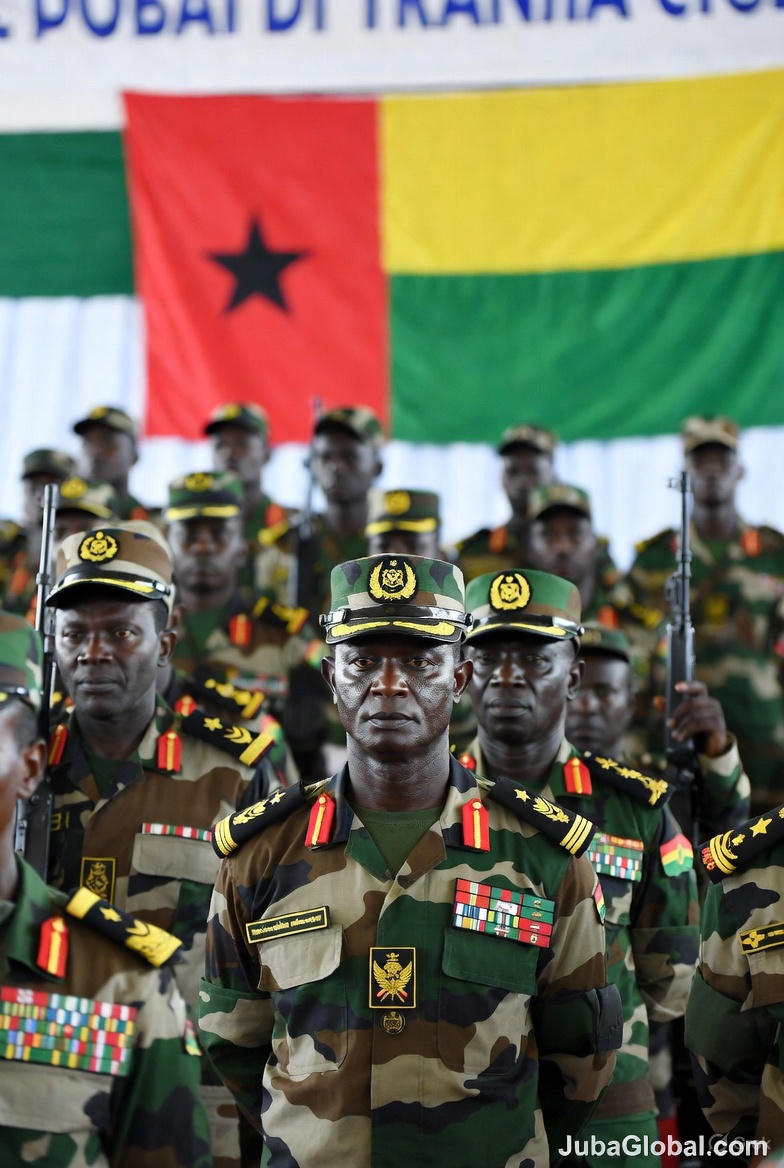
By Juba Global News Network Staff
Juba, South Sudan – 12 December 2025
BISSAU – On Wednesday, Guinea-Bissau’s military-dominated National People’s Assembly voted unanimously in favor of a 12-month Transitional Charter, cementing the junta’s hold over the small West African country exactly two weeks after troops toppled President Umaro Sissoco Embaló and Prime Minister Rui Duarte de Barros in a dawn coup that didn’t spill a drop of blood. The new 35-article charter, which Colonel Baciro Dja—spokesman for the self-proclaimed “Committee for the Restoration of Constitutional Order and Democracy”—read out in the assembly chamber, suspends the 1996 Constitution, dissolves the parliament, and makes it plain that neither the interim president nor prime minister can run in future elections. The document also stretches the transitional period through December 2026, kicking presidential and legislative elections—originally slated for late 2025—down the road by at least a year.
For a nation that’s seen eleven coups or failed coups since it gained independence from Portugal in 1974, adopting this charter feels like a turning point, especially after the junta started out promising a speedy return to civilian government. Privately, diplomats in Bissau are now describing the transition as “managed democracy with military characteristics”—a neat phrase that says a lot, really.
From Barracks to the Presidential Palace
The coup on 27 November 2025 got underway at 04:30 GMT, when crack troops from the Presidential Guard Battalion, backed up by regular army units, blocked off key roads in the capital and put President Embaló under house arrest. Within a matter of hours, state TV announced that the armed forces had “taken responsibility for the destiny of the nation,” blaming “grave threats to institutional stability and the systematic looting of public funds.” The junta accused the ousted government of plotting to rig the next elections, siphoning off millions from cashew export revenue—the backbone of the country’s economy—and letting cocaine traffickers run wild in the Bijagós Archipelago. There’s never been any proof shown, but in a country weary from years of corruption, those claims struck a nerve with many.
By lunchtime, General Tomás Djassi, Chief of General Staff, had already been sworn in as Interim President in a small ceremony attended by top brass and some traditional chiefs. In his first speech, Djassi vowed to hold “free, fair and transparent elections within the shortest possible time compatible with national reconciliation.” But, looking at the new charter, that promise seems, well, a lot less definite than it sounded.
Key Details in the Transitional Charter
- Duration: 12 months, renewable once (so, until 31 December 2026, tops).
- Interim Leadership: Both president and prime minister—who’ll be picked by the junta—can’t stand in the next elections.
- Legislative Authority: Lies with a 102-member National People’s Assembly made up of military figures, civil society, political parties, and traditional leaders.
- Judiciary: The Supreme Court and Constitutional Court are frozen “until new organic laws are adopted.”
- Political Parties: They can keep going but can’t hold congresses or primaries until six months ahead of elections.
- Media: Private media can operate but will answer to a new “National Communication Council” led by a junta appointee.
One article, number 34, is already drawing fire: it gives the armed forces “guarantor” status over the transition, with the stated right to “intervene to safeguard constitutional order”—which, as analysts see it, is basically a green light for more military meddling down the road.
Regional and International Responses
The Economic Community of West African States (ECOWAS) slammed the coup on 28 November, slapping travel bans and asset freezes on 14 top officers. Still, they stopped short of suspending Guinea-Bissau from the group, maybe just tired after so many recent coups in Niger, Mali, Burkina Faso, and Guinea. At an emergency summit in Abuja on 8 December, ECOWAS gave the junta six months to hand over an “acceptable roadmap,” yet hinted that a two-year transition could slide by, so long as elections take place by the end of 2026. Senegalese President Bassirou Diomaye Faye, who currently chairs ECOWAS, told journalists, “We have learned that blanket suspensions often punish the population more than the coup leaders.”
The African Union Peace and Security Council echoed ECOWAS but hasn’t pulled the trigger on its full anti-coup protocol yet. Meanwhile, Portugal—the old colonial ruler—demanded “an immediate and unconditional return to constitutional order,” while China, who bankrolls much of Bissau’s infrastructure, stuck to blandly calling for all parties to “resolve differences through dialogue.”
A Deeply Divided Political Scene
Inside the country, people are sharply split. The African Party for the Independence of Guinea and Cape Verde (PAIGC), which long dominated and placed second in the contested 2019 elections, has cautiously welcomed the charter—as long as the military actually sticks to its timeline. Domingos Simões Pereira, the PAIGC’s leader and a longtime adversary of Embaló, put it this way: “The people want stability, not perpetual military tutelage.”
By contrast, smaller opposition parties grouped under the Platform of Democratic Forces accused the junta of “institutionalising a soft dictatorship,” and tried to organize street protests—protests that fizzled out quickly after police banned all public gatherings “for security reasons.” Civil society is just as divided. The National Human Rights League gave the charter a nod for including gender quotas in the transitional assembly, but the prominent Guinean Human Rights League slammed the suspension of constitutional courts, calling it “a dangerous precedent.”
Cashew, Cocaine, and That Same Old Question of Stability
Guinea-Bissau’s curse, some say, is its geography: eighty islands, tangled mangroves, and two million of the poorest people in the world make for a perfect staging ground for Latin American cocaine headed to Europe. The UNODC figures up to thirty tonnes a year pass through, fuelling bribes that are way larger than the country’s entire budget. On top of that, 80% of rural families survive off cashew nuts. Past governments, again and again, have just treated export taxes like their own private stash, so farmers are left at the mercy of middlemen and big Indian buyers.
No surprise, then, that a lot of ordinary people simply met the coup with weary shrugs, not outrage. “We just want to sell our cashews and feed our children,” Fatumata Djalo, a market vendor in Bafatá, told reporters. “Whoever is in power, the suffering is the same.”
What’s Next?
General Djassi says an electoral calendar will be published by February 2026, and he’s promised talks with political parties starting in January. But if you look closely at the transitional charter’s language, there’s little doubt: the military is planning to keep its hand firmly on the country’s future for at least another two years. For a country ranked 177th out of 191 on the UN Human Development Index—where most folks live on less than $2 a day—the question now isn’t so much whether elections will be free or fair, but whether they’ll actually happen at all.
One Bissau-based diplomat summed it up privately: “West Africa is running out of red lines. After enough coups, suspension is just a symbol and sanctions are pure theatre.”
So, for the moment, it’s the soldiers who call the shots, the constitution stays on ice, and the people of Guinea-Bissau are left waiting—again—to see if this time will be any different, or if it’s just the same story repeating itself, one more time.
Juba Global News Network – Independent African journalism without borders.
www.JubaGlobal.com
