

Nigeria’s Children Return Home: The Release of 100 Abducted Schoolboys and the Crisis That Refuses to End
By Juba Global News Network – Special Investigative Report December 9, 2025 Under the blazing midday sun on December 8, 2025, in the dusty yard of the Gove
By Juba Global News Network – Special Investigative Report
December 9, 2025
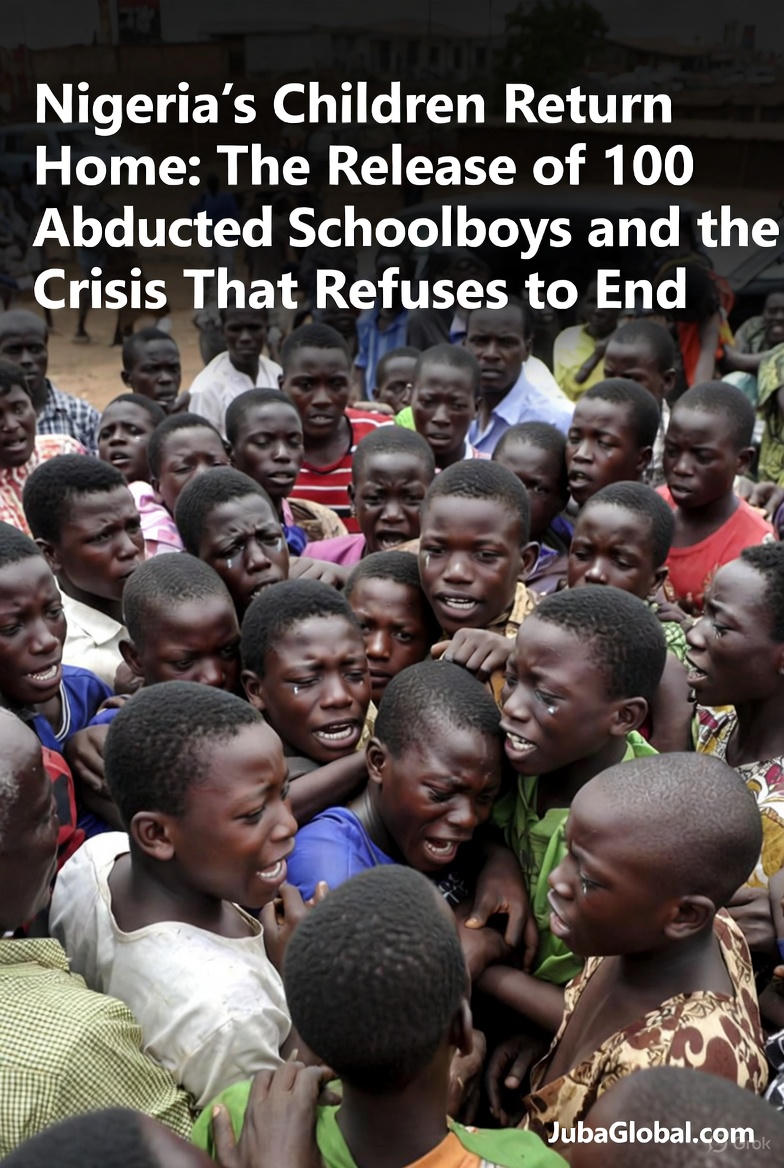
Under the blazing midday sun on December 8, 2025, in the dusty yard of the Government Science Secondary School in Kazaure, northwestern Nigeria, you could see a scene that was equal parts heartbreak and relief. One hundred boys, between 11 and 17 years old, shuffled out of battered pickup trucks—some barefoot, a few hugging worn Qur’ans, their uniforms pretty much in tatters after spending 38 days held captive. There were mothers screaming, fathers standing off to the side in silent tears, and local officials trying, often in vain, to keep order as families rushed in to embrace sons they’d feared lost forever. The release of these 100 boys from a Catholic-run school in Kaduna State now stands as the largest single liberation of kidnapped Nigerian schoolchildren since the Kankara abduction back in 2021. And yet, even as people in Kaduna and neighboring Katsina State celebrated, that same old grim reality hung in the air: Nigeria’s northwest is still a playground for well-armed criminal gangs who snatch children with what feels like complete impunity.
The Abduction: November 1, 2025 – A Morning That Shattered Lives
It all began at 1:17 in the morning, Saturday, November 1. Over 120 gunmen—on dozens of motorcycles in what’s become a tried-and-true tactic—swept past four private security guards and a police post barely 200 meters away. Survivors, who spoke to Juba Global News Network on condition their names weren’t used, described gunmen firing wildly into the air, rounding up students from their beds, and herding them straight into the vast Rugu Forest, which stretches for 2,000 square kilometers and has become a byword for bandit hideouts.
Eyewitnesses painted a picture of an attack that was anything but amateurish. Power was cut, the few security cameras were destroyed, and the attackers used shrill whistles to coordinate—a tell-tale sign of groups that have evolved far beyond cattle rustling into something far more organized. By sunrise, 112 students were gone. Somehow, twelve managed to slip away during the march through the woods, running for hours till they reached nearby villages.
The Negotiations: A Shadowy Deal Behind Closed Doors
For 38 days, families were trapped in a kind of waking nightmare. Parents camped outside Kaduna State Government House, holding prayer vigils and waving around photos of their missing sons. The Catholic Diocese of Sokoto, which runs the school, was flooded with desperate appeals. Meanwhile, in the background, a hush-hush negotiation played out. According to several sources in the Kaduna State government and security community (all speaking anonymously), a ransom of ₦850 million (just about US$520,000 at the street rate) got paid in multiple installments between November 25 and December 6. Local go-betweens handled the payment, which was, as always, delivered in cash—pretty standard in Nigeria’s kidnap-for-ransom economy.
The government, as usual, flatly denied paying any ransom. Kaduna State Commissioner for Internal Security and Home Affairs, Samuel Aruwan, told reporters on December 8 that it was all down to “sustained military pressure and ongoing dialogue.” But parents and community leaders gave a very different account behind closed doors. One father put it bluntly for Juba Global News Network: “We sold land, borrowed from loan sharks, emptied every kobo we had. The government did nothing but talk.”
The Bandits: From Rustlers to Child Traffickers
The men responsible belong to one of several loosely connected armed groups that operate across Zamfara, Katsina, Kaduna, and Niger States. Security analysts lump them together as “bandits,” but honestly, that word hardly covers how organized they’ve become. Many of these gangs trace their roots to the Fulani herder–farmer clashes of the mid-2010s but have since grown into well-oiled syndicates mixing cattle theft, kidnappings, and now, more and more, sexual slavery and forced recruitment.
Intelligence documents seen by Juba Global News Network suggest the Kazaure abduction was the work of a gang led by a commander known only as “Kachalla Halilu,” who runs operations deep in Rugu and Kamuku forests. Snatching kids from schools has become lucrative business—since the 2014 Chibok kidnapping by Boko Haram made headlines worldwide, criminal groups have copied the blueprint, but with none of the ideological trappings. The Global Initiative Against Transnational Organized Crime, in a December 2024 report, estimated that these gangs pulled in over US$18 million in ransom in just the first ten months of 2025.
The Human Toll: Trauma That Will Linger for Decades
The boys who made it home don’t just have visible scars; the invisible ones might last even longer. Doctors at the 44 Nigerian Army Reference Hospital in Kaduna found widespread malnutrition, malaria, and nasty skin infections. A few boys needed surgery to treat infected machete wounds picked up on brutal forced marches. Psychologists who did the first assessments said the boys showed classic PTSD signs—nightmares, jumpiness, shutting down emotionally. One 15-year-old, speaking in barely a whisper from his hospital bed, recalled being forced to watch older students who tried to escape get killed. “They said if we ran, our bodies would feed the vultures,” he said. “And we believed them.”
For parents, the happiness of getting their boys back is mixed with a fresh terror. Many are already pulling their remaining children out of boarding schools, piling onto an education crisis in a region where school attendance was already pitifully low.
A Failing State Response
President Bola Tinubu’s government has made repeated vows to crush the wave of insecurity in the northwest. But here we are, five months after a July 2025 “state of emergency” on kidnapping was declared, and the numbers just keep getting worse. Military operations—like the recent “Operation Whirl Stroke”—may have killed plenty of bandits, but they’ve barely dented the networks or secured the sprawling countryside where the gangs operate. The Nigerian Air Force has bombed known camps, but people say the criminals just melt away into deeper forest or slip across state lines.
And then there’s corruption. Several soldiers and police officers have already been arrested this year, caught selling weapons and intel to the very gangs they’re supposed to fight. Maybe worst of all, the government still has no solid plan for helping victims. Not one family interviewed by Juba Global News Network reported receiving any real government help—medical, financial, or psychological—aside from a ride home for their boys.
A Regional Crisis with No End in Sight
The Kazaure release, while it’s certainly something to celebrate, is just another episode in a crisis with no finish line in sight. By December 9, 2025, at least 312 more kids, abducted from schools in Katsina, Sokoto, and Zamfara States, were still missing, according to figures put together by Nigerian advocacy group SBM Intelligence. The cycle just feeds itself: ransom payments bankroll better guns and bigger recruitment drives, which make the next attack more likely and more brazen.
Unless there’s some kind of big, sweeping change—a ton of investment in rural security, real governance, real schools, and a willingness to go after the powerful people who shield these gangs—Nigeria’s kids will keep paying the price.
As the sun went down on December 8, families in Kazaure held candles and said prayers of thanks. But in villages circling Rugu Forest, other parents are still waiting, clutching faded photos, counting the days, and dreading that tomorrow, the kidnappers might strike again.
Juba Global News Network will keep following developments in Nigeria’s northwest and bring updates as they come.
